
 Sarah Kim
Choosing a CRM is one of the highest-leverage decisions a B2C business makes — and one of the easiest to get wrong. Most CRM advice online is written for B2B companies with long sales cycles, small lead volumes, and account-based selling. If you run a gym, a spa, a clinic, an entertainment venue, or any business where hundreds of consumers walk through the door or hit your website every week, that advice will steer you toward the wrong tool.
This guide covers what actually matters in a B2C CRM: the capabilities that separate consumer-grade platforms from retrofitted B2B tools, an honest side-by-side comparison of the leading options, and a decision framework based on your business size and model.
Why B2C CRM Is a Different Category
B2B CRMs are built around deals: a rep works a small number of high-value opportunities through a pipeline over weeks or months. B2C businesses face the inverse — thousands of low-consideration decisions happening fast, where the winner is usually whoever responds first and stays present afterward.
That inversion changes the requirements completely. Speed-to-lead matters more than deal stages. Automated lifecycle journeys matter more than rep task lists. Two-way SMS matters more than email sequences aimed at office workers. And retention economics matter more than new-logo bookings, because most B2C revenue comes from repeat visits, renewals, and memberships. For a full breakdown, see B2C vs. B2B CRMs: What’s the Difference.
The 9 Capabilities That Matter in a B2C CRM
1. Unified customer profiles
Every visit, purchase, message, and web session in one record. If your CRM can’t merge data from your POS or booking system with marketing activity, you’ll personalize on guesswork. Look for native integrations with the systems your industry runs on, and a true customer data foundation underneath.
2. Behavioral segmentation
Static lists decay immediately in B2C. You need dynamic segments that update in real time — “members who haven’t visited in 14 days,” “leads who toured but didn’t join,” “customers whose package expires this month” — with tags and custom metadata you control.
3. Speed-to-lead automation
In consumer sales, response time is the single biggest conversion variable. The CRM should respond to every new inquiry within seconds — by text, not just email — and keep following up automatically until a human takes over or the lead books.
4. Two-way SMS as a first-class channel
Not SMS blast add-ons: real conversational texting with a shared team inbox, compliance handling, and automation triggers. Consumers answer texts; they ignore B2B-style email cadences. See email and text marketing done as one system.
5. AI agents for conversations at scale
The newest dividing line. Modern B2C CRMs include an AI agent that answers questions, books appointments, and re-engages leads across SMS, chat, and email 24/7 — effectively a front desk that never closes. If a platform’s “AI” is limited to writing email copy, it’s a generation behind.
6. Lifecycle journey orchestration
Visual journey builders that trigger on real behavior — first visit, missed appointment, declining usage, upcoming renewal — across every channel. This is where retention revenue is made.
7. Landing pages and forms built in
Lead capture should feed the CRM natively, with instant follow-up automation — no integration duct tape between your forms and your database.
8. Multi-location support
If you operate (or plan to operate) multiple locations or franchises: location-level segmentation, corporate-controlled campaigns with local flexibility, and roll-up reporting. Most SMB CRMs break down here.
9. Reviews, referrals, and loyalty
B2C growth compounds through reputation and repeat behavior. Platforms that treat review generation and loyalty as core features — not integrations — remove two more tools from your stack.
B2C CRM Comparison: The Leading Platforms
| Platform | Built for | Two-way SMS | AI agents | Multi-location | Typical fit |
|---|---|---|---|---|---|
| Gleantap | B2C service businesses (fitness, wellness, healthcare, attractions) | Native, conversational | Native (SMS, chat, email, voice) | Yes, franchise-grade | High-volume consumer businesses, single or multi-location |
| HubSpot | B2B marketing & sales | Add-on / limited | Copy assistance | Partial | B2B teams; B2C brands often overpay for unused deal machinery |
| Salesforce | Enterprise B2B | Via add-ons | Einstein (enterprise tiers) | Yes, heavy config | Enterprises with admin resources |
| Mailchimp | Email marketing | Limited | Copy assistance | No | Email-first small businesses; not a true CRM |
| HighLevel | Agencies reselling to SMBs | Native | Bot workflows | Sub-accounts | Agencies managing many small clients |
| Klaviyo | Ecommerce email/SMS | Campaign SMS | Predictive analytics | No | Online retail; weak for in-person service businesses |
The pattern to notice: most “B2C-capable” platforms started somewhere else — B2B pipelines, email marketing, or ecommerce — and added consumer features later. Purpose-built B2C platforms invert that: conversations, visits, and retention are the core, with sales pipeline layered on top. For detailed head-to-heads, see Gleantap vs. HubSpot, Gleantap vs. Mailchimp, and Gleantap vs. HighLevel.
A Decision Framework by Business Type
Single-location service business
Prioritize speed-to-lead, two-way SMS, and review generation. You don’t need enterprise deal management; you need every inquiry answered in under a minute and every happy customer asked for a review. Budget range: $200–500/month for a platform that does all three natively.
Multi-location or franchise brand
Multi-location architecture is non-negotiable and hard to retrofit — evaluate it first, before features. Demand corporate campaign control with local flexibility, location-level attribution, and unified reporting. Ask vendors to demo their permission model, not just their dashboards.
Ecommerce-primary brand
Klaviyo-style platforms fit better; your “visit” is a web session, and cart and browse abandonment automation matters more than appointment booking.
High-volume consumer sales team
You need genuine pipeline management — but B2C-shaped: high volume, short cycles, automated follow-up between human touches. This is exactly the gap a B2C sales CRM fills that both B2B CRMs and email tools miss.
Implementation: Where B2C CRM Projects Fail
Three failure modes account for most stalled implementations. Dirty data migration — dedupe and standardize before import, not after; merge rules for duplicate consumers matter far more in B2C than B2B. Big-bang launches — roll out by use case (speed-to-lead first, then retention journeys, then loyalty), proving ROI at each step. No adoption owner — assign one person accountable for staff usage in the first 90 days; consumer businesses have frontline staff, not CRM-native sales reps, so training must be built into shifts. A good vendor provides an implementation plan with named milestones — treat its absence as a red flag.
B2C CRM Examples: What It Looks Like in Practice
The fastest way to understand what a B2C CRM actually does is to watch it work in a real business. Here are four examples of B2C CRM in action across the industries where it delivers the most measurable revenue impact.
Example 1: Gym trial conversion
A prospect submits a trial-pass form at 9:40 PM. The CRM’s AI agent texts back within a minute, answers a question about class times, and books a Thursday tour. When the prospect no-shows, an automated recovery sequence rebooks them for Saturday. After their first visit, a nurture journey tracks attendance through the trial and alerts a salesperson the moment engagement dips. Gyms running this exact flow see roughly twice the lead-to-member conversion of manual follow-up, because speed and persistence are automated instead of staff-dependent.
Example 2: Med spa rebooking and win-back
A med spa’s CRM watches visit intervals. When a client who normally books every six weeks hits week eight with no appointment, it triggers a personalized text with a one-tap rebooking link. Clients who lapse past ninety days enter a win-back journey with an escalating offer. The segmentation runs on behavior — visit frequency, service history, spend tier — not on a static mailing list.
Example 3: Family entertainment center birthday pipeline
An FEC captures the birth month of every child on a waiver. Eight weeks before each birthday, the CRM opens a sales opportunity, sends the parent a party-package offer, and routes replies into an omnichannel inbox where staff and AI close the booking together. What was once a walk-in-luck business becomes a predictable annual revenue pipeline per family.
Example 4: Multi-location franchise campaigns
A 40-location franchise runs corporate-controlled campaigns with local flexibility: headquarters builds the summer promotion once, every location’s send goes out with local hours and staff names merged in, and cross-location profiles ensure a customer who visits two locations is recognized as one person. Reporting rolls up by region without spreadsheet stitching.
B2C CRM Strategy: Getting Value After You Buy
Choosing the platform is half the job. A working B2C CRM strategy comes down to five decisions, made in order:
1. Automate speed to lead before anything else. The highest-ROI automation in any B2C business is responding to new inquiries within the first minutes, when intent is hottest. Get this flow live in week one — everything else can follow.
2. Segment on behavior, not demographics. Visit frequency, purchase recency, and engagement signals predict revenue far better than age or zip code. Build your first segments around lifecycle stages: new lead, active trial, engaged customer, at-risk, lapsed.
3. Assign one journey to each lifecycle stage. Resist building twenty clever automations. Five journeys — welcome, trial conversion, at-risk save, win-back, and review request — cover the revenue moments that matter in nearly every B2C business.
4. Put SMS at the center for time-sensitive touches. B2C customers respond to text at rates email never reaches. Use email for depth and nurture; use SMS for bookings, reminders, and offers with expiration.
5. Measure revenue per member, not open rates. The scoreboard for a B2C CRM strategy is conversion rate on new leads, retention rate on existing customers, and revenue per customer over time. Campaign metrics are diagnostics, not goals.
If your team is evaluating platforms against this playbook, our B2C sales CRM was built around exactly these workflows — speed-to-lead automation, behavioral segmentation, and lifecycle journeys in one system.
Frequently Asked Questions
The best B2C CRM is one built for high-volume consumer relationships: unified customer data, two-way SMS, speed-to-lead automation, and retention journeys. Gleantap leads for service businesses like fitness, wellness, and attractions; Klaviyo fits ecommerce; HubSpot and Salesforce fit B2B-style teams.
A gym using a B2C CRM captures a website lead, texts back within 30 seconds via an AI agent, books a tour automatically, follows up on no-shows, and later triggers win-back journeys when visit frequency drops. See what top B2C brands do with their CRM.
Gleantap supports unlimited custom tags, fields, and behavioral attributes on customer profiles, with dynamic segments that update automatically as data changes.
Gleantap includes a native landing page builder and forms that feed captured leads directly into follow-up automation — no third-party form tools required.
Look for location-level segmentation, corporate and local campaign permissions, and roll-up reporting. Gleantap is built for multi-location and franchise operations; most SMB CRMs support only single-location data models.
Entry platforms run $50–150/month but usually lack SMS and automation depth. Full B2C engagement platforms run $200–600/month per location. Enterprise deployments start around $1,500/month plus implementation.
Marketing automation sends campaigns; a B2C CRM also owns the customer database, two-way conversations, sales pipeline, and frontline tools. Modern platforms like Gleantap combine marketing automation and CRM in one system.
Running a gym, studio, or fitness franchise? See our dedicated ranking of the best fitness CRM software.
Pipeline management, speed-to-lead automation, and AI follow-up designed for B2C from day one — not retrofitted from B2B.
Explore the B2C Sales CRM →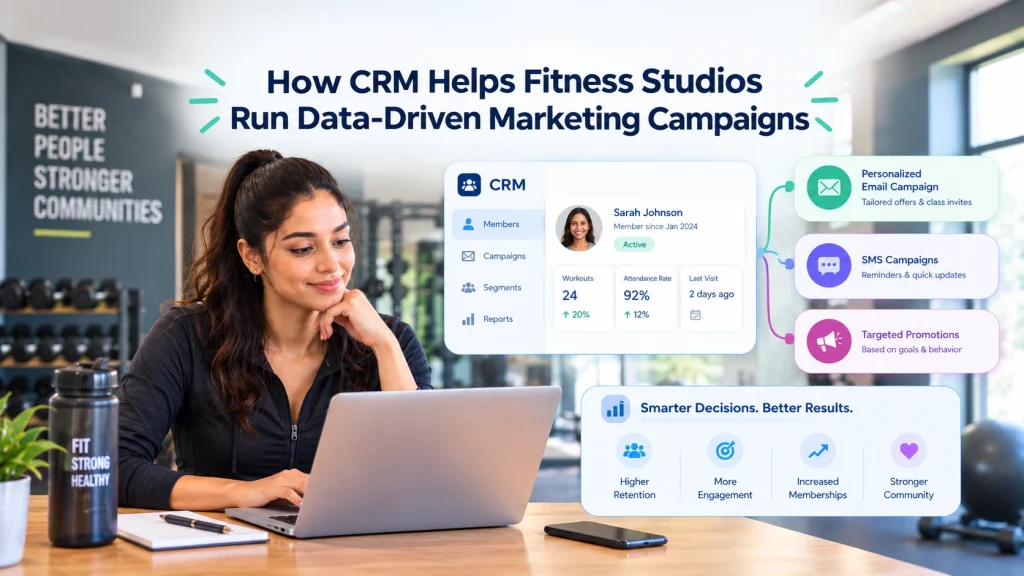
Ready to Run Successful Marketing Campaigns and Grow Your Business?
Gleantap helps you unify customer data, track behavior patterns, and automate personalized campaigns, so you can increase repeat purchases and grow your business.
Ready to Run Successful Marketing Campaigns and Grow Your Business?
Gleantap helps you unify customer data, track behavior patterns, and automate personalized campaigns, so you can increase repeat purchases and grow your business.