
 Divya Ghughatyal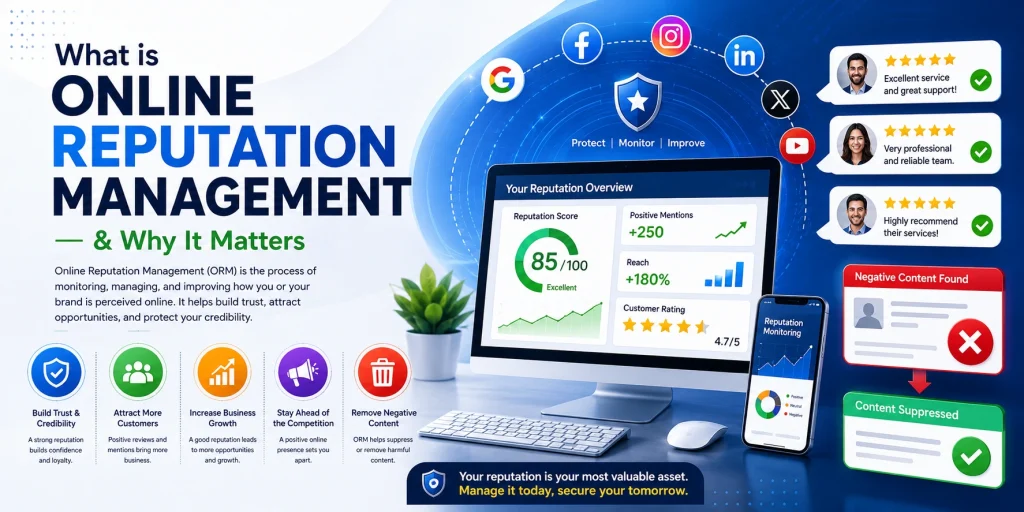
Online reputation management is the operational work that turns scattered reviews, social mentions, and search signals into measurable business outcomes. This article explains practical reputation management workflows that use customer profiles, sample use cases, and KPIs you can implement this quarter. You will get step-by-step tactics for monitoring, automated review generation, response playbooks, and a short test plan to link review activity to local search visibility and revenue.
Why Online Reputation Management Directly Impacts Revenue and Visibility
ORM drives top-line results through three direct channels: search visibility, click-through behavior, and on-site conversion. As part of Reputation & Review Monitoring: Tools, Strategies & Business Impact, businesses can track how local search algorithms and consumers both rely on the same signals – average rating, review volume, and recency – turning those signals into measurable growth levers instead of vague branding chores.
Evidence is straightforward. Research shows consumers weight review recency, volume, and average score when choosing a local business. Google uses review signals in local pack ranking and displays ratings prominently in results. Thoughtful response and remediation materially change customer perception and reduce fallout (Harvard Business Review).
| Causal path | Operational metric to track | Why it matters |
| Search visibility (local pack) | Local pack impressions, rank | Higher average rating and steady review velocity increase chances of showing in top 3 local results |
| Click-through rate from results | Search CTR, listing clicks | Star ratings and recent positive reviews increase clicks from search results |
| Conversion after click | Booking/sign-up rate, trial conversion | On-page social proof and response history reduce friction and lift conversions |
Practical trade-off: push volume fast and you risk soliciting feedback from dissatisfied customers or triggering platform policy flags with incentives. The smarter move is targeted velocity – ask recent and likely satisfied customers first, then broaden. Use customer profiles to filter by transaction recency, NPS, or lifetime value before sending an automated SMS or email request.
Concrete example: a neighborhood gym with a 3.6 average focuses on targeted SMS review requests to members who completed onboarding in the last 14 days and rated their trainer 9 or 10. Over 12 weeks the gym increases monthly review volume by roughly 30 percent and raises the average rating toward 4.0–4.5, which typically improves local-pack placement and lifts trial-to-member conversion. A measured 90-day plan with these filters avoids mass solicitation of unhappy customers and keeps remediation workflows manageable.
What people get wrong: obsessing over a perfect score rather than review freshness and response behavior. A steady stream of new 4-star reviews and fast, personalized responses beat sporadic 5-star bursts. Removal of negative reviews is rare; treat remediation, response quality, and profile-driven targeting as your primary tactics.
Track four leading indicators: average rating, review velocity (new reviews per month), response time, and conversion rate from listings to customer action.
Key takeaway: Invest in targeted review generation tied to customer profiles, and measure impact on local pack impressions and conversion rate. If you can only do one thing: improve review recency and response speed.
Core Components of a Practical ORM Program
Start with the systems, not the slogans. A practical ORM program is a set of integrated capabilities you can run week after week: monitoring, review generation, response and remediation, and measurement. Each component must be tied to customer profiles so actions map to real people and measurable outcomes.
Monitoring and prioritization
Core fact: Not all review signals are equal. Prioritize platforms that drive bookings and discovery for your business and route high-impact items to people who can act. For most local businesses that means Google Business Profile, Facebook, Yelp, and one industry site like TripAdvisor for hospitality.
- Centralize feeds: Connect platform APIs or use an aggregator so every new review creates a ticket in one inbox.
- Prioritize by impact: Flag reviews by rating change, mentions of safety/price, or mentions of class cancellations – not just sentiment score.
- Route by location and role: Auto-assign to a location owner for local issues and to a central escalation queue for legal or PR risks.
Review generation and customer targeting
Targeted requests beat spray-and-pray. Use customer profiles to pick who to ask, when, and by which channel. Recent transaction, NPS or CSAT scores, and preferred contact channel are the minimal fields you need to raise conversion on review asks.
- Timing: Send the first SMS 24-72 hours after service for most local businesses; delay for products until delivery confirmation.
- Sequence: 1 SMS request -> 1 reminder after 4 days -> a soft-email reminder after 10 days if no response.
- Personalization: Include the customer first name and the service they purchased; if the profile shows prior positive feedback, escalate the CTA to public review sites.
Practical limitation: Aggressive volume tactics increase total reviews but can depress average rating if you solicit indiscriminately. Trade-off: higher velocity versus preserving current rating. Use segment filters – high-LTV and recent-satisfied customers first.
Response protocols and escalation
Public response is triage, private remediation is recovery. Public replies should acknowledge and offer a remediation path; move the conversation to a private channel tied to the customer profile for resolution. Keep templates, but require one bespoke sentence pulled from the profile to keep responses authentic.
- Templates + personalization rule: Use templates for speed, but mandate a profile field insertion – date of visit, service name, or staff member.
- Escalation threshold: Any review that contains the words refund, injury, or legal – and any 1-star review from a recent high-value customer – triggers immediate escalation to manager.
- Policy on removal requests: Document attempts to resolve before filing a platform removal request; platforms require evidence, so attach tickets and correspondence to the profile.
Concrete Example: A gym tags trial-class attendees in the customer profile. If a member rates a class poorly in a post-class NPS, the system sends a private SMS offering a manager follow-up. If the follow-up fails and the customer posts a negative review, the profile contains the prior ticket and staff notes, letting the manager respond publicly with specifics and a private remediation offer.
KPI targets to operationalize: aim for a 24-hour response SLA for flagged negative reviews, a 20-50% increase in monthly review volume within 90 days from targeted requests, and a 0.2-0.4 point lift in average rating for active campaigns. See BrightLocal research for industry context.
Judgment call: Implement automation, but design human checkpoints. Automation wins at scale for routing and first-contact messages; humans win at remediation and reputation repair. The right balance depends on location count, ticket volume, and how tied reviews are to immediate revenue.
Using Customer Profiles to Improve Reputation Outcomes
Customer profiles are the operational hub for reputation work. If you cannot connect a review or complaint back to a customer record, you will always be doing reactive triage instead of targeted recovery and learning.
Practical idea: unify transaction history, communication logs, satisfaction signals, and prior reviews into one profile so actions (review ask, private remediation, escalation) are rule-driven and measurable.
A three-step profile-driven ORM workflow
- Identify: segment recent transactors and high-LTV customers using last_visit, order_value, and channel_preference fields. Prioritize customers who interacted in the last 7 to 14 days for review asks.
- Target: send a personalized review request via the customer preferred channel (SMS works best for local services). Use profile data to change CTA and destination – e.g., Google for storefronts, TripAdvisor for hospitality.
- Respond & Close-the-loop: route negative replies or low-satisfaction signals to a human with the full profile attached, log remediation actions, and update the profile with outcome and follow-up date.
Trade-offs and limits: linking reviews to profiles improves conversion and attribution, but expect matching errors. Platforms like Google often present reviews without contact info, so use attribution signals (transaction timestamps, reservation IDs, or hashed phone numbers) rather than perfect identity matching.
Practical constraint: obey consent and opt-out rules. Aggressive SMS or follow-up based on profile data can increase complaints and platform flags. Keep review requests permission-based and respect DNC lists.
Concrete example: A gym tags members who attended a trial class in the past 7 days and sends an automated SMS review request through Gleantap with a short, single-click CTA to Google. If the reply sentiment is negative, the system creates a support task on the member profile and assigns a manager to offer a free personal training session and request an update to the public review after resolution.
What most teams get wrong: they over-automate the public response for negative feedback. In practice, automated public replies without profile context escalate issues. Use automation to capture and route negative signals, not to close them publicly without human review.
Profile fields to capture for effective ORM: lastvisit, servicereceived, NPS or CSAT score, communication history (SMS/email), reviewhistory (platform + date), lifetimevalue, preferred_channel, and case/escalation status. Store reservation or invoice IDs as matching keys.
Measurement and judgment: prioritize tying review outcomes to revenue signals. Track review conversion rate by segment (recent purchase vs. cold list), and measure LTV lift for customers who left positive reviews after a remediation touch. That attribution is what turns reputation work from clerical to strategic.
Use profiles to target review asks and to personalize remediation. Automation should capture sentiment and route cases; humans should resolve the ones that matter.
Next consideration: if you don’t have unified profiles today, start by linking two keys: phone number and transaction ID. That simple match enables targeted review generation and accurate follow-up metrics.
Operational Playbooks and Templates You Can Implement Today
Operational playbooks convert ad-hoc reputation work into repeatable, measurable actions. Below are concrete sequences, ownership rules, and templates you can drop into your CRM or automation engine this week to stop firefighting and start improving review velocity.
Daily monitoring and triage
- Morning sweep (15 minutes): surface new reviews from Google, Yelp, Facebook; sort by sentiment and star rating.
- Triage rules: tag reviews urgent if 1–2 stars or mention safety/legal terms; escalate if customer is high-LTV or mentions regulatory/medical issues.
- Owner assignment: route urgent to on-duty manager, non-urgent to location owner; use a 24-hour SLA for public reply and 48 hours for private remediation.
- Record action: log follow-up outcome in the customer profile and close the loop in the ticket.
Concrete template for ownership: assign review_owner role in your ORM tool or CRM; if unresolved after 48 hours, auto-notify regional manager.
Automated sequence A — High-value review request (SMS)
Trigger: completed purchase or first visit recorded in the customer profile within 24–72 hours. Use last_visit and LTV fields to select recipients.
- Day 1 after visit: send NPS-style one-question SMS: How was your visit today? 1-5.
- If response >=4: send SMS with direct Google Business Profile link and CTA: Thanks! Would you share a quick review? It helps others find us: [Review Link] (send once).
- If response <4: open private remediation thread asking for details and offer a phone callback.
Sample SMS copy: Thanks for coming in today, [FirstName]. Quick question: how was your experience on a scale of 1-5? Reply with a number. If 4–5, we send a short link to leave a review. Do not offer incentives for reviews on Google — that violates platform policies.
Automated sequence B — Negative feedback capture and private remediation
- Trigger: NPS <=3, a manual complaint, or automated sentiment detection on a public review.
- Step 1: auto-send private message within 2 hours: We’re sorry to hear this. Can we call you at this number or would you prefer to reply?
- Step 2: create a remediation ticket with required fields: issue_type, staff_involved, resolution_offer, follow_up_date.
- Step 3: if unresolved in 48 hours, escalate to regional manager for off-platform resolution and possible goodwill gesture.
Trade-off to accept: automation speeds response but can feel robotic. Use templates as scaffolding and require a one-line personalization before public replies when review_owner responds. That single sentence saves authenticity and reduces repeat public complaints.
| Playbook | Trigger | Owner | SLA / KPI |
| Daily Triage | New review (all platforms) | Location owner | Public reply <24h; update profile note |
| Positive Review Request | Purchase/visit 24–72h | Automation (marketing ops) | Review conversion 10–25% from SMS; increase velocity |
| Negative Capture Flow | NPS<=3 or 1–2 star review | Customer success manager | Private remediation started <2h; resolved <48h |
Key takeaway: aim to increase review velocity by 20–50% in 90 days and keep initial public reply under 24 hours. Track review volume, response time, and conversion from review requests as your core KPIs.
Industry Use Cases and KPIs: Gyms, Restaurants, Dental, and Ecommerce
Direct point: Different industries need different reputation levers. What moves revenue for a gym is not the same signal that drives table bookings for a restaurant or conversions for an ecommerce SKU. Pick industry-specific KPIs first, tactics second.
Gyms
What matters: Trial-to-member conversion and class bookings. Recency matters — a review from a recent trialer carries more weight with prospects than a two-year-old testimonial. Use review velocity (new reviews/month/location) and trial conversion delta as primary KPIs.
Trade-off: Aggressive follow-up with new trialers increases volume but risks annoying people after a workout. Time the ask 24–72 hours after the first class and prefer SMS for immediacy. Practical example: A neighborhood gym that targeted SMS review requests to trial signups within 48 hours saw a 15–25% lift in trial-to-member conversions over 90 days when paired with a 24-hour response SLA for negative feedback.
Restaurants
What matters: Average rating on Google/Yelp and review recency affect discovery and reservation behavior. Track weekly changes in reservation conversion and local search impressions tied to review trends, not just total counts.
Limitation: Platforms have different policies and audience behavior — TripAdvisor matters for tourists, Google for local diners. Incentivized reviews can backfire and violate platform terms. Example: A mid-sized restaurant prioritized quick responses to one-star reviews and rerouted serious service complaints to private remediation; they recovered several bookings and prevented negative review chains.
Dental Practices
What matters: Trust metrics — percentage of new patients citing online reviews, patient retention, and referral rate. Privacy and tone are critical; public replies must avoid clinical detail and move sensitive issues to secure channels.
Consideration: Patients expect thoughtful, patient-centered responses. A templated apology without a remediation path increases churn. Example: A dental office that linked patient records to review alerts flagged former patients with high lifetime value for personalized outreach and recovered a high-value patient after a complaint by offering a follow-up visit.
Ecommerce
What matters: Product review volume and average rating directly affect on-page conversion and paid search efficiency. Track add-to-cart conversion by rating band and review-generated revenue per SKU as KPIs.
Trade-off: Strict gating for only verified purchasers reduces fake reviews but can slow velocity; open review systems generate more noise. Use verified-purchase badges and sampling programs to balance volume and credibility. Example: An ecommerce brand that added post-delivery SMS review requests and displayed verified badges saw a 12% lift in product page conversions in 60 days.
| Industry | Primary KPIs | Practical Target (90 days) |
| Gyms | Review velocity/location, avg rating, trial→member conversion | Increase reviews 20–40%/month; +0.2–0.4 rating; +10–20% trial conversion |
| Restaurants | Weekly reservation conversion, local pack impressions, response time | Lift reservations 10–25%; response <48h; +15% local impressions |
| Dental | New patients citing reviews, patient retention, referral rate | 20–50% more review mentions by new patients; retention +5–10% |
| Ecommerce | Review volume per SKU, avg rating, add-to-cart conversion | Review volume +30%; rating +0.1–0.3; conversion lift 8–15% |
Key takeaway: Choose the one KPI that maps to revenue for your business (trial conversion, reservations, new-patient bookings, or SKU conversion). Run a 90-day test that prioritizes review velocity plus a 24–48 hour response SLA and measure lift against that revenue metric.
Next consideration: Pick the metric tied to revenue, instrument it in your reporting, and run a focused test — that single decision separates reputation programs that prove ROI from those that become busywork.
Toolset Comparison and Selection Criteria
Start with integrations, not feature lists. For local businesses the single most important selection filter is whether the ORM tool ties directly into your customer records and communication channels (SMS, email, POS). Without that link you get manual workarounds and inconsistent review requests — which kills velocity and measurability.
Practical tool comparison
| Tool | Strengths | Best fit / notes |
| Gleantap | SMS-first review generation, unified customer profiles, automated follow-up | Local multi-location businesses that need profile-driven review flows and conversational outreach. |
| Podium | High conversion across messaging channels, good for review funnels and payments | Good for businesses that want an integrated messaging + payments + reviews suite; stronger at single-location to mid-market. |
| Birdeye | Enterprise monitoring, broad platform coverage, strong analytics | Enterprise or multi-brand operations that need centralized monitoring and advanced reporting. |
| Yext | Listings and local SEO control, structured data syncing | Choose when listings accuracy and schema consistency are your priority; pairs with review tools for monitoring. |
| ReviewTrackers | Focused review aggregation and reporting | Straightforward monitoring and reporting for multi-location businesses without heavy messaging needs. |
| Google Business Profile (native) | Direct hosting of the most impactful local reviews | Always use natively for responses and API interactions; follow Google guidance. |
Decision criteria that matter in real deployments. Prioritize: (1) customer profile integration, (2) SMS and two-way messaging support, (3) automation rules that map events to review requests, (4) multi-location role-based controls, (5) reliable reporting tied to revenue metrics, and (6) API access for future integrations.
- Cost vs coverage: Cheaper monitoring tools save money short-term but fragment workflows. Expect higher operational costs if you must bolt together five point solutions.
- All-in-one vs best-of-breed: All-in-one platforms simplify operations and SLAs; best-of-breed gives deeper capability but increases integration work and vendor management.
- SMS dependency tradeoff: SMS converts far better than email for review requests, but compliance and opt-in management are non-negotiable; factor in carrier costs and consent records.
Concrete example: A three-location gym chose Gleantap for SMS-driven review asks tied to member check-ins and Yext to lock down NAP data across directories. The gym automated review requests for new trial conversions, routed negative responses to a staff queue, and reduced manual follow-up by 60% within 90 days while increasing monthly review velocity.
Judgment call: If you run fewer than five locations, prioritize tools that reduce manual reach and automate personalized SMS flows. If you manage dozens or hundreds of locations, prioritize centralized monitoring, role-based permissions, and enterprise analytics even if it costs more.
Key takeaway: Choose the tool that minimizes manual stitching between customer profiles and outreach channels. Integration wins over breadth when your goal is measurable review growth and predictable workflows.
Measuring ROI and Continuous Improvement
Start with the metrics that connect to cash, not vanity. Review count and star average matter, but the things you should measure first are impressions, clickthroughs to booking or product pages, and actual conversions that can be traced back to a customer record.
- Leading indicators: review velocity (new reviews per week), response time, percentage of review requests delivered and opened, sentiment trend in incoming feedback.
- Lagging indicators: average rating, local pack impressions, clickthrough rate, bookings or sales attributed to review-driven traffic, revenue per customer influenced by reviews.
- Operational KPIs: percent of negative reviews triaged within 24 hours, percent of review requests linked to a customer profile, number of follow-ups completed per week.
Practical limitation to accept up front. Attribution will never be perfect for local businesses. Last-click models over-attribute to search; assisted models require more tagging and will inflate the signal if you do not control for seasonality and marketing cadence. Use customer profiles to tighten attribution, but expect a residual error margin and report ranges, not single-point precision.
90-Day Test Plan (practical and measurable)
Week 0: Baseline and segmentation. Pull 90-day baselines for impressions, GBP clicks, conversions, monthly review volume, and average rating. Segment by location, service type, and customer value using your customer profiles.
- Implement a single, automated review request flow for one location or cohort and leave other locations unchanged as a control.
- Track delivery, open, and click rates on the request; capture explicit intent like NPS or thumbs-up to route high-propensity customers to public review prompts and dissatisfied customers to private remediation.
- Report weekly on leading indicators and compare conversion rate for control versus test. After 90 days, evaluate change in conversions and compute conservative revenue attribution using matched customer records.
Concrete example: A 3-location gym used customer profiles to identify members who completed an orientation in the last 7 days. They launched an SMS review request for one location only. Over 90 days review velocity rose from 4 to 12 per month at the test location and trial-to-member conversions increased from 12 percent to 18 percent. By matching new member records to the review request cohort the gym conservatively attributed a 15 percent uplift in monthly trial revenue to the program.
| Attribution method | Strength | Weakness / When to avoid |
| Last-click from GBP or ad click | Simple, easy to report | Overstates search conversions and ignores assisted influence |
| Customer-profile matching (transaction linked to review request) | Highest fidelity for local businesses | Requires disciplined data hygiene and consistent tagging |
| Hybrid assisted model (weighted influence) | Captures multi-touch journeys | More complex, sensitive to seasonality and channel mix |
Continuous improvement cadence. Run small A/B tests on timing, channel (SMS versus email), and call to action, but only one variable at a time. Weekly reviews should focus on leading indicators; monthly reviews evaluate conversion lift and revenue impact. If sample sizes are small, extend the test rather than jump to conclusions.
Key operational target: aim for a 20 to 50 percent increase in review velocity in 90 days, a response time under 24 hours, and at least 60 percent of review requests tied to customer profiles for defensible attribution. See BrightLocal research and Google review guidelines for context.
Judgment call that matters. If your platform does not let you reliably connect review events to customer profiles, do not run large-scale attribution claims. Invest first in that integration, then scale A/B tests and budget. The smarter move is disciplined measurement with smaller wins than flashy but untraceable metrics.
Frequently Asked Questions
Direct answers first. Below are concise, operational responses to the questions teams actually ask when running an ORM program – not academic definitions.
Practical FAQs and what to do about them
- How quickly should my business respond to a negative review? Aim for a public reply inside 24 to 48 hours and a private remediation outreach within 24 hours after that reply. Speed matters, but quality of remediation matters more – a fast canned response can make things worse.
- Which platforms should I prioritize? Prioritize platforms that drive bookings or conversions for your business: for most local businesses start with Google Business Profile, Facebook, Yelp and one industry-specific site such as TripAdvisor. Pick the top two that send measurable traffic and automate monitoring there first.
- Can customer profiles increase review conversion? Yes. Targeted asks based on recent transactions or high NPS raise response rates.
- What is a realistic three-month KPI goal? A defensible target is +20 to +50 percent monthly review volume and a +0.2 to +0.4 increase in average rating, depending on starting point and intensity of outreach.
- How to handle fake or malicious reviews? First document and attempt private remediation. If remediation fails, file a formal removal request on the host platform with evidence – for guidance see Google Business Profile help.
- Do templates harm authenticity? Templates are a force multiplier when they are single-sentence scaffolds plus at least one personalized detail from the customer profile. Automation without personalization looks robotic and damages trust.
Tradeoff to accept. Automation buys speed and scale but reduces nuance. For multi-location businesses, use automation for triage and routing, and reserve human time for high-value cases or escalation. That balance protects staff hours while preserving authenticity where it matters.
Concrete example: A neighborhood gym routes any 1- or 2-star review flagged by sentiment analysis to a member success manager within one hour. The manager calls the member, resolves the issue, and updates the customer profile. Within 72 hours the member updates the public review to reflect the fix – tangible retention saved for the monthly membership value.
Common misunderstanding. Teams often optimize for total review count and ignore distribution and recency. A steady flow of recent 4- and 5-star reviews moves local SEO and conversion faster than a spiky campaign that produces many old reviews once a quarter.
Key takeaway: Prioritize speed plus personalized remediation. Automate monitoring and review requests tied to customer profiles, but keep human follow-up for negative reviews and high-value customers.
Next actions you can implement this week. 1) Add automated alerts for any review below 3 stars and route to a named owner. 2) Build one SMS review request sequence for customers in the last 7 days and A/B test timing. 3) Log three profile fields for every customer – last visit, NPS or satisfaction tag, and preferred contact channel – then use those fields to personalize review asks.

Ready to Run Successful Marketing Campaigns and Grow Your Business?
Gleantap helps you unify customer data, track behavior patterns, and automate personalized campaigns, so you can increase repeat purchases and grow your business.
Ready to Run Successful Marketing Campaigns and Grow Your Business?
Gleantap helps you unify customer data, track behavior patterns, and automate personalized campaigns, so you can increase repeat purchases and grow your business.