
 Divya Ghughatyal
When companies try to scale, small mistakes compound into major customer retention failures and engagement strategy errors. This post lays out seven common ways customer engagement breaks at scale, using real use cases and measurable signals you can spot in your data. For each mistake you get an immediate triage step, a 30 day operational fix, and a strategic control to reduce churn and restore momentum.
1. Treating All Customers the Same Instead of Using Segmented Personalization

Blanket messaging kills relevance as you scale. Sending the same promotion or onboarding sequence to every customer turns your engagement into background noise, drives unsubscribes, and accelerates churn when the user base becomes more diverse.
Why this fails in practice
Segmentation is not optional at scale. Early on a single message can reach an active group and look fine. At 10,000 or 100,000 users those same words hit power users, new signups, lapsed customers, and corporate accounts, each expecting different value and cadence. The common mistake is increasing volume without increasing relevance.
Tradeoff to accept: finer segments improve relevance but increase operational complexity. If you over-segment without test capacity you fragment learning and slow decision making. The right balance is minimal segments that explain the majority of behavior, not an exhaustive taxonomy.
Measurable signals this problem exists
- Flat or falling open rates while active users or sends rise
- Rising unsubscribe or opt out rates concentrated in specific campaigns
- Diverging cohort retention where some segments keep returning and others drop sharply
- Low conversion on personalized offers indicating poor targeting rather than creative failure
Concrete Example: Netflix invests heavily in personalization and recommendation to keep engagement high across diverse tastes. In contrast, many retailers that run identical email blasts across customer groups see lower open and repeat purchase rates. The difference is not just better copy on Netflix – it is segmentation and content matched to predicted user intent.
Practical use case: Start with recency-frequency segmentation. Mark users as new (0-7 days), engaged (active in the last 7 days), at-risk (no activity 7-30 days), and lapsed (30+ days). Create two message variants per group – one focused on value reminder and one on a behavioral hook – and measure lift on the core action.
Three concrete fixes
- Immediate triage (0-72 hours): Implement basic RFM segments and run two targeted message variants. Stop any high-volume generic sends until these segments are active. This is low lift and exposes obvious mismatches fast.
- 30 day operational change: Build behavioral segments such as new users, weekly active users, and lapsed users. Route each segment to a tested playbook – onboarding nudges for new users, feature highlights for active users, and reactivation flows for lapsed users. Use small A B tests to validate messaging for each segment.
- Strategic control: Maintain a living segmentation inventory and run a monthly review that prunes or merges segments based on sample size and impact. Require every campaign to declare the segment and the retention or conversion KPI it targets before launch.
Measurement note: Link campaign performance to downstream retention metrics, not just opens. Use 7 day and 30 day retention for the core action as the primary success signals, then break results out by segment to spot winners and losers.
Practical limitation: If your analytics or CRM only supports coarse segmentation, you will see diminishing returns. The fix is process first – define segments and guardrails – then upgrade tooling. You can run meaningful segmented campaigns with simple lists and rules without heavy engineering.
How Gleantap helps: Use the Gleantap Customer Profile to centralize behavioral signals and keep segments consistent across channels. That prevents the common mistake of multiple teams emailing different versions of the same group.
Key point: Focus on a small set of high-impact segments first. Relevance wins over breadth.
Retention matters. Bain finds a small uptick in retention can boost profits substantially; prioritize segmentation work because it multiplies the ROI of existing customers.
Secondary tip: As you scale, add behavior drift checks – segments that look stable can change after seasonality or product updates. Schedule automated alarms when a segment’s retention or response rate moves beyond an agreed threshold.
Next consideration: If teams struggle to coordinate segments across channels, evaluate an orchestration partner or partner program that centralizes segment definitions and delivery. Gleantap offers options to standardize segment logic so channels work from a single source of truth.
2. Over Reliance on Automation That Removes Human Context
Automation without human context creates brittle engagement. At scale, automated flows are efficient, until they deliver the wrong tone, hit the wrong segment, or fail to respond to an unexpected event. Those failures drive visible customer retention failures and engagement strategy errors because automation amplifies mistakes.
How this breaks in practice
Key failure mode: Rigid rules trigger high-volume messages that ignore recent customer signals, returns, complaints, product outages, or life events, and the result is annoyance, public complaints, and faster churn. Automation scales action, not judgment.
- Measurable signals: sudden spikes in negative social sentiment or one-star reviews after a campaign
- Measurable signals: rising unsubscribe or opt-out rates tied to specific automated flows
- Measurable signals: support tickets that reference an automated message or incorrect account state
Concrete example: Snapchat’s 2018 redesign triggered large, automated product push communications without coordinated human community management; the automated volume and tone turned a product change into a public backlash. Similarly, retailers who run automated price-drop emails during a supply disruption see returns and complaints multiply because automation missed the service constraint.
Practical fixes you can apply now
- Immediate triage (next 72 hours): Pause or throttle any high-volume campaigns that overlap with recent negative sentiment or service incidents. Route replies from these campaigns to a human queue and triage the top 5 percent of flagged responses.
- 30 day change: Introduce conditional human review gates for high-risk messages, e.g., product changes, billing communications, or outreach to high-value cohorts. Use customer signals like recent support contact, churn risk, or LTV to auto-flag messages for review.
- Strategic control: Build playbooks that blend automation and scheduled human outreach for critical milestones (major releases, policy changes, billing cycles). Set decision thresholds for when automation acts and when a human steps in. If you expect to scale outreach aggressively, consider partner-level support to embed these governance rules across teams.
Trade-off and limitation: Adding human gates reduces throughput and increases operational cost. That is intentional. The right balance is not zero humans and not full manual handling, it is conditional human judgment where the risk of lost customers is highest. Use sampling and automation for low-risk sends, and human review for high-impact conversations.
Key point: Small improvements in retention materially affect profitability, a modest retention lift drives outsized returns, so accept slower, higher-quality outreach for high-risk touchpoints.
Takeaway: Automate predictable, low-risk touches. For high-impact messages, embed human context through rules, review gates, and targeted manual outreach, then measure the difference in complaints and short-term churn. This reduces engagement failures and prevents automation from eroding customer loyalty.
3. Prioritizing Acquisition Metrics Over Retention Metrics
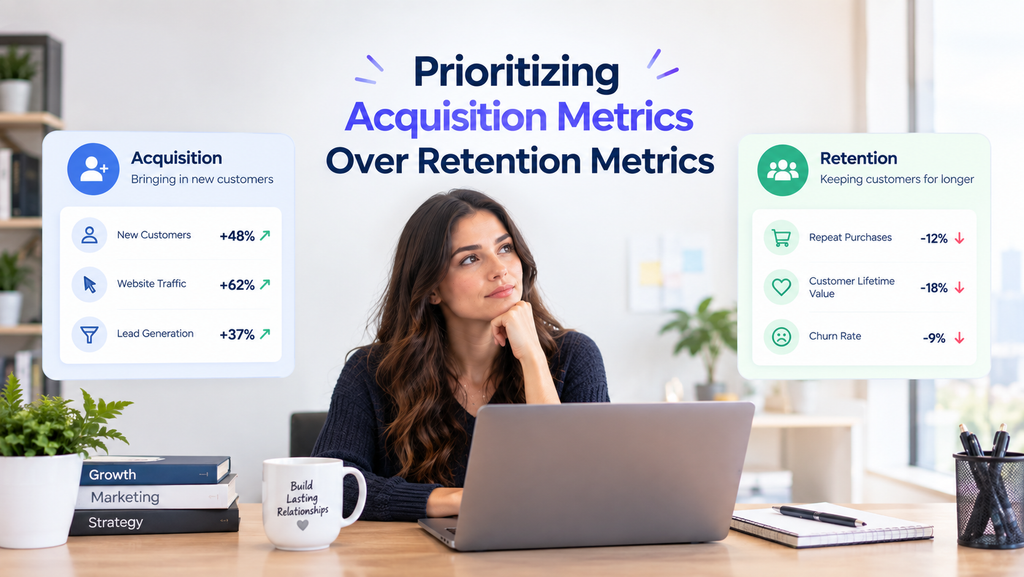
Straight truth: growing installs while ignoring retention is not growth, it is amplifying wasted spend. When teams optimize for acquisition metrics alone they mask the real unit economics until it is too late.
Measurable signals that acquisition is hiding retention failures
- Rising CAC to LTV ratio: customer acquisition cost climbs while cohort LTV stalls or drops, that gap is the silent profit leak.
- Divergent cohort retention: installs up but 30-day and 90-day retention falling for newer cohorts compared with older ones.
- High one-time conversions: lots of first purchases or activations that do not translate into repeat behaviors or subscription renewals.
- Shifting channel ROI: paid channels show strong short-term conversion but very poor repeat rates compared with organic/referral channels.
Trade-off to expect: reallocating budget toward retention will slow raw acquisition numbers initially. That feels risky to growth-oriented leaders, but the alternative is inflating user counts that add no long-term revenue and increase churn-driven volatility.
Three practical remediations you can apply this week and next month
- Immediate triage (this week): take one paid channel and shift 10–25 percent of its spend into retention playbooks, winback flows, onboarding nudges, and reactivation offers, then measure 30-day cohort retention for those users.
- 30-day operational change: build retention cohorts in your analytics (new users by acquisition source, first-week activity buckets) and start reporting LTV and 30-day retention by cohort weekly. Use those cohorts to stop or scale acquisition channels based on downstream performance, not installs alone.
- Strategic control (quarterly): set a hard LTV:CAC threshold for incremental spend (for example do not increase acquisition until LTV:CAC for new cohorts exceeds your target). Pair this with a retention roadmap that prioritizes onboarding, product habit loops, and loyalty programs.
Practical insight: measuring installs and immediate conversion is cheap; measuring retention requires instrumenting a single core action and holding teams accountable to it. Pick one core event that predicts long-term value, instrument it across channels, and make it the success metric for both marketing and product teams.
Concrete use case: A mid-market fitness app scaled installs aggressively with discount-driven campaigns and doubled month-one signups. But 30-day retention dropped and CAC rose. The team paused one high-volume channel, used Gleantap customer profiles to create behavioral cohorts, and redeployed budget to a segmented onboarding and reactivation program, 30-day retention rose within a month and LTV per cohort improved measurably.
Key stat: a small improvement in retention dramatically changes economics, Bain estimates a 5 percent increase in retention can raise profits by 25 to 95 percent.
What teams usually misunderstand: leaders assume acquisition is the faster lever to revenue growth. That is true only if the users you acquire stick. In practice, acquisition should be demand generation for a retention engine, not a replacement for it.
Where tools help and where they don’t: attribution and user profiles can show which channels produce loyal customers; use them. But tools alone will not fix playbooks, you need ownership, cohort reporting, and a spend gating rule.
Next consideration: after you verify which channels deliver durable value, formalize a guardrail: require downstream retention tests before any channel gets an increased budget. That discipline prevents acquisition spikes from turning into long-term retention problems.
Operational shortcut: if your team is short on analytics bandwidth, allocate a small cross-functional squad to run the cohort LTV audit for 30 days and use the findings to reassign at least one acquisition channel budget to retention programs.
4. Measuring Vanity Metrics Instead of Actionable Retention KPIs
Vanity metrics mask retention failures. Teams comfort themselves with rising downloads, email open rates, or total messages sent while the number that actually matters, customers who keep using and buying, drifts downward. Those surface metrics feel positive, but they do not predict long-term value.
What you should measure instead
Focus on downstream behaviors, not impressions. Track 7-day and 30-day retention for your core action, repeat purchase or return-visit rate, cohort LTV, feature adoption rates, and churn/reactivation windows. These are the metrics that connect engagement programs to revenue and loyalty.
- Measurable signals you are fooling yourself: improved open rates with flat or falling DAU; rising clickthroughs but no lift in feature adoption; higher campaign volume with increasing opt outs or complaint rates.
- When open/clicks matter: they are useful as early signals only if you have validated their correlation with retention for the same audience and campaign type.
- Limitation to accept: retention metrics take time and samples. Expect 30 to 90 day windows for reliable cohort lifts; fast wins on opens rarely translate to long-term revenue without product changes.
Concrete example: A national retailer A B tested subject-line personalization and raised open rates 12 percent. Thirty days later the repeat purchase rate did not budge. Investigation showed clicks landed on a generic homepage, leaving customers with extra friction to find products. The lesson: opens improved the headline, not the customer experience that drives repeat buying.
Practical fixes you can apply now
- Immediate triage (this week): add 7-day and 30-day retention, repeat purchase rate, and cohort LTV to your campaign dashboard and require a simple control group for any high-volume campaign. If you cannot measure downstream lift, pause scaling.
- 30 day change: map each campaign to a single downstream KPI (for example, email -> product activation; push -> weekly DAU). Run every campaign with a holdout and report incremental lift with sample sizes and time windows documented.
- Strategic control: make a launch checklist that forces a retention KPI, a required control group, and a minimum statistical threshold before you scale. Treat opens and clicks as diagnostic signals, not success criteria.
Key point: Any engagement program that does not define the retention metric it intends to move should not be scaled.
Retention pays. Bain finds a small increase in retention can dramatically lift profits,using retention KPIs to prioritize programs rather than vanity metrics.
Practical trade-off to plan for: using holdout groups reduces short-term reach and can feel like wasted opportunity. That loss is the cost of knowing whether the program actually moves retention. If you skip it, you compound errors at scale and pay much more in wasted acquisition later.
How tools help, but don’t replace the rulebook. Use unified customer profiles to tie opens and clicks to product events so you can measure true lift. Platforms like Gleantap can bring event-driven KPIs into a single view to make this mapping easier; use that consolidated view to build your campaign-to-KPI templates rather than chasing surface metrics. Also coordinate with your analytics owner to ensure cohort LTV is reportable on a weekly cadence.
Immediate next consideration: pick one live campaign and run it with a holdout. If your uplift on 30-day retention is underwhelming, stop repeating the tactic and investigate the experience gap between click and value realization.
Note on operationalizing: after you prove a retention lift, bake the validated campaign pattern into your playbooks and customer profiles. Gleantap customer profiles can store the event mappings you validated so future campaigns reuse proven logic instead of chasing ephemeral vanity wins.
5. Weak Onboarding That Fails to Prove Value Quickly

Key problem: When onboarding does not deliver a clear first value within the first session or the first week, most customers never get far enough to become loyal. Harvard Business Review and onboarding studies show the initial window is decisive – failing to shorten time to first value drives avoidable churn and hides deeper engagement strategy errors.
Why this breaks at scale
Onboarding fails for two correlated reasons. First, teams expose everything at once – feature overload – which buries the single action that predicts retention. Second, onboarding is treated as product markup instead of a measured funnel – there is no target metric for first value and no gating of downstream messages. The tradeoff is real: aggressive guidance accelerates new users into value but can frustrate power users if overdone. The solution is targeted, measured, progressive guidance.
Measurable signals this is your problem
- High initial dropoff: more than 40 to 60 percent of signups do not complete the first key action in the first session.
- Low welcome flow completion: fewer than 30 percent finish the guided flow or checklist you present after signup.
- Time to first value stretched: median time to the core action is greater than seven days for new users.
- Weak new user sentiment: NPS or satisfaction scores for users in their first 14 days trail overall NPS by 10 points or more.
Concrete example: A mid market SaaS product offered a 14 day trial with full features and a long self guided help center. Conversion from trial to paid was low because most users never completed the core setup task. After switching to a single guided task that could be completed in five minutes, trial to paid conversion rose noticeably within the first month.
Three immediate, near term, and strategic fixes
- Immediate triage – drive one action: identify the one user action most correlated with 30 day retention and add a clear, contextual nudge to push users to that action in the first session. Use a single CTA and remove competing distractions for new users.
- 30 day change – segment onboarding paths: build two to three distinct onboarding flows – new users, returning users, and power users – with tailored messaging and timing. Power users get optional advanced tips; new users get the fast first win.
- Strategic control – instrument, test, and gate features: instrument the onboarding funnel with events for each microstep, run weekly A B tests to shorten time to first value, and require new major features to include a measured onboarding path before wide release.
Practical nuance – do not overcook the guidance. Progressive disclosure works better than a forced checklist for complex products. Offer a quick guided path by default and an opt in for advanced setup. That preserves discovery for expert users while still proving value to most customers.
Key metric to watch: reduce median time to first value and track cohort retention tied to that metric.
Takeaway: Prioritize proving value fast – pick one core action, get most new users to complete it in the first session, and make that metric the gate for scaling onboarding and acquisition spend.
6. Siloed Channels and Poor Cross Channel Orchestration
Problem: Channel teams operating independently create duplicated outreach, conflicting creative, and customer fatigue. At scale this does more harm than good – repeated pushes across email, SMS, and in app without coordination drive opt outs and degrade brand loyalty.
Measurable signals this is happening
- Duplicate sends: high overlap of recipients receiving email and SMS within the same hour or same campaign window
- Opt out spikes: increases in unsubscribes or SMS stop replies after multi channel campaigns
- Conflicting messages: examples of different calls to action or pricing live in two channels at once
- Channel ROI mismatch: one channel shows low incremental conversion when used alongside another, meaning wasted spend
- Customer complaints and support tickets: rising tickets that mention mixed instructions or repeated notifications
Three practical fixes you can apply now and over the next month
- Immediate triage – suppression and priority rule: build a shared suppression list and a simple priority rule so a user receives only one promotional message in a defined window. This is a low technical lift and prevents obvious duplication immediately.
- 30 day change – map journeys and assign channel ownership: map your primary customer journeys and assign one owner per touchpoint. Owners are accountable for message timing, creative, and selecting the channel sequence based on user preference and value.
- Strategic control – orchestration layer plus governance: implement an orchestration layer that sequences messages by channel and respects frequency caps and declared preferences. Pair the tool with a governance process – campaign approvals, SLA for last minute sends, and a monthly cross functional review.
Concrete Example: A retail brand reported customer complaints after a holiday push where email and SMS went at the same hour with different discounts. The immediate suppression fix cut duplicate sends by 80 percent in the next campaign. Contrast that with Starbucks which coordinates offers across app, email, and in store so customers see a single, coherent incentive tied to loyalty status and channel preference.
Practical insight and tradeoff: Orchestration tools solve many problems but they are not a substitute for ownership. Centralizing message control without clear SLAs will slow campaigns and frustrate channel teams. The right pattern is a lightweight orchestration rule set – frequency caps, preference checks, and channel priority – plus devolved ownership for creative and timing.
Operational note: Use customer level signals – recent engagement, purchase value, and explicit channel preferences – to decide sequencing. A single frequency cap for all users is brittle. High value customers tolerate higher cadence but should still not receive duplicate content across channels in the same window.
Where to start with limited resources: implement suppression rules and a channel priority matrix first. Next, use a unified customer view to store channel preferences and recent interactions. Gleantap customer profiles can centralize those signals so marketing and success teams share a single source of truth.
Key takeaway: Preventing duplicate outreach is the quickest retention win on cross channel problems. Suppression lists stop visible harm right away; governance and orchestration stop it from returning.
Next consideration: When teams scale outreach, consider a partner program or vendor that supports sequencing and preference management to avoid rebuilding orchestration in house. Gleantap offers practical orchestration options for teams scaling outreach and has a partner program to accelerate operational maturity.
7. Stopping After Launch Instead of Continuous Experimentation
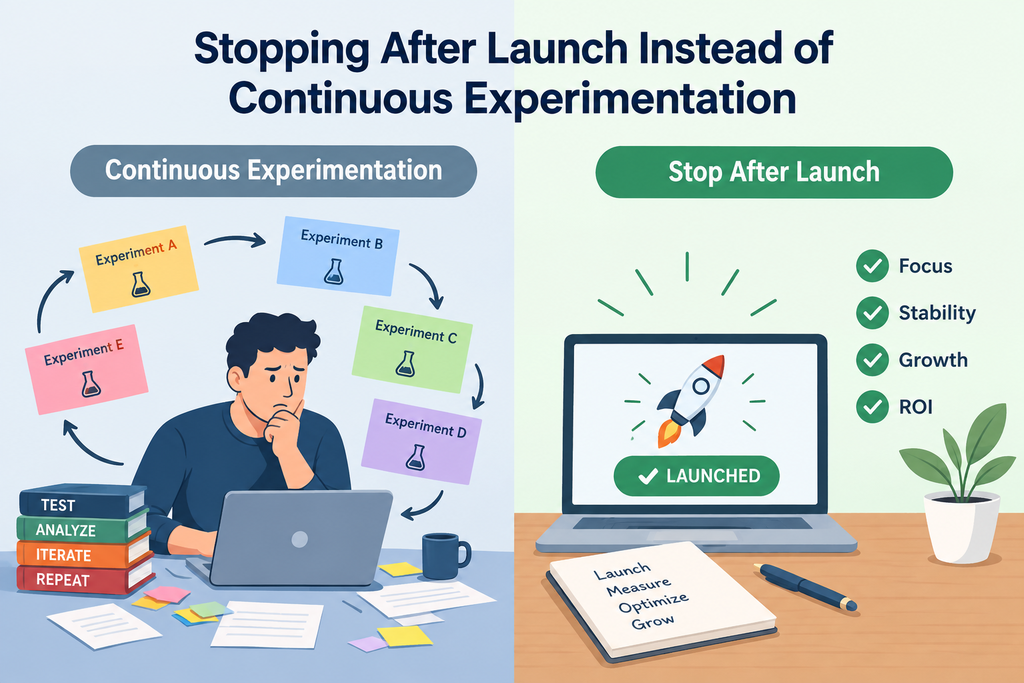
Hard truth: launching a campaign or feature is the easy part; the real work is iterating on it. When teams treat launch as the finish line they lock in ideas that may have short-term impact but will degrade as customer behavior shifts.
Signals that experimentation has stalled
- Plateauing lift: A/B tests stop producing clear wins and effect sizes shrink.
- Long gaps between tests: more than two weeks without a new test is usually a red flag for mid-market teams.
- Repeat creative reuse: the same subject lines, CTAs, or onboarding copy get recycled because no new hypotheses are being tried.
- Slow hypothesis-to-deploy time: tests take so long to run that learnings are outdated before they finish.
Immediate fix: start tiny, measurable loops. Run one lightweight hypothesis per week that targets a single retention metric (for example, 7 day return rate or time-to-first-value). Keep sample and observation windows short enough to learn, then push winners into a staged rollout.
What to change in 30 days
- Build an experiment backlog: capture hypotheses from marketing, product, and support; prioritize by expected retention impact and ease of execution.
- Assign owners and success criteria: each test must have a single owner, a clear metric, and a pre-defined measurement window.
- Standardize short tests: use templates for hypothesis, segment, metric, and rollout plan so tests are repeatable and comparable.
Use case: a retail app I worked with moved from ad-hoc tests to a 30-day backlog. They shifted one recurring creative test into a product-level experiment, changing the in-app reward timing, and saw a measurable bump in 14 day repeat purchases. That single change paid back the time invested within two months.
Strategic control: make winning tests the default path. Create test gating rules so only validated variants are promoted, and retire failed ideas quickly. This prevents drift and accumulates reliable learnings over time.
Trade-off to accept: continuous testing consumes attention and can slow launches if you over-gate. The right balance is testing what meaningfully moves retention and fast-tracking low-risk improvements that have already proven effective.
Concrete example: Zynga’s early social games grew fast on platform mechanics, then dropped users as competitors iterated. Teams that stopped experimenting with retention mechanics lost players to rivals who kept testing new hooks and onboarding tweaks. The lesson is simple: iteration beats standing still.
Practical judgment: most teams limit experiments to creative A/Bs. That is necessary but not sufficient. The highest-leverage tests change user flows, incentives, and timing across channels, not just subject lines. Treat experiments as product-level currency, not only a marketing tactic.
Operational tip: unify signals so you can evaluate experiments against retention, not vanity metrics. Tools that expose customer event histories and lifetime behavior make it easier to know which tests moved the needle, for example use Gleantap customer profiles to combine events and campaign outcomes into a single view.
Key takeaway: treat experimentation as an operational capability: short cycles, clear owners, and automated promotion of winners prevent stagnation and drop in retention.
Next consideration: if your team lacks orchestration to run multi-channel experiments consistently, evaluate partner options and process changes now, combining an orchestration platform with a disciplined backlog stops launch-day optimism from becoming long-term retention failures.
Frequently Asked Questions
Short answers you can act on now. Below are concise, practical responses to the questions teams ask most when scaling customer engagement, followed by the tradeoffs and a concrete next step for each item.
How quickly will changes to onboarding and segmentation show improvement in retention? Expect visible shifts in early indicators inside two to four weeks for onboarding nudges and within one month for segmentation campaigns. Full cohort-level improvements take 30 to 90 days because you need the cohort to pass the relevant behavior windows – trial end, subscription renewal, or repeat purchase cycle.
Practical tradeoff: quick wins are real but fragile. Short-term nudges can lift first-session activation without improving long-term loyalty unless you follow with reinforced value and behavioral hooks.
Which retention metric should I start tracking first? Track 7 day and 30 day retention for your core action, plus a 90 day repeat rate or repeat purchase metric for medium term loyalty. Add cohort LTV only after you can segment by acquisition source and onboarding experience.
Concrete example: a regional gym chain measured attendance as the core action. After focusing on 7 day checkins and a 30 day membership conversion metric, they identified that a single welcome SMS increased first-week visits by 18 percent and improved 90 day retention by 6 percent.
How do I prevent automation from feeling impersonal? Combine automation with conditional human touchpoints, personalize messages based on recent behavior, and respect channel frequency preferences. Use activity or sentiment triggers to route edge cases to human agents.
Limitation to watch: personalization at scale requires good behavioral data and governance. Automation alone amplifies bad segmentation. A customer data layer helps, but you still need ownership, rules, and quality controls to avoid tone-deaf messages.
What is a realistic experiment cadence for a mid market team? Aim for one to two meaningful A B tests per week that are small, focused, and measurable within a 14 to 30 day window. Prioritize tests that move downstream retention signals, not just opens or clicks.
Tradeoff: faster cadence increases learning but reduces sample size per test. Rotate small, high-frequency tests on low-risk elements and reserve larger, higher-impact experiments for the monthly cycle.
How can I identify if channel messaging is duplicated or causing fatigue? Audit recent sends for overlapping recipients and timestamps, watch for opt out spikes after cross-channel blasts, and implement a suppression rule that prevents two or more sends to the same user within a defined time window.
Practical use case: retailers coordinating email and SMS used a shared suppression list and simple channel priority rules. That cut duplicate sends by 72 percent and reduced opt outs after promo weekends.
When should we shift budget from acquisition to retention? Start reallocating when cohort LTV flattens or CAC to LTV ratio worsens. Move a small percentage first, measure 30 day retention impact, then scale reallocation based on results.
Can a customer data platform replace the need for better processes? No. A platform unifies signals but does not create governance, ownership, or playbooks. Technology without clear segment rules and release controls simply centralizes confusion.
Key statistic: a small retention improvement compound. Bain shows modest retention gains translate into outsized profit increases – keep this front of mind when prioritizing fixes.
One realistic limitation people miss: many teams treat FAQs as a document instead of an operational control. Answers are only useful if they map to a checklist, owner, and measurement,otherwise guidance never leaves the slide deck. Implement one governance change this week: assign an owner to each FAQ item and add the outcome to the weekly ops review.
Where to start right now: 1) Add 7 day and 30 day retention to your weekly dashboard. 2) Run one segmentation campaign targeted at a lapsed cohort for 30 days. 3) Create a suppression rule to stop duplicate channel sends.



Ready to Run Successful Marketing Campaigns and Grow Your Business?
Gleantap helps you unify customer data, track behavior patterns, and automate personalized campaigns, so you can increase repeat purchases and grow your business.
Ready to Run Successful Marketing Campaigns and Grow Your Business?
Gleantap helps you unify customer data, track behavior patterns, and automate personalized campaigns, so you can increase repeat purchases and grow your business.