
 Divya Ghughatyal
Scaling customer engagement exposes recurring problems that quietly erode revenue and relationships: customer retention failures, engagement strategy errors that look small at first but multiply with volume. This post lists the top mistakes teams make as they scale, how to spot each problem fast, and ranked, practical fixes you can apply this week. Expect clear signs to watch and the specific metrics to track so you stop churn and make growth stick.
1. Treating all customers the same instead of segmenting engagement
One-size messaging becomes harmful as the customer base diversifies. What worked for early adopters will not hold when you add volume, geographies, price tiers, or different usage patterns. Uniform campaigns drive down relevance, accelerate churn for lower-fit cohorts, and waste acquisition-driven gains.
Why this happens at scale
Teams copy a single successful campaign and push it to every new user because it is fast and visible. Management rewards reach and signups, not nuanced engagement outcomes, so nobody builds the extra wiring for segmentation. At a larger scale the diversity of behavior and value means mismatched messages create more harm than good.
Three signs you have this problem
- Falling engagement in subgroups: Open or click rates look fine overall but drop sharply for specific cohorts such as new signups, lower-spend customers, or certain channels.
- Cohort retention divergence: Retention by signup month or campaign source shows widening gaps instead of converging improvements.
- Irrelevance complaints increase: Customers report messages are not useful, or opt out at higher rates after specific lifecycle points.
Immediate corrective actions – ranked by impact and effort
- High impact, moderate effort – Define three priority segments and map tailored journeys. Start with value-based or behavior-based segments such as high-value repeaters, at-risk first-timers, and low-frequency users. Build one distinct message sequence for each segment and retire generic blasts for those groups.
- Medium impact, low effort – Audit customer profiles and attributes. Pull the attributes that actually predict behavior – recency, frequency, monetary, product usage – and fix missing or inconsistent data.
- Quick win, low effort – Run targeted A/B tests per segment. Test one variable at a time: subject line, offer timing, or CTA. Stop one-size campaigns for the segment if tests show clear lift.
Tradeoff and limitation: More segments increase complexity in content creation and campaign governance. The practical answer is not infinite personalization but the right number of segments you can operate reliably. Start with three to five segments you can measure and maintain, then add only when you can sustain quality.
Metrics to monitor
- Retention rate by segment – track 7, 30, and 90 day retention to see early differences and long term trends.
- Engagement rate by segment – opens, clicks, and conversion events tied to the specific journey for each segment.
Concrete example: A regional gym segmented members into new joiners, resumed members, and core monthly members. The team replaced a single weekly newsletter with three short sequences tuned to each group – a welcome flow for new joiners, reactivation incentives for resumed members, and instructor highlights for core members. Within six weeks the gym saw higher class bookings in the welcome group and lower churn in resumed members.
Key takeaway: Start simple and operationalize segmentation – pick three priority segments, fix the data that defines them, and measure retention by segment before expanding.
Next consideration: After you stabilize segments, plan a quarterly review to retire segments that add complexity without lift and to fold high-performing tactics into other journeys. For teams that need faster setup of segmentation and measurement, consider bringing in a partner to accelerate the audit and flow design.

For background on why improving retention matters as you scale see Bain on customer loyalty.
2. Prioritizing acquisition metrics over retention metrics
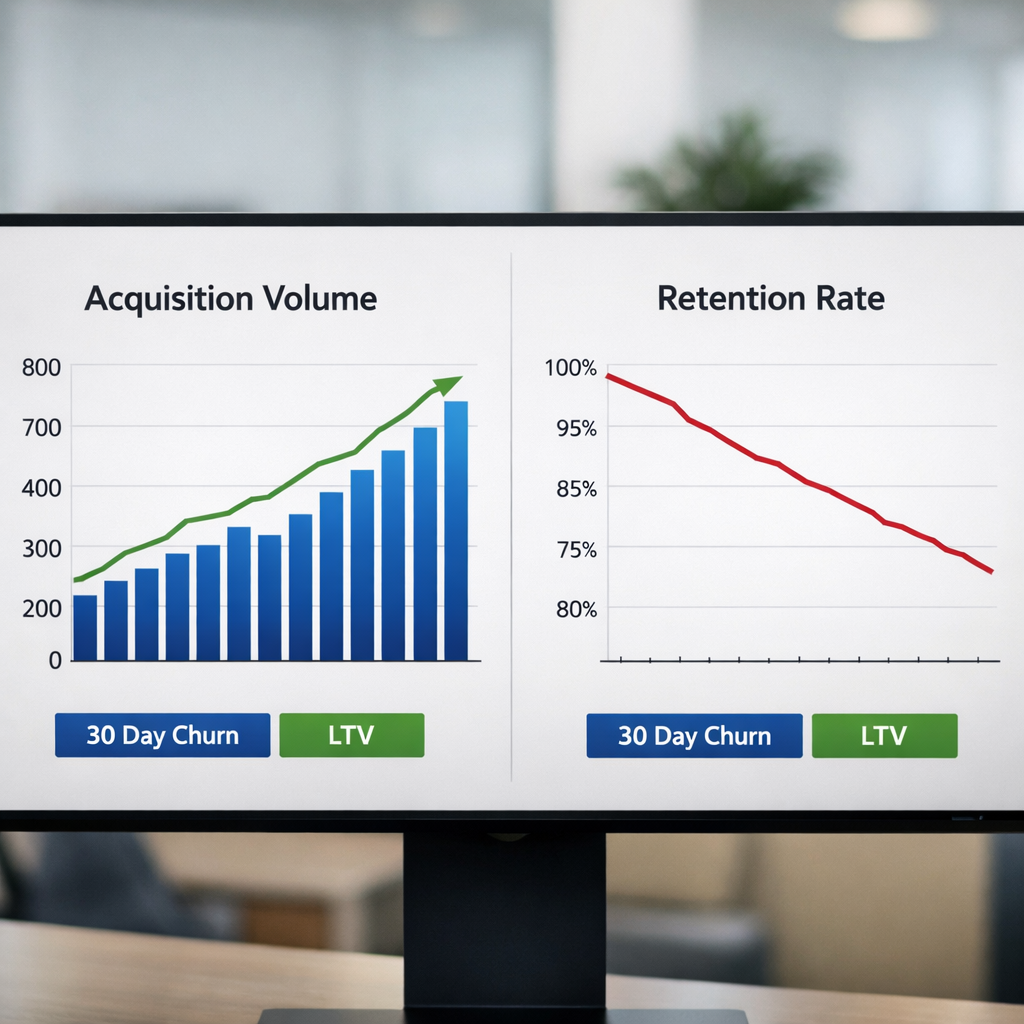
Hard truth: chasing new users while ignoring retention creates a growth illusion that collapses as volume rises. When acquisition metrics dominate reporting and incentives, teams optimize for signups and cost per acquisition while lifetime value and churn quietly deteriorate.
Why this happens at scale: Acquisition delivers fast, visible wins that please leadership and investors. Retention improvements take longer, require cross-functional changes, and compete for budget with product and paid channels. As customer counts grow, under-resourced retention work becomes invisible until churn becomes a hard problem.
Signs you have this problem
- Budget and attention mismatch: spend on acquisition rises while LTV and retention stay flat or fall.
- Churn shows up late: churn rate increases within 30 to 90 days of signup, but teams only notice after monthly dashboards are compiled.
- Disconnect between channels and revenue: high top-of-funnel engagement but low repeat purchases or product usage.
Immediate corrective actions – ranked by impact and effort
- Reallocate budget to retention initiatives (high impact, moderate effort): Fund targeted welcome flows, onboarding content, and small loyalty incentives that protect early LTV. Stop or pause low-performing acquisition experiments and divert a portion of that budget into retention tests.
- Add retention KPIs to executive reporting and team incentives (high impact, low effort): Require cohort retention, 30-day churn, and customer lifetime value to appear alongside CAC in weekly updates. Tie a portion of growth team compensation to these retention KPIs.
- Audit customer profiles to find high-risk cohorts (moderate impact, low effort): Pull cohorts by signup date, source, and behavior to see where retention drops off.
Concrete example: A regional subscription service doubled new signups after a seasonal campaign but saw 45 percent of those new accounts inactive after 30 days. The team paused one low-converting paid channel, shifted budget into a three-email onboarding flow, and added a 30-day engagement KPI. Within six weeks 30-day retention rose by 12 percent.
Practical trade-off to accept: shifting resources to retention usually slows headline growth temporarily. That pause is intentional – you want fewer low-value customers and more durable users. Expect acquisition cost-per-signup to rise while average revenue per user improves if retention work succeeds.
Metrics to monitor
- Customer churn rate: monitor cohort churn at 30 and 90 days so you see the problem early rather than when it shows up in aggregate revenue.
- Customer lifetime value trend: track LTV by acquisition source and cohort to understand which channels deliver sustainable value.
Key takeaway: Make retention as visible as acquisition in weekly dashboards and budgeting. Small, timely interventions to onboarding and segmentation pay back more than continued emphasis on raw acquisition numbers.
Next consideration: once you stabilize retention, institutionalize the change: include retention targets in campaign briefs, give product and CX teams clear retention goals, and consider bringing a partner when internal bandwidth is limited. When you need help auditing profiles or building retention flows quickly, a partner such as Gleantap can shorten the time from insight to impact.
3. Bombarding customers with irrelevant or too frequent messages
Direct point: Sending too many messages or irrelevant content is a faster path to churn than any single misplaced acquisition campaign. Customers tolerate some noise when they see clear value; once messages feel like clutter they stop trusting the brand.
Why this becomes a problem as you scale
Why it happens at scale: Growth teams layer new campaigns on top of older ones without pruning, and ownership blurs across channels. What worked for a few thousand customers breaks when you have different cohorts, varying purchase cadences, and multiple teams pushing messages.
- Rising opt-outs and blocks: A steady uptick in unsubscribe, spam reports, or blocked numbers is the clearest sign that frequency or relevance has broken.
- Short-term spikes then drop-off: Campaigns that generate an initial engagement spike but fail to produce repeat activity indicate message-driven action, not sustained value.
- Negative feedback and complaints: Direct customer feedback about being overwhelmed or irrelevant messages, and more support tickets about communication, mean messaging is harming the experience.
Practical insight: Frequency is not one-size-fits-all. Caps need to be cohort-aware. High-frequency may work for active weekly buyers but will alienate monthly or seasonal customers. Applying a single cap across all customers is a retention analytics mistake.
Concrete example: A multi-site service business started sending daily reminders and promotions as volume grew. Unsubscribes climbed and repeat visits fell. After combining messages into a weekly digest, suppressing recent purchasers, and enforcing simple per-channel caps, customer complaints dropped and repeat activity stabilized.
Immediate corrective actions (ranked by impact and effort)
- Audit active campaigns (Impact: High, Effort: Medium): Inventory every live email, push, SMS, and in-app campaign. Map overlaps by recipient and timing, then retire or consolidate campaigns that target the same event window.
- Set channel frequency caps and suppression rules (Impact: High, Effort: Low): Implement hard limits per channel (daily/weekly) and a suppression window after conversion or support contact. Start strict and relax only for high-value segments.
- Test message consolidation and timing (Impact: Medium, Effort: Low): Replace multiple touches with a single, better-timed summary for low-engagement cohorts. Measure lift before reintroducing individual triggers.
Trade-off to consider: Reducing frequency lowers noise but can also reduce opportunistic revenue from impulse buyers. The right approach is targeted suppression plus dynamic caps: fewer messages to indifferent customers, timely messages to engaged ones.
- Unsubscribe or opt-out rate: Track by channel and cohort; a rising trend is a fast signal to act.
- Repeat purchase or return visit rate: Measure whether messages translate to ongoing behavior, not just one-off clicks.
Key action: Start with a campaign audit and a 7-day suppression window for recent converters. This is low effort and often produces the largest immediate reduction in churn. For tools and profiles to speed the audit, consider partnering with an engagement platform like Gleantap.

Next consideration: After immediate fixes, add per-cohort frequency rules and tie suppression logic to lifecycle events to prevent the same problem returning as volume grows.
4. Failing to automate lifecycle and triggered messaging
Straight to the point: manual, one-off campaigns stop being effective as volume rises. When teams do not convert critical lifecycle moments into automated, triggered flows, timing slips, personalization breaks down, and retention drops.
Why this breaks at scale
Core cause: early-stage workflows work because a few people can move fast. At scale those same manual steps become bottlenecks. Delays pile up, human errors increase, and opportunities that require immediate, contextual messaging are missed.
Practical limitation: building a large, conditional automation system takes time and discipline. The risk most teams get wrong is trying to automate every possible branch at once instead of starting with a small set of high-value triggers.
Three signs you have this problem
- Delayed onboarding moments: welcome emails, verification prompts, or first-use tips send hours or days late instead of minutes.
- Inconsistent sequences: different customers get different numbers of messages or miss steps in a welcome or winback journey.
- Operational firefighting: your team spends time manually sending reengagement or apology messages instead of focusing on strategy.
Immediate corrective actions (ranked by impact and effort)
- Automate the three highest-value moments first: implement triggered flows for welcome, first purchase activation, and lapsed-customer reengagement. This delivers the largest retention lift with modest effort.
- Add simple error monitoring and alerts: create automatic alerts when a flow fails or when delivery latency exceeds a threshold so issues are fixed before they affect many customers.
- Keep flows intentionally simple and observable: limit branches, log key events, and add a visible dashboard so non-technical owners can see performance and stop runs if messaging goes off brand.
Note on data hygiene: automation only works with fresh, accurate profiles. Audit the fields your flows rely on, and stop automations from firing on incomplete records. Use tools to reconcile profiles and enrich missing keys such as lifecycle status or last purchase date.
Metrics to monitor
- Time to first engagement after signup: measure median minutes or hours between signup and first meaningful action triggered by your welcome flow.
- Conversion rate from triggered flows: percent of recipients who complete the desired action within a defined window after a triggered message.
Tradeoff to consider: more automation reduces latency and scale costs but increases the risk of mechanical, tone deaf messages. The right balance is small, well monitored automations plus scheduled human review of content and exceptions.
Concrete example: a gym that manually messages new members saw activation rates fall because follow up messages went out late. After automating the welcome and first-class reminder flows, time to first visit dropped from 48 hours to under 6 hours and activation rose. They added a single alert that fires if a welcome message fails to deliver and fixed the delivery issue within a day.
Key takeaway: automate the critical lifecycle moments first, instrument simple alerts, and keep flows minimal so you can iterate. Automation without monitoring turns into silent damage.

5. Measuring vanity metrics instead of retention drivers
Straight talk: when reporting favors surface-level numbers you lose sight of what actually keeps customers coming back. High open rates, impressions, and clicks feel good, but they can mask customer retention failures and hide engagement strategy errors that grow worse as volume rises.
Why this happens at scale
Teams scale fast by copying dashboards that are easy to read: sessions, impressions, CTR. Those metrics are attractive because they move daily and please stakeholders. At the same time, cohort analysis, holdout tests, and revenue-linked measures take time to build and explain, so they get deprioritized. The result is measurement that rewards short-term activity instead of long-term value.
Three signs you have this problem
- Surface lift, no stickiness: campaign clicks go up but repeat usage or purchases do not follow.
- Disconnected dashboards: reports lack cohort windows or any link from campaign to revenue per customer.
- Budget follow-the-noise: teams increase spend where impressions spike rather than where retention improves.
Immediate corrective actions (ranked by impact and effort)
- Build cohort retention as a primary KPI (High impact, Medium effort): replace or pair vanity KPIs with cohort retention at 30 and 90 days segmented by acquisition channel and campaign. That single change forces conversations about long-term value and reallocates budget to what actually reduces churn rate problems.
- Introduce controlled holdouts for major campaigns (High impact, Higher effort): run experiments with proper control groups so you measure incremental retention, not just activity. This cuts through correlation and reveals whether engagement tactics truly move repeat purchase and loyalty.
- Audit and link customer profiles to revenue events (Medium impact, Low effort): stitch basic revenue or usage events to profiles so every campaign report shows whether activity translated to repeat business.
Concrete Example: A mid-size retailer saw promotional emails drive clicks but not store visits. After switching their dashboard to show cohort retention by promotion and running a 30-day holdout on one campaign, they discovered the promotion accelerated one-time purchases while accelerating churn among bargain seekers. They stopped that promotion and redirected the budget to a retention-focused offer with clearer value.
Metrics to monitor
| Metric | Why it matters |
| Cohort retention at 30/90 days | Shows whether initial engagement converts into repeat behavior and future revenue. |
| Repeat purchase rate / Net revenue retention | Links campaigns to actual customer value and highlights retention analytics mistakes when detached. |
A practical constraint: cohort and holdout analysis requires clean event taxonomy and patience. You will trade speed of reporting for accuracy. Expect slower, more useful answers rather than daily vanity signals that encourage wasteful spend.
Key takeaway: Stop rewarding surface-level activity. Rebase reporting around cohort retention and incremental impact.
Next consideration: once you measure retention properly, tie budgeting and incentives to those retention drivers so decisions at scale stop being driven by vanity and start improving repeat business.
If you lack internal bandwidth to set up cohorts, holdouts, and profile stitching quickly, bring a partner experienced in retention analytics to accelerate impact without the usual trial-and-error.
6. Ignoring customer feedback and behavioral signals
Ignoring customer feedback and behavioral signals accelerates churn. When you stop treating feedback and real usage data as inputs to your engagement program, messaging becomes stale and interventions miss the customers most at risk.
Why this happens at scale
Operational noise wins over insight. As volume grows, teams are flooded with tickets, survey responses, and clickstream events but rarely have a simple process to turn those signals into prioritized actions. Data accumulates but decision loops do not – so campaigns continue running on assumptions that no longer match customer behavior.
Signs you have this problem
- Repeated complaints about the same issue. The same topic appears in tickets, surveys, and social channels week after week with no product or messaging change.
- Low resolution or long ticket lifecycles. Problems are logged but not closed quickly or routed to the right owner, so customers feel unheard and drop off.
- Static messaging despite changing behavior. Usage patterns shift – for example fewer repeat visits or different purchase cadence – yet the marketing calendar and scripts remain unchanged.
Immediate corrective actions (ranked by impact and effort)
- Triage and route the top signals. Impact high, effort low. Create a weekly triage: collect top 10 recurring themes from tickets, surveys, and behavior, assign an owner, and require a proposed fix or message update within seven days.
- Map signals to actions and automate simple responses. Impact medium, effort medium. Connect behavioral triggers to targeted flows – for example pause promotional sequences for customers showing cancellation intent – and add templated responses for frequent support issues.
- Build a lightweight feedback-to-product loop. Impact high, effort higher. Formalize how recurring feedback gets prioritized into product or content workstreams with a single stakeholder accountable for follow-through.
Metrics to monitor
- Customer satisfaction trend for top feedback categories – track movement week over week rather than single snapshot scores.
- Resolution time for top feedback categories – measure median time from report to action for the three highest-frequency issues.
Practical tradeoff: surveys are useful but noisy; behavioral signals are less subjective and should drive prioritization. Do not treat survey volume as proof that something matters unless you see corresponding behavior change. In practice the fastest wins come from acting on signals that appear in both channels.
Concrete example: A subscription service noticed a drop in month-two usage and an uptick in ticket topics about confusing billing. After routing the billing complaints to an owner and pausing an aggressive renewal campaign for affected cohorts, the team recovered repeat usage in four weeks. The change required a small script update and a short campaign suppression rule, not a full redesign.
Key point: Closing the loop matters more than collecting more feedback. Prioritize signals you can act on within two weeks.
Actionable next step: Audit your customer view to make feedback actionable. Start by consolidating tickets, survey themes, and behavioral flags into one shared profile so owners can see patterns at a glance. If you need a faster way to assemble profiles, consider using a purpose-built customer profile tool such as the Gleantap customer profile to reduce manual stitching and speed triage.
Judgment: Teams that treat feedback as a reporting exercise lose retention faster than teams that act. If your internal bandwidth is limited, bring external help to set up the triage and automation rules so you can convert signals into action quickly. For partner support consider exploring the Gleantap partner program to accelerate setup when internal resources are constrained.
Next consideration – make the loop repeatable: set a weekly cadence, own the outcomes, and measure whether the top three recurring issues shrink over time. That is the simplest signal showing you moved from noise to control.
7. Lacking standardized processes and playbooks for scaling engagement
Key point: Standardized playbooks are the control layer that prevents your engagement from becoming noisy and inconsistent as teams grow and channels multiply.
Why this fails when you scale
Problem mechanics: Early stage teams rely on informal habits and tribal knowledge. Those practices work with a handful of campaigns but collapse when multiple people, contractors, and new channels are added. Without playbooks you get duplicated campaigns, conflicting messages, and nobody accountable for maintaining frequency, tone, or legal checks.
Three signs you have this problem
- Multiple versions: Different teams run separate variants of the same campaign and customers receive mixed messages.
- Unclear ownership: No single person is responsible for campaign health, so errors persist after staff turnover.
- Rework spikes: New hires frequently copy existing campaigns rather than following a standard template, creating cleanup work and message drift.
Immediate corrective actions (ranked by impact and effort)
- High impact, moderate effort: Create three concise playbooks for onboarding, retention, and reengagement. Each playbook should include the objective, target segment, message cadence, required approvals, suppression rules, and a simple version history. As part of this step audit customer profiles using Gleantap to confirm the segments and attributes your playbooks reference are accurate and up to date.
- High impact, low effort: Assign a single owner for each playbook with a one line SLA: who approves, who executes, and who monitors. Make owners accountable for runbooks, not just documents. Require owners to sign off on every campaign push until compliance is stable.
- Moderate impact, low effort: Schedule quarterly playbook reviews that include a short checklist for localization, legal updates, and suppression lists. Pair each review with a 30 minute training for anyone who will use the playbook so the rules are practiced, not just documented.
Metrics to monitor
- Campaign deployment time: Track time from campaign request to live as a proxy for process friction and handoff clarity.
- Campaign errors or duplication rate: Measure how often campaigns are sent outside playbook rules or duplicated to the same audience.
Practical insight: Standardization is not the same as rigidity. You must allow lightweight exception paths so local teams can adapt language or timing for edge cases. The tradeoff is governance versus speed; the right balance is fast approval for small deviations and stricter control for any change that touches core lifecycle messages.
Concrete example: A regional gym chain scaled from a single club to a dozen locations and ended up with five welcome sequences in the market. Members who moved between locations received conflicting onboarding messages. Consolidating to a single onboarding playbook, assigning a playbook owner, and auditing member attributes with Gleantap eliminated the overlap and reduced member confusion within one quarter.
Takeaway: Documented playbooks plus clear ownership stop message drift. If your team cannot maintain playbooks, bring in external support to build initial templates and ownership workflows so internal staff can focus on tuning, not firefighting.
Next step to consider: If internal bandwidth or expertise is limited, consider partnering with a specialist to set up playbooks and governance.
Frequently Asked Questions
Direct answers to the questions teams ask when retention slips. These are practical expectations and tradeoffs you will face while fixing customer retention failures and engagement strategy errors at scale.
How quickly should I expect retention to improve after fixing one of these mistakes
Short fixes show up fast; structural fixes take time. Small changes you can deploy within a week – frequency caps, a welcome flow, or suppressing recent purchasers – typically move targeted metrics within four to eight weeks. Bigger work – reworking segmentation logic, rebuilding attribution, or realigning teams – will take up to three months to show reliable shifts in cohort retention and lifetime value.
Which metric should I prioritize if I can only track one
Make cohort retention at 30 days your single priority. It ties early behavior to future revenue and exposes whether initial experiences stick. If you have one number to show executives, 30 day cohort retention reveals whether acquisition is producing customers who return.
Can automation replace manual team judgment when scaling engagement
Automation handles routine timing and scale; people handle nuance. Automate time sensitive actions – welcome sequences, post purchase confirmations, churn risk nudges – so messages arrive consistently. Keep humans in the loop for tone adjustments, edge cases, and when you see engagement dropping in a cohort.
Concrete Example: A gym moves its welcome email from a manual sent to an automated three step flow. The automated flow reaches every new member within 24 hours, boosting first week activity. Staff still review the content weekly and adjust language for seasonal offers.
How do I balance personalization with privacy and compliance
Follow consent and minimize data use. Personalize using only the fields customers agreed to share and avoid building complex profiles from inferred data without notice. The tradeoff is simple: less aggressive personalization reduces short term conversion but preserves long term trust and lowers risk.
What is the quickest win for reducing message fatigue
Frequency caps and recent-activity suppression are the fastest wins. Put per-channel caps in place and suppress customers who completed the desired action within a short window. You will see unsubscribes and complaints fall quickly; the tradeoff is potentially slower reengagement for very active segments, so monitor repeat activity closely.
When should I bring in an external partner to help scale engagement
Bring a partner when speed or specialty matters. If you do not have bandwidth to build reliable automated flows, or you need an accurate segmentation and measurement setup quickly, an experienced partner shortens the learning curve. Expect to pay for that speed; a good partner invests in mapping retention drivers and hands off repeatable playbooks.
Key metric to track now: 30 day cohort retention. Small improvements here deliver outsized profit impact – see Bain on customer loyalty for the economics behind retention gains.
A practical limitation to accept: Quick wins do not guarantee durable improvement. Many teams mistake early lifts in opens or clicks for recovery. Only sustained movement in cohort retention and repeat purchase shows that engagement changes stick.
- Immediate action: Put a 7 day and 30 day measurement window on any fix so you can verify short term and medium term impact.
- Priority metric focus: Track cohort retention at day 30 and repeat purchase rate together to avoid being misled by surface engagement.
- If you need help: Consider working with a partner to accelerate segmentation and flow building review of the Gleantap partner program.
- Quick operational step: Add a suppression rule for recent purchasers and set per-channel caps this week to reduce message fatigue immediately.
Start with measurements you can trust. If cohort retention is not visible within your dashboards, nothing else you do will reliably improve retention.
Next steps you can implement this week – pick one: enforce frequency caps, automate a welcome flow, or enable 30 day cohort reporting. Each action reduces the most common causes of customer retention failures and engagement strategy errors and gives you a clear signal to act on next.


Ready to Run Successful Marketing Campaigns and Grow Your Business?
Gleantap helps you unify customer data, track behavior patterns, and automate personalized campaigns, so you can increase repeat purchases and grow your business.
Ready to Run Successful Marketing Campaigns and Grow Your Business?
Gleantap helps you unify customer data, track behavior patterns, and automate personalized campaigns, so you can increase repeat purchases and grow your business.