
 Divya Ghughatyal
Most teams bring in conversational AI to solve a speed problem. Leads arrive at nine at night, on a Saturday, from a social ad or a web form, and nobody answers until Monday morning. An AI agent fixes that part fast. It replies in seconds, every day, on every channel you’ve turned on.
But speed on its own wears off. Once the AI has answered, the question that matters is what happens to that conversation. If it lives inside a chat tool and nowhere else, your CRM still shows a name and a phone number with no story attached. Your email and SMS campaigns still treat that person like a stranger. Your team still calls people who already booked an appointment two hours ago.
The real value shows up when the conversation becomes part of your customer data. When what someone says in chat updates their record, moves them into the right segment, triggers the right follow-up, and appears on your team’s screen before they pick up the phone.
This article walks through how that connection works in practice: what the AI needs to know before it replies, what it should send back, how conversations feed your marketing automation, and what to look for when you’re comparing tools.
What “integrated” actually means
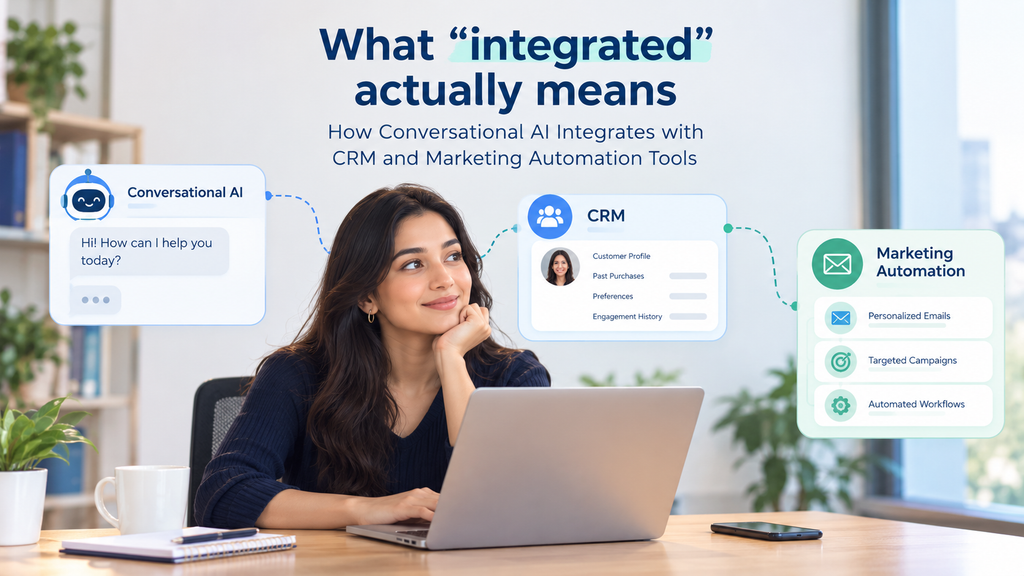
Integration gets used loosely. A tool can claim it “works with your CRM” and mean nothing more than a nightly export of email addresses. That is not the same thing as a conversation that changes what happens next.
A properly connected AI agent moves information in three directions.
It reads. Before the AI writes a single reply, it pulls up what you already know about the person. Are they a current member or a first-time visitor? Did they buy it last month? Do they have an appointment on the calendar? Have they already been offered the new-customer discount?
It writes. As the conversation happens, the AI updates the customer record. It adds the transcript, notes what the person asked for, records the outcome, and tags the record so your segments stay accurate.
It triggers. Once the record changes, your marketing automation picks it up. A booked appointment starts a reminder sequence. An abandoned conversation starts a nurture sequence. A complaint routes to a person instead of a campaign.
Take any one of those three away and the system leaks. An AI that reads but doesn’t write gives good answers that disappear. An AI that writes but doesn’t read asks people questions you already have answers to. An AI that does both but triggers nothing leaves your campaigns running on last quarter’s assumptions.
The customer profile is the connection point
Everything above depends on one thing: a single place where all of a customer’s information lives.
Most businesses don’t have this. Appointment history sits in a booking system. Purchase history sits in a point-of-sale tool. Email engagement sits in a marketing platform. Text messages sit in whatever the front desk uses. Each tool holds a partial version of the same person.
An AI agent working from a partial profile gives partial answers. It might greet a ten-year customer as a new lead, or pitch a membership to someone who already has one.
This is why conversational AI works best inside a platform that already unifies customer data rather than bolted on beside one. Gleantap takes this approach: the AI agent, the customer profiles, the segments, and the campaigns all read from the same underlying data, so a conversation on WhatsApp on Tuesday shows up on the same profile as an email click on Wednesday and a purchase on Thursday.
If your AI tool sits outside your customer database, you’ll need a reliable connection between them, and you’ll need to be honest about how often it updates. A sync that runs once a day is fine for reporting. It is not fine for a conversation happening right now.
What the AI needs to know before it replies
There are two kinds of knowledge an AI agent needs, and they come from different places.
The first is knowledge about your business. Hours, locations, pricing, policies, service descriptions, what’s included in each package, how cancellations work. This comes from documents, your website, and whatever you upload during setup. It’s what keeps the AI from inventing an answer.
The second is knowledge about the person. This comes from your CRM, and it’s what turns a decent answer into a useful one.
A retail chain’s AI agent that can see purchase history answers “do you have this in my size” very differently from one that can’t. It knows what the customer bought before, which store they shop at, and whether they’re in the loyalty program. The reply can name the nearest location with stock rather than sending a generic link to the catalogue.
A fitness studio’s agent that can see membership status answers “what are your prices” differently depending on who’s asking. A prospect gets the new-member offer. An existing member asking the same question gets the upgrade path, not a pitch for something they already pay for.
A healthcare practice’s agent that can see upcoming appointments handles “I need to come in” without making the patient repeat their history. It already knows they have a follow-up scheduled and can offer to move it rather than book a duplicate.
None of this requires a complicated setup on the marketer’s side. It requires that the AI is allowed to look at the customer record before it responds, and that the record is current.
What the conversation should send back

This is where most of the long-term value sits, and where a lot of tools fall short.
At minimum, every conversation should leave four things behind on the customer record.
The transcript. The full exchange, attached to the contact and timestamped. Your team reads it before they call. Your marketing team reads a sample of them every month and learns more about objections than any survey will tell them.
The outcome. Did the person book, buy, ask a question, complain, or drift off? One clear result per conversation, written somewhere you can filter on.
The details the person gave you. Preferred location. Preferred time of day. What they’re actually looking for. Whether they mentioned a budget, a deadline, or a specific concern. These are the fields your campaigns will use later.
The interest level. Some signal, even a simple high-medium-low, that tells your team and your automations how warm this person is.
Keep the list short on purpose. It’s tempting to capture every detail the AI picks up, and it’s a mistake. A record with forty half-filled fields is harder to use than one with six reliable ones. Pick the handful you will actually build segments and campaigns on, make sure those are always populated, and add more only when you have a clear use for them.
The point of writing data back isn’t record-keeping. It’s that every one of these fields is something a marketer can act on. Preferred location becomes a store-level campaign. Preferred time of day becomes a better send time. Interest level becomes the difference between a call and an email.
Turning conversations into marketing automation
Once conversations update the customer record, your marketing automation has something new to work with: intent that’s expressed rather than inferred.
Traditionally, marketing automation runs on behaviour you can observe from a distance. Someone opened an email. Someone visited a pricing page. Someone hasn’t purchased it in sixty days. You infer interest from actions and build journeys around your best guess.
A conversation removes the guessing. The person said what they wanted. That’s a much stronger signal, and it can drive much better-targeted follow-up.
A few patterns that work across industries:
Booked, but not yet showed up. The conversation ends with an appointment on the calendar. That should start a confirmation and reminder sequence automatically. For a clinic, this is the difference between a full schedule and a day of no-shows. For a gym, it’s the difference between a booked trial and an empty one.
Interested, but didn’t commit. Someone asked about pricing and then went quiet. They don’t need a hard sell. They need the one piece of information that was probably holding them back, sent two days later, on the channel they were already using. Your automation can do this without anyone remembering to.
Asked about something specific. A retail customer asked about a product that’s out of stock. That’s a back-in-stock alert waiting to happen, and it converts far better than a general promotion because it answers a question the customer already asked.
Bought or joined. New customers should move straight into onboarding. What to expect, how to get started, what to do first. Conversational AI usually handles the first conversation of a customer’s life with your business, so it’s the natural trigger for the sequence that follows.
Went quiet after being active. If a customer who used to talk to you regularly stops, that’s worth a re-engagement campaign. The conversation history tells you what they cared about, so the win-back message can reference something real instead of offering a generic discount.
The mechanics matter less than the principle. When conversations update the record and the record drives your journeys, your campaigns stop being calendar-driven and start being customer-driven.
Segmentation gets better too. Instead of building lists from demographics and email opens, you can build them from what people said. Everyone who asked about weekend availability. Everyone who mentioned a specific service. Everyone the AI flagged as high interest in the last thirty days who hasn’t been contacted by a human yet. These are small, precise lists, and they can outperform big, vague ones because they’re built around more relevant targeting signals.Handing off to your team without losing the thread
Not every conversation is best handled by AI. Some questions need a person, either because they’re complicated or because the customer is upset or because the deal is big enough to deserve one.
The handoff is where integration proves itself. Done badly, the customer repeats their whole story to a human who has no idea what just happened. Done well, the team member opens the conversation and sees everything: the full transcript, the customer’s history, what they asked for, and what the AI already told them.
Three things make handoffs work.
A clear trigger. Decide in advance what sends a conversation to a person. High-value inquiries, specific keywords, repeated confusion, an explicit request to speak to someone, or anything outside business hours that can’t wait. Write the rules down and review them monthly.
Complete context. The transcript and the customer record travel with the conversation. If your team has to open a second tool to understand what’s going on, the handoff has failed.
A record of what happened next. When the person finishes the conversation, that outcome goes back onto the same record. Otherwise you’ve created a gap in the history, and the next conversation, human or AI, starts blind again.
The practical test is simple: can a team member pick up a transferred conversation and say something useful within thirty seconds of reading the screen? If not, something isn’t connected.
One customer, many channels, one record
Customers don’t think in channels. They’ll ask a question on your website, follow up by text, and call the next day. Internally these often land in three separate systems and become three separate records for the same person.
Conversational AI now spans web chat, SMS, email, social messaging, WhatsApp, and phone calls. That’s useful reach, and it’s also a data problem if every channel writes somewhere different.
What you want is straightforward: every conversation, regardless of channel, attaches to the same customer profile. Someone who chatted on your site last week and texts you today should be recognised. The AI should pick up where the last conversation left off.
This also protects you from the most common complaint about automated messaging, which is over-contact. When all channels share one record, your system knows this person was already texted yesterday and can hold back the email. When they don’t share a record, the customer gets hit three times and unsubscribes.
Where Agentic AI Fits Into CRM and Marketing Automation
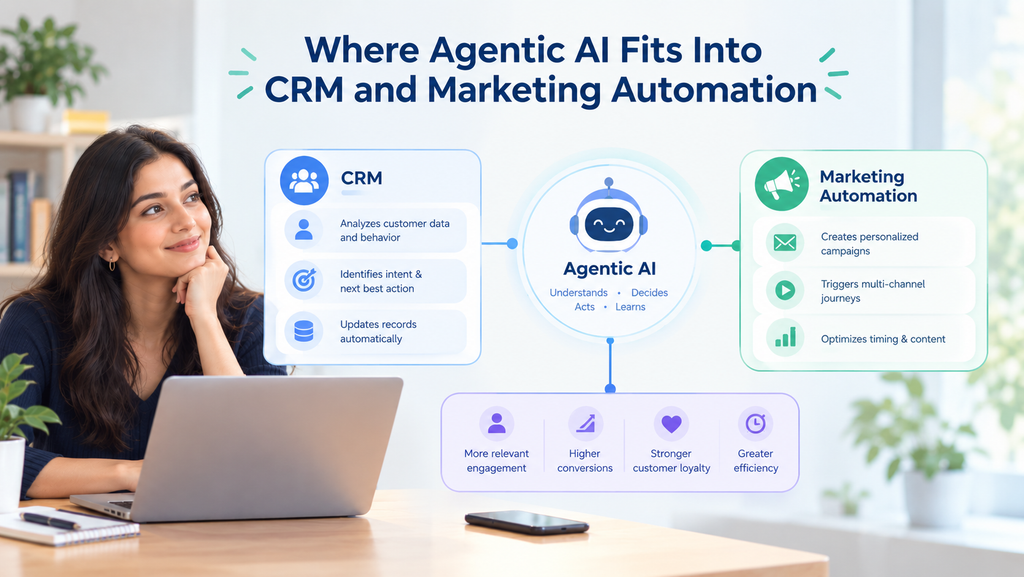
Once customer conversations, profiles, and campaign activity live in one system, Agentic AI can turn that connected data into action. Instead of simply answering questions, an agentic layer can work across CRM and marketing workflows to build segments, create campaigns, manage conversations, and pull reports using natural-language instructions.
For example, a marketer could ask the system to create a win-back campaign for customers who haven’t visited in 30 days, exclude anyone contacted recently, and prepare the email and SMS flow for review. An Agentic MCP Server connects AI assistants to these CRM and marketing functions, allowing teams to work with customer data and execute workflows without moving between multiple tools.
The important distinction is that Agentic AI works on top of connected customer data. When the CRM knows a customer’s previous conversations, activity, and campaign history, AI can use that context to make each interaction more relevant while reducing unnecessary outreach.
What to look for when you’re evaluating tools
You don’t need a technical background to ask the right questions. Most of what matters is visible in a demo if you know what to look for.
Ask to see the customer record after a conversation. Not the chat window, the CRM record. Is the transcript there? Are the fields filled in? Is it obvious what happened and what should happen next? If the vendor has to explain what you’re looking at, it’s probably not clean enough to build campaigns on.
Ask whether it reads before it writes. Have them show a conversation with an existing customer. Does the AI know who it’s talking to, or does it start from zero?
Ask how fast the data moves. Real time or near real time is what you need. If a booking made in chat takes an hour to appear on the record, someone will double-book.
Ask what happens when the AI doesn’t know. A good agent says it doesn’t know and hands it off. A bad one invents an answer, and in healthcare or any regulated category that’s a serious problem.
Ask about your existing systems. Whatever runs your bookings, payments, or memberships needs to be part of the picture. Gleantap connects with the platforms B2C businesses typically already run on, including booking and point-of-sale systems, which matters more than the length of any integration list.
Ask who maintains it. Conversations change as your business changes. Find out whether updating the AI’s knowledge is something your marketing team can do or something that requires a support ticket every time you change your hours.
Where integrations usually go wrong
A few failure patterns come up repeatedly, and all of them are avoidable.
Duplicate records. The same customer appears three times because the web chat created a record by email, the SMS conversation created one by phone number, and the phone call created a third. Decide early how records are matched and merged.
Unclear ownership. Nobody is responsible for conversation quality, so nobody notices when the AI starts giving a wrong answer about a policy that changed in March. Give one person on the marketing team the job of reading conversations weekly.
Too much automation, too fast. Turning on every sequence at once makes it impossible to tell what’s working. Start with the sequences tied to clear outcomes, booked, interested, purchased, and expand from there.
Stale knowledge. The AI keeps quoting prices from six months ago because nobody updated the source documents. Put this on a recurring schedule alongside your other content reviews.
No human path. If customers can’t reach a person, a percentage of them will simply leave. Always leave the door open.
Bringing it together

Conversational AI is often sold as a way to answer faster. That’s the smallest part of what it does.
The larger shift is that conversations become a data source. Every question a customer asks tells you something about what they want, and when that information flows into your CRM and out into your campaigns, your marketing gets more accurate without you doing more work.
That’s the real test of an integration. Not whether the chat window looks good, but whether your customer records are richer at the end of the month than they were at the start, and whether your campaigns are using what’s in them.
If conversations are updating profiles, profiles are driving segments, and segments are driving campaigns that reference what customers actually said, the integration is doing its job. If your AI is answering questions beautifully in a tool nobody else looks at, you’ve bought a faster front desk and left the marketing value on the table.
See how Gleantap connects conversational AI, customer data, and marketing automation in one platform.

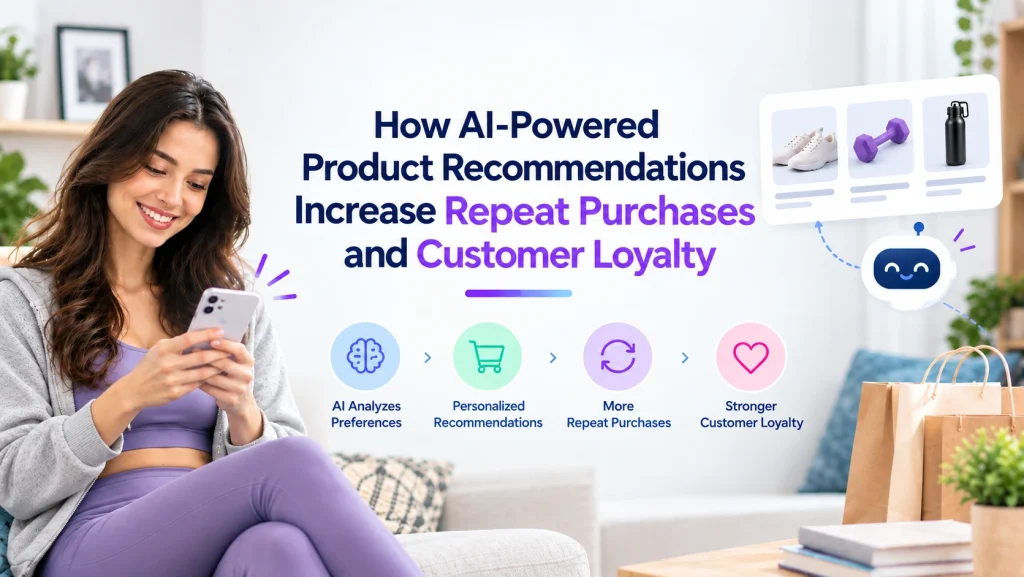

Ready to Run Successful Marketing Campaigns and Grow Your Business?
Gleantap helps you unify customer data, track behavior patterns, and automate personalized campaigns, so you can increase repeat purchases and grow your business.
Ready to Run Successful Marketing Campaigns and Grow Your Business?
Gleantap helps you unify customer data, track behavior patterns, and automate personalized campaigns, so you can increase repeat purchases and grow your business.