
First-Party Data Strategy: Why CDPs Are More Important Than Ever

Privacy shifts and the end of reliable third-party identifiers have turned first-party data into a business asset, and CDP first-party data workflows are now the operational backbone for identity, activation, and measurement. This guide shows marketing and product leaders how to choose and pilot a CDP, unify customer identity across POS, apps, and email, and run a 30/60/90 roadmap that proves incremental impact. Read on for a vendor checklist, high-impact use cases for membership and retail businesses, and the KPIs to measure lift.

1. Why first-party data is nonnegotiable in 2026

Reality: By 2026, owning reliable first-party signals is the only practical way to know who your customers are across devices and channels. Cookie loss, stricter platform policies, and privacy rules have removed the cheap, probabilistic glue marketers relied on. That means CDP first-party data is no longer optional infrastructure — it is the foundation for consistent personalization, measurement, and audience portability. See the CDP Institute for the basic framing of what a CDP solves: CDP Institute.

Consequence of inaction: If you keep relying on fragmented contact lists and analytics-only views, expect higher acquisition costs, weaker personalization, and blind spots in attribution. Practically, that looks like wasted ad spend because you cannot accurately suppress known customers from acquisition campaigns, and missed revenue because churn signals from POS or attendance systems never reach the channels that could re-engage members.

Trade-off to accept: Not every first-party datum is equally valuable. Deterministic identifiers — email, phone, membership ID — are hard currency for membership and retail businesses; behavioural streams and enrichment are helpful but secondary. Investing first in identity quality and consent capture delivers more immediate ROI than trying to ingest every telemetry stream at once. The trade-off is speed versus completeness: prioritize identity and a few high-value events before broad ingestion.

Concrete example: A boutique gym integrated its POS, check-in system, and email provider through a CDP to create a unified member profile. When a member misses three scheduled classes and has a recent declined payment, the CDP sends a real-time audience into the messaging platform to trigger a personalized SMS with a targeted offer. That single flow reduced manual churn outreach and recovered members who would otherwise have lapsed.

Practical limitation: Building a CDP or centralizing first-party data does not magically fix bad data governance. Expect duplicates, stale email addresses, and conflicting consent records. Plan for a data stewardship process, a small set of automated quality checks, and a cadence for resolving identity conflicts. Without that, unified profiles will degrade and undermine trust with both customers and trading partners.

Operational imperative: Real-time processing matters where timing changes outcomes — failed payments, last-minute cancellations, or in-store returns that should suppress ad targeting. But real-time pipelines cost more and require more rigorous monitoring. The pragmatic move: make a short list of 3 real-time events that are business-critical and run everything else as nightly batches until the team stabilizes the stack.

Action to take now: Run a 48-hour audit of all customer touchpoints and answer these three questions for each: which deterministic ID is emitted (email/phone/membership ID), is consent captured and stored, and which one immediate event would improve revenue or retention if activated in real time? Prioritize fixes that align with those answers.

Next consideration: After the audit, pick one deterministic identifier and one real-time event to operationalize in the next 30 days — that narrow focus separates pilots that deliver measurable results from projects that become perpetual data plumbing.

2. How a CDP operationalizes first-party data compared to CRM and data warehouse

Direct point: a Customer Data Platform makes first-party data operational by turning disparate signals into identity, persistent profiles, and immediate channel actions — in ways CRMs and data warehouses do not.

Where each system actually contributes

  • CDP: resolves identity across devices, builds a single persistent profile, enriches fields from multiple sources, and exposes real-time audiences and APIs for activation to messaging, ad, and experimentation tools.
  • CRM: holds canonical customer records and interaction history used by sales and support. Good for operational workflows and case management but poor at stitching anonymous signals or streaming audiences to ad networks.
  • Data warehouse: centralizes raw event and transaction data for analysis and modeling. Excellent for long form analytics and predictive models but not built for low latency activation or honoring per interaction consent during activation.

Practical insight: reverse ETL from a warehouse plus the CRM is a viable pattern for analytics led teams, but it is slower, engineering dependent, and brittle for real-time personalization. If your use case needs sub minute triggers or channel level consent enforcement, a CDP is the pragmatic choice.

Tradeoffs and limitations to accept up front

  • Cost and scope: CDP solutions add recurring cost and require governance. Small teams sometimes overbuy a full enterprise CDP for a single use case when a focused integration could suffice.
  • Identity quality matters: deterministic matches using email and phone are reliable; probabilistic matching is convenience, not guaranteed. Evaluate identity graph quality and be prepared to surface confidence scores into downstream logic.
  • Vendor lock and activation routes: some CDPs lock you into particular activation connectors or require middleware. Confirm connectors to your messaging provider and ad platforms before committing.

Judgment call: for membership businesses with limited engineering bandwidth and a priority on retention messaging, buy a CDP. For companies with large data teams and primarily exploratory analytics needs, a warehouse first approach with selective reverse ETL can be cost efficient but slower to produce revenue impact.

Concrete example: real-time churn intervention

Concrete Example: a boutique gym ingests POS transactions, class attendance, and app opens into a CDP. The CDP flags a member with three missed classes and a dropped membership payment attempt as high churn risk, resolves their phone number to the persistent profile, and sends that audience to Gleantap for an SMS reengagement sequence within seconds. The same audience is simultaneously pushed to Facebook via server side API for a complementary offer without relying on cookies.

What many teams miss: they assume the CRM is sufficient because it stores email and notes. In practice CRMs lack the streaming identity stitching and privacy aware activation controls that reduce false positives in automated campaigns. That failure mode costs reputation and opt outs.

Key takeaway: prioritize a CDP when your priority is real-time, privacy safe activation and cross channel identity resolution. If your primary need is retrospective analysis without immediate activation, a data warehouse alone is acceptable.

Next consideration: map one high value use case into responsibilities. List which system owns identity resolution, which stores the source event, and which executes the action. That mapping reveals whether you need a CDP to remove the operational gap.

3. High-impact use cases for first-party data powered by a CDP

Clear payoff: CDP first-party data unlocks operational activations that directly move revenue and retention metrics because unified profiles make messaging relevant and timely. The value is not theoretical; it is realized by closing gaps between identity, orchestration, and measurement.

Three high-return use cases to prioritize

Use case 1 – Personalized lifecycle messaging. Combine membership status, purchase history, and recent engagement to drive targeted SMS, email, and in-app flows. With a CDP you can trigger a sequence when a profile meets deterministic rules – for example, lapsed members who bought a class pack but missed three sessions in 30 days. The tradeoff: these flows require clean identity keys and explicit consent for messaging, otherwise activation fails or causes compliance risk.

Use case 2 – Cross-channel paid media activation without cookies. Translate first-party segments into server-side audiences for Facebook Conversions API and Google Ads using CDP connectors. This reduces reliance on fragile browser signals and improves match rates. Consideration: ad platform match is only as good as the customer identifiers you collect – email and phone are high value, but expect diminishing returns if you rely on hashed or incomplete records.

Use case 3 – Retention, reactivation, and loyalty analytics. Feed transaction, attendance, and NPS data into the CDP to build predictive churn scores and tailor offers for high-risk cohorts. Practical limitation: predictive models amplify garbage in, garbage out. If event instrumentation or POS data are noisy, the model will misprioritize members and waste spend.

Concrete example

Concrete Example: A boutique gym connects POS, membership database, and class attendance into a CDP to detect a 14-day inactivity window for premium members. When the unified profile hits the inactivity rule, the CDP pushes an audience to Gleantap for an automated SMS offering a free personal training session; CRM notes are updated and a holdout cohort is tracked for incrementality. Practical constraints included phone number verification, explicit SMS opt in, and a control group to measure true lift.

Use caseKey data sourcesActivation endpointsPrimary KPI
Personalized lifecycle messagingMembership DB, email, app eventsSMS, email, in-appRetention rate, engagement rate
Paid media activationEmail, phone, purchase historyGoogle Ads, Facebook Conversions APIROAS, incremental conversions
Predictive churn and loyalty analyticsPOS, attendance, NPS, support logsCRM flags, retention campaignsChurn reduction, LTV uplift

Practical insight and vendor judgement: Prioritize use cases that require two to three data sources and one activation channel for the pilot. Vendors with prebuilt connectors to your messaging provider and ad APIs shorten time to value. If a vendor leads with analytics and lacks activation endpoints, expect extra integration work or an additional tool for orchestration.

  • Start small: Pick one use case and instrument a control group for incrementality.
  • Guard the identity layer: Invest in deterministic matching before modeling or media activation.
  • Respect consent: Ensure consent signals travel with profiles to prevent compliance failures.

Actionable next step: Choose one pilot use case, list required data sources and owners, and run a 30 to 60 day test with a holdout.

Final judgment: CDP first-party data pays off fastest when used to automate simple, high-frequency decisions – who to message, when, and with what incentive. Complex predictive projects can follow, but only after the identity layer and activation plumbing are proven.

4. 30/60/90 day CDP implementation roadmap for marketing leaders

Direct point: You can produce a measurable business outcome from a CDP-first party data plan inside 90 days — but only if you restrict scope, name owners, and commit to one activation that ties to revenue or retention. Start small, measure incrementally, and avoid the temptation to ingest every data source on day one.

Days 1–30: Audit, prioritize, and align

  • Inventory: List the top 6 data sources (CRM, POS, web, app, email, attendance) and capture sample records to verify keys like email, phone, and membership ID.
  • Success metric: Choose one measurable KPI (for membership businesses this is usually retention rate or reactivation conversion). Keep it single-minded.
  • Identity rule: Define deterministic matching rules first — email + phone + membership ID — defer probabilistic merging until later.
  • Stakeholders: Assign a marketing owner, an engineering/product contact, a data steward, and a legal/privacy reviewer.
  • Quick privacy check: Capture existing consent flags now and map where they live; do not activate audiences until consent is honored.

Practical consideration: Scope limits velocity. If engineering bandwidth is a constraint, skip client-side tagging and start with server-side or batch connects for CRM and POS to show wins faster.

Days 31–60: Prototype identity and one activation

  • Ingest samples: Connect 1–2 sources into the CDP and validate profile stitching on a sample cohort.
  • Build profile: Configure identity graph rules and confirm a persistent profile schema that includes consent state, membership status, and last-attended date.
  • Create activation: Build one end-to-end activation — for example, an SMS reengagement flow triggered by 14 days of missed classes.
  • Measurement plan: Define holdout logic (5–20% holdout depending on volume), primary metric, and how you will capture attribution.

Concrete example: A boutique gym connects POS and attendance into the CDP, creates unified profiles with membership ID and phone number, and launches an SMS reengagement campaign through Gleantap for members who missed two weeks. Within 45 days they can measure open-to-conversion on the campaign and compare membership retention against a 10% randomized holdout.

Days 61–90: Scale activations, governance, and prove incrementality

  • Expand sources: Add web events, email history, and one ad-platform connector for cross-channel activation.
  • Run incrementality test: Execute the holdout experiment at scale, monitor cohort behaviour for 4–8 weeks, and compute lift on the chosen KPI.
  • Governance: Put simple SLAs in place for data freshness, set automated quality checks, and lock down consent enforcement for all activations.
  • Operationalize: Document playbooks, hand off daily operations to the marketing owner, and schedule a monthly review cadence with product and legal.
MilestoneMarketingProduct/EngineeringData StewardLegal/Privacy
Day 1–30: Inventory & success metricOwnerSupportValidate samplesReview consent map
Day 31–60: Prototype & activationBuild campaignConnect sourcesMonitor stitchingApprove activation rules
Day 61–90: Scale & measureRun experimentsEnsure scale reliabilityAutomate checksConfirm compliance

Critical constraint: If your user base is small, classic A/B tests may be underpowered. Use larger holdout percentages, longer test windows, or sequential lift methods to detect meaningful impact rather than waiting for perfect statistical certainty.

Trade-off to accept: Speed versus completeness. Prioritize one clean activation and clean identity over a half-baked universal profile. You can always expand once the pilot proves value.

Next consideration: After 90 days, formalize your vendor scorecard for longer-term investments and prepare a three-metric weekly dashboard (activation volume, lift vs holdout, revenue per cohort) to justify scaling the CDP effort.

5. CDP vendor selection checklist with example vendors

Straight talk: pick a CDP that solves your activation bottleneck, not the one with the flashiest demo. Vendors differ most on identity quality, activation endpoints, and pricing model — those three determine whether a CDP will actually move metrics or just collect logs. For a quick primer on the category see CDP Institute.

Core technical checklist

  • Real-time ingestion and activation: can the platform accept events and update profiles with <5s latency, and push audiences to messaging/ad endpoints in real time? If you rely on time-sensitive SMS or cart-abandon flows, this is non-negotiable.
  • Identity resolution quality: look for deterministic matching (emails, phone, membership ID) first, with optional probabilistic graph only as fallback. Ask for sample match rates using your data patterns.
  • Prebuilt connectors to your channels: Twilio/SMS, email providers, ad platforms, POS and membership systems. Fewer custom connectors means faster pilots.
  • Privacy and consent controls: does the CDP ingest consent signals, honor suppression lists at activation time, and support deletion/residency that meet GDPR/CCPA needs?
  • Data model and schema flexibility: can you store nested event data and enrich profiles without heavy engineering?

Commercial and operational checklist

  • Pricing clarity and TCO: event-based, MAU, or seat pricing changes outcomes. Insist on a 12–24 month TCO estimate including expected event growth and integration services.
  • Implementation support and SLAs: who does the mapping, connector work, and identity-rule tuning? Ask for a Kiln-style implementation timeline and success metrics.
  • Vendor ecosystem: does the vendor have certified partners or a marketplace for membership/POS integrations? This reduces custom work.
  • Data residency and security certifications: require SOC2 or equivalent, and verify residency options if that matters for your business.

Trade-offs, limitations, and practical judgments

  • Trade-off – features vs complexity: enterprise CDPs like Amperity or Treasure Data deliver powerful identity graphs but need more engineering and budget. Lightweight choices like RudderStack or Segment get you running faster with simpler pricing but may cap identity sophistication.
  • Limitation – pricing shock: many vendors bill on events; a successful activation can multiply events and raise costs. Model activation volume before committing.
  • Practical judgment: small to mid-size membership businesses often win faster by pairing a CDP focused on identity with a specialist activation layer (for example, routing audiences into Gleantap for SMS orchestration) rather than expecting one product to excel at both.
VendorBest fitNotable limits
Segment (Twilio Segment)Fast onboarding, broad connectors, strong for product/marketing teamsEvent-based pricing can grow with volume
RudderStackDeveloper-friendly, good for cloud-native stacks and reverse ETLSmaller ecosystem of turnkey membership connectors
mParticleStrong mobile event handling and enterprise integrationsHigher entry cost for smaller businesses
TealiumSolid tag management plus CDP features; good for web-heavy operationsIdentity graph less advanced than enterprise-only CDPs
AmperityEnterprise-grade identity resolution and customer insightsRequires significant data engineering and budget
Treasure DataScalable for large event volumes and complex queriesLonger implementation; can be overkill for small pilots

Concrete Example: a boutique gym shortlisted Segment and Amperity. Segment enabled a 30-day pilot connecting POS and web events to build simple reengagement audiences quickly; Amperity was chosen later for a year-two initiative focused on advanced identity and LTV modeling.

Run a one-week POC with two vendors using your data and one live activation (SMS or ad audience). Score results on match rate, activation latency, and estimated monthly cost. That scorecard will expose real differences faster than sales demos.

Next step: build a weighted vendor scorecard and run the one-week POC.

6. Measuring ROI and proving incremental impact

If you cannot demonstrate incremental impact, a CDP first-party data investment becomes a cost center, not a growth driver. Measurement is not optional — it is the governance mechanism that forces clean identity, reasonable activation scope, and disciplined experiment design.

A practical measurement framework

Define the business increment first. Pick one clear outcome you will optimize and measure: retention rate for memberships, reactivation visits in 60 days, or revenue per cohort. Tie that outcome to the activation you control (for example, SMS reengagement flows delivered through your messaging stack).

  1. Choose the right test method. Prefer randomized holdouts for owned-channel activations (email/SMS) and geo or audience holdouts for paid channels; use ad-platform incrementality where randomization is impossible.
  2. Instrument identity and events. Ensure your CDP first-party data feeds the same deterministic identifier to analytics and ad platforms so conversion joins are consistent across test and control.
  3. Set sample size and window. Estimate required sample sizes before launch and pick a measurement window that captures the behavior (30–90 days for visits/retention; shorter windows sometimes work for immediate conversions).
  4. Analyze both statistical and commercial significance. A tiny percentage lift may be statistically significant but not worth the campaign cost or operational complexity.

Practical trade-off: start with owned channels.** Testing in email and SMS is cheaper, easier to randomize, and avoids attribution leakage. If you can show a reliable lift in owned channels, you can justify the more complex and costly paid-channel incrementality tests.

Limitation to accept up front. Cross-channel contamination is real: customers see messages and ads across channels, which dilutes measured lift unless you design exclusion lists and coordinate schedules. Expect some friction between product, marketing, and analytics during this coordination.

Concrete example — membership reactivation

Concrete Example: A mid-size fitness studio uses the CDP first-party data profile to identify members with zero visits in 45 days. They randomize 20% of that audience into a holdout, send a targeted SMS offer to the treatment group, and measure visit rate and revenue over the next 60 days. Because the CDP pushes consistent identifiers into analytics and the messaging system, they can attribute incremental visits to the SMS flow without relying on last-click attribution.

Judgment: start small, document the test design, and treat the first pilot as learning rather than truth. A single pilot will rarely generalize across segments; you will need 2–3 pilots to understand variance by cohort and offer type.

  • Key KPIs to track: activation volume, conversion lift vs holdout, revenue per cohort, retention rate, cost per incremental acquisition.
  • Tools to use: your CDP for identity and audience export, Mixpanel/Amplitude for behavioral cohorts, GA4 for site events, and ad platform experiments for paid incrementality. See CDP Institute and Twilio Segment’s guide for measurement patterns.

Weekly pilot dashboard: Activation volume | Conversion lift vs holdout (percent and delta) | Revenue per treated cohort. Use these three numbers to decide whether to pause, iterate, or scale.

One operational pitfall to watch: data latency and inconsistent identity mapping will produce noisy results. If your CDP does not persist a deterministic customer ID across ingestion and activation sinks, your measured lift will underreport true impact and undermine stakeholder confidence.

Next consideration: after you prove owned-channel incrementality, expand to paid channels with geo or creative holdouts and ensure your CDP’s server-side integrations (or partner CDP connectors) feed conversion events to ad platforms for clean incrementality measurement.

Takeaway: Design tests that your organization can operate and trust: small, repeatable pilots on owned channels prove the logic; incrementality tests on paid channels justify scale. Always bake identity consistency and sample planning into the test before you spend budget.

7. Common pitfalls and how to avoid them

Most CDP failures are organizational, not technical. Teams buy a shiny CDP, wire up a few sources, then discover the hard work is keeping profiles accurate, activations lawful, and value measurable. The mistakes that sink pilots are predictable — and avoidable if you treat the CDP as an operational system, not a one-time project.

Where projects trip up — and what to do instead

  • Identity overfitting: Relying on a single matching rule or complex heuristic that looks good in testing but breaks in production. Remedy: adopt a tiered matching strategy (deterministic first, fall back to conservative probabilistic), add a manual-review queue for ambiguous merges, and log link reasons for audits.
  • Stale segments and activation churn: Segments that are built once and never refreshed cause wasted ad spend and bad customer experiences. Remedy: enforce refresh windows, tag segments with last-evaluated timestamps, and measure churn in audience size to catch runaway growth or shrinkage.
  • Consent propagation failure: Consent stored in one system but not applied during activation creates legal and reputational risk. Remedy: model consent as a first-class piece of the profile, persist source, timestamp, and scope, and block activations unless consent checks pass at runtime.
  • Underestimating maintenance load: Data schemas, POS exports, and membership feeds change constantly. Remedy: budget 10–20 percent of the initial implementation effort for ongoing ops work, create a lightweight runbook, and automate schema validation where possible.
  • Vendor lock-in and export risk: Some CDP features look great until you need to migrate data out. Remedy: ensure raw profile exports, schema documentation, and an export SLA are in your contract before you build critical workflows.
  • Measurement confusion: Running activations without a measurement plan leads to correlation illusions and wasted spend. Remedy: design experiments or holdouts up front and tie activations to a clear incrementality test in analytics tools like GA4 or Amplitude.

Concrete Example: A boutique gym merged POS transaction feeds with membership records and used a single email-match rule to unify profiles. Result: several family accounts merged into one profile and automated billing reminders were sent to the wrong person. Recovery took a manual rollback, audience recheck, and a new deterministic-first matching policy. In practice, staged rollouts and manual verification for the first 5,000 merges avoid these costly mistakes.

Practical trade-off: Conservative matching reduces false joins but increases profile fragmentation; aggressive matching reduces fragmentation but raises merger risk. Choose the safer side during pilot phases and iterate toward more permissive matching only after you have monitoring and rollback procedures.

Pre-mortem checklist (run before your first production activation): 1) Top 5 failure modes and owners, 2) Data sources with schema owners and cadence, 3) Consent sources and enforcement points, 4) Experiment/holdout definition and measurement owner, 5) Export path and rollback plan.

A common mistake I see is treating the CDP like a feature checklist item instead of a team change. Integrations, governance, and measurement require real roles and recurring processes. Assign a data steward, a marketing owner who controls activation rules, and a legal reviewer for consent. If you need a concrete starting point, map the minimal profile fields required for your pilot and connect only those sources for the first 30 days to limit blast radius.

Next step: run the pre-mortem above with stakeholders this week and publish the owners and rollback plan.

8. How Gleantap customers can leverage CDP capabilities today

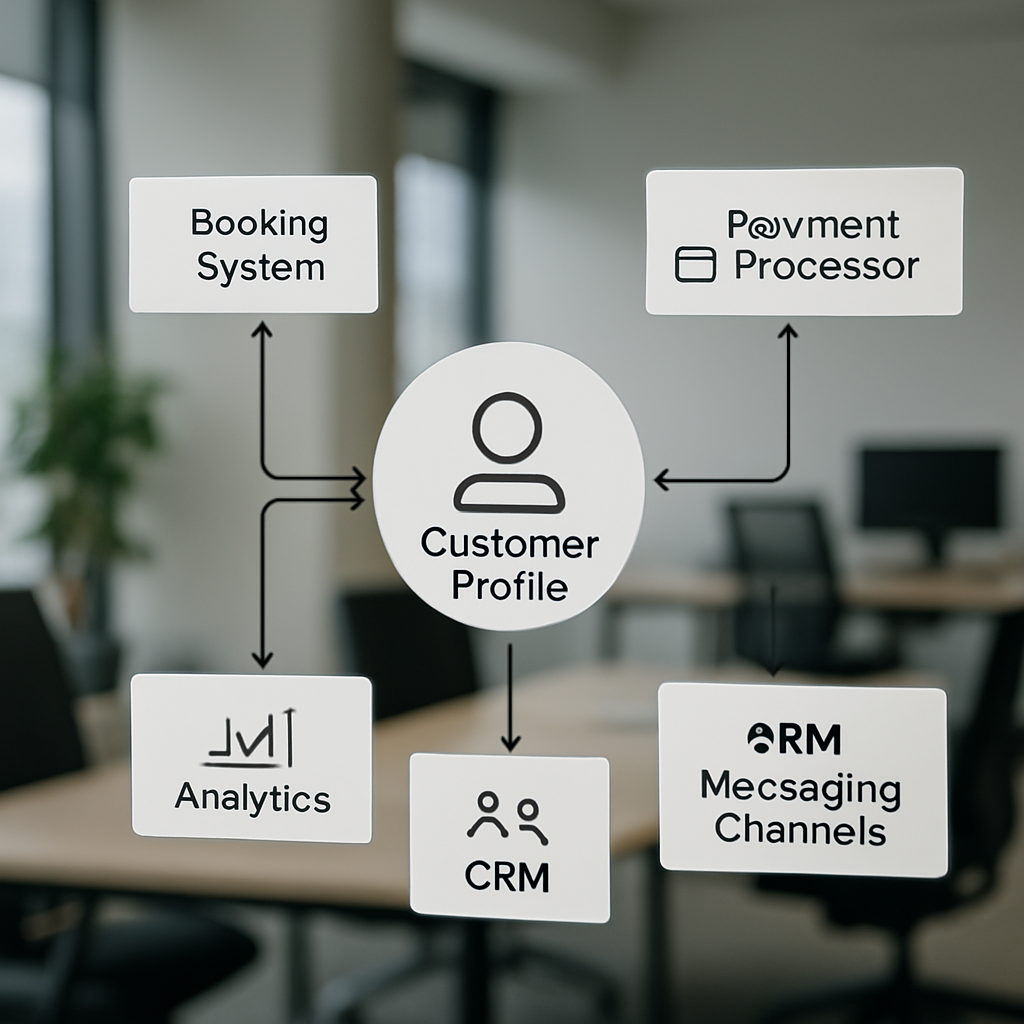
Direct payoff today: Gleantap customers do not need to wait for a full enterprise CDP rollout to get value. Use Gleantap Customer Profile as the activation layer while a CDP handles heavy lifting around identity, enrichment, and consent propagation — or run Gleantap alone for fast, tactical wins when engineering bandwidth is limited.

Two practical integration patterns and when to pick each

Layered approach (recommended for scaling): Send raw events and membership records into a CDP for identity resolution, enrichment, and audience building; export target audiences into Gleantap for messaging orchestration, A/B workflows, and loyalty triggers. This splits responsibilities cleanly and keeps messaging logic in Gleantap where your marketers work.

Gleantap-first approach (fastest to launch): If you need an immediate retention or reactivation flow and lack engineering support, assemble profiles inside Gleantap from your POS, membership system, and email/SMS logs. Works well for single-location or small multi-site businesses but becomes fragile as channels and devices multiply.

  • Trade-off: Layered approach reduces profile duplication and improves cross-device accuracy but adds vendor cost and a short integration layer to maintain.
  • Limitation: Gleantap-first is quicker but risks fragmented identity across devices and limited deterministic matching when you need cross-device attribution or ad activation.
  • Judgment: For groups with recurring contact volumes above low four figures and ambitions for paid reactivation ads, invest in a CDP for identity now; otherwise, start in Gleantap and document the migration path.

Concrete example — reactivation flow using attendance + POS data

Concrete Example: Combine membership status, last-attendance date, and a 90-day lapse flag to create a target audience in your CDP; enrich with lifetime spend from POS; push that audience to Gleantap to run a personalized SMS sequence offering a discounted class pack. Track redemptions and incremental revenue by holding out 20 percent of the audience for measurement.

  1. Quick wiring checklist: Map identity keys (email, phone, membership_id) and ensure they flow into the CDP and Gleantap consistently.
  2. Consent: Propagate consent signals from signup and web preferences from the CDP into Gleantap so messaging honors user choices.
  3. Enrichment: Attach lifetime spend and attendance recency in the CDP instead of computing them ad hoc in Gleantap for consistent segmentation.
  4. Activation endpoints: Configure CDP exports to Gleantap via API or webhooks and set up server-side ad sync for paid channels to avoid pixel loss in cookieless environments.
  5. Measurement owner: Assign a marketing owner, a data steward, and a legal reviewer for each flow; document expected metric lifts and the holdout methodology.

Pilot next step: Start a one-week pilot: connect membership and POS to Gleantap Customer Profile, create the lapsed-audience, and run a single SMS reactivation. If you plan to scale audiences to advertising or need cross-device joins, shortlist a CDP and run a 2-week proof of concept.

A final practical note: Many teams overestimate the difficulty of routing audiences between tools. The harder decision is ownership: treat the CDP as truth for identity and Gleantap as truth for messaging. That boundary keeps profiles accurate and workflows manageable while you scale.

Frequently Asked Questions

Practical answers only: below are the questions you will actually use when planning or buying for CDP first-party data — not marketing fluff. Each answer focuses on trade-offs, what usually goes wrong, and the one action you can take immediately.

What is a realistic time-to-value for a CDP first-party data pilot?

Short answer: you can validate an activation in 30 to 60 days if you scope tightly. Why it slips: connector gaps, poor source data, or unclear identity keys add weeks. Prioritize one high-value use case, two data sources, and a single activation endpoint to prove impact quickly.

Can a CDP handle consent and compliance on its own?

No — not alone. Modern CDPs ingest and honor consent signals and can enforce suppression during activation, but they are not a substitute for an organization-level consent policy, legal review, or a dedicated consent management platform when you need full auditability and UI for customers. Treat the CDP as part of the compliance stack, not the entire stack.

Which identity matching approach should membership businesses favor?

Prioritize deterministic matching using email, phone, and membership ID. For gyms and studios these keys are high quality and high value. Probabilistic linking adds complexity and little incremental value after cookies disappear — it also increases privacy risk and makes compliance harder.

How can I measure incremental impact without running a full-scale RCT?

Use pragmatic tests: a short randomized holdout for a pilot channel, a time-based cohort comparison, or geo splits when feasible. Holdouts are the cleanest; time-cohort tests are faster but vulnerable to calendar effects. Always choose one primary KPI and limit the window to avoid drift.

What hidden costs do teams underestimate?

Budget for people and ops, not just seats. Expect costs for mapping and cleanup, ongoing data quality monitoring, connector maintenance, data egress (if you move profiles out), and legal governance. Vendor pricing often hides the work required to keep profiles accurate.

If engineering bandwidth is limited, what is the fastest path to value?

Buy integrations, not promises. Choose CDP solutions with managed connectors or partner implementations and limit custom sources for phase one. Alternatively, use a layered approach where the CDP handles identity and unification and a specialist like Gleantap handles messaging orchestration and quick activation. See Gleantap Customer Profile for a practical activation layer you can plug into.

Concrete example: A mid-size gym ingested POS transactions and class attendance into a CDP, resolved members by phone and membership ID, then triggered an SMS offer after three missed classes. They deployed an 8-week randomized holdout; the activation group showed a measurable lift in attendance and rebookings within two months, and the CDP handled identity while the messaging platform executed the offers.

Key action: pick one pilot, pick two sources, and pick one activation channel. Run a 30–60 day test with a small holdout. Score vendors only against that pilot.

Tradeoff to accept: faster pilots mean narrower scope; broad unification projects rarely deliver quick ROI.

  • Next step (30 days): Inventory the two data sources you will connect, record the identity keys, and assign a data steward.
  • Next step (60 days): Run the pilot activation with a randomized holdout and capture activation volume, conversion lift, and revenue per cohort.
  • Next step (90 days): Review results, document mapping and governance, and decide whether to scale connectors or switch to a vendor with stronger integration support.
Data Privacy and Compliance in Customer Data Platforms

CDP data privacy is the gatekeeper between useful personalization and regulatory, financial, and reputational harm. This practical guide shows heads of marketing, product, and ops at B2C businesses how to evaluate, configure, and operationalize privacy and compliance controls in a CDP by mapping legal obligations to vendor features, technical checks, and operational runbooks. You will find concrete checklists, vendor verification tests, and step-by-step workflows for consent orchestration, automated data subject requests, field-level protections, and residency controls so you can centralize customer data safely and lower compliance risk. It also explains why a Customer Data Platform is the foundation of omnichannel engagement—unifying customer data across touchpoints to enable consistent, personalized experiences at scale while maintaining compliance.

Regulatory landscape most relevant to B2C CDPs

Plain fact: compliance obligations dictate CDP architecture decisions, not the other way around. CDP data privacy requirements determine what you can ingest, how long you store attributes, what profiling is allowed, and which downstream activations are lawful. Treat legal regimes as engineering constraints during vendor selection and implementation.

Core laws and the specific obligations that matter for CDPs

  • GDPR (EU): Lawful basis for processing, purpose limitation, data minimization, retention limits, and enforceable data subject rights that require export, rectification, and erasure capabilities.
  • CCPA / CPRA (California): Consumer rights to access, deletion, and opt out of sale or sharing – impacts profiling, data mapping, and consent-or-opt-out enforcement for targeted advertising.
  • HIPAA (US health sector): If the CDP processes protected health information on behalf of a covered entity or business associate, technical and contractual safeguards apply including BAA requirements.
  • Brazil LGPD: Similar to GDPR on lawful processing, with extra emphasis on cross border transfer rules and local authority cooperation.
  • APAC PDPA variants: Often focus on consent and notice; regional deployments or pre-ingest filtering reduce transfer risk.

Sector triggers and tradeoffs: collecting a health attribute for personalization can convert ordinary PII into regulated PHI under HIPAA – the practical tradeoff is between richer personalization and much greater contractual and technical burden. Likewise, collecting childrens birth dates or account details for family entertainment center loyalty programs may trigger COPPA-like obligations which demand parental consent and stricter retention.

Concrete example: A midmarket fitness chain collecting wearable heart rate data and medical notes for class recommendations must decide if that data will live in the CDP. If medical staff or a partnered clinic also manages those records, HIPAA likely applies and the operator must use a CDP deployment with a BAA, field level encryption, and strict access controls. Without that, ingesting the data exposes the business to regulatory and contractual risk.

  • Use case – GDPR, fitness club: Consent must be explicit for profiling that uses health adjacent signals. Implementation requires recording consent version, linking consent flags to profiling engines, and honoring opt outs across marketing destinations.
  • Use case – CCPA, retail loyalty program: Consumers can request portability or deletion of their loyalty profile. The CDP must support unified export and an erasure cascade to downstream ad partners and CRM systems.
  • Use case – HIPAA, healthcare clinic: The CDP must operate under a BAA, segregate PHI fields, and log every access. Profiling for treatment coordination may be allowed, but marketing activations are curtailed by PHI rules.

Key judgment: Vendor claims of being compliant are not sufficient. Insist on evidence – current SOC or ISO reports, a signed DPA or BAA where relevant, and testable technical controls like field level encryption and deletion APIs.

Action items: evidence to collect per law – Maintain a packet for auditors and vendors that includes: 1) a lawful basis mapping spreadsheet for GDPR/LDGP, 2) data inventory export from the CDP showing schemas and retention tags, 3) retention policy documents, 4) vendor DPA or BAA, 5) proof of consent capture and stored versions, and 6) sample audit logs showing DSR completions. Use these during procurement and quarterly reviews.

Mapping privacy principles to CDP architecture

Practical rule: map every legal privacy principle to a specific CDP control before you start sending production events. Treat principles as engineering tickets with acceptance criteria, not as high‑level policy statements.

Core mapping: principle -> CDP feature -> what to test

Privacy principleCDP architectural controlOperational step to validateReal world tradeoff
Data minimizationSchema gating and selective ingestion rulesAttempt to ingest a superset event; verify the CDP rejects or strips fields marked forbiddenReduces analytic breadth; expect some loss in signal for micro‑segmentation
Purpose limitationAttribute purpose tags + destination gatingCreate attribute with purpose marketing; try to forward to analytics and advertising destinations and confirm enforcementAdds mapping overhead; requires ongoing governance to keep purpose tags accurate
Retention limitsPer‑attribute retention metadata + automated deletion jobsSet short retention on sensitive fields; run deletion job and verify downstream cascadeFrequent deletes increase complexity for historical reporting and long‑term modeling
AccuracyData lineage, reconciliation jobs, and writeback mechanismsIntroduce corrected value upstream; confirm CDP updates unified profile and logs change eventWritebacks can cause sync conflicts with legacy systems; define master record rules
AccountabilityImmutable audit logs, access controls, and DPIA links to schemasReview an access log for a sample profile and trace it to a DPIA entryAudit tooling is often verbose; invest in searchable log retention to make audits practical

Key operational insight: gating at ingestion is the highest‑leverage control. If you prevent sensitive or out‑of‑scope attributes from entering the CDP, you avoid a cascade of downstream controls, complex deletion workflows, and expensive contractual obligations such as BAAs.

  1. Implement purpose tags first: add a purpose column to your CDP schema and require product owners to declare purpose before new attributes are accepted.
  2. Automate retention enforcement: schedule deletion jobs per attribute rather than per table so you don’t have to rebuild retention logic when schemas change.
  3. Test downstream enforcement: during onboarding run integration tests that exercise advertising, CRM, and analytics destinations to confirm purpose/consent flags block or allow flows as intended.

Concrete example: A regional retail chain used purchase velocity and in‑store Bluetooth location events to predict churn. They added a purpose tag indicating analytics only, configured the CDP to block forwarding of location events to ad networks, and set a 30‑day retention on raw location pings. The result: the predictive model kept enough signal to work while advertising partners never received raw location data that could be re‑identified.

Practical checkpoint: at vendor selection demand a demo where the vendor: 1) shows schema purpose tagging, 2) runs an ingestion that is selectively stripped, 3) executes an attribute deletion and shows audit evidence. If any step is manual in the demo, treat it as a missing feature.

Judgment: purpose tags and ingestion gates are necessary but insufficient; enforcement must be verified across every downstream integration and surfaced in audits. Vendors often show tagging UI but fail to demonstrate automated enforcement — that is where most CDP data privacy failures occur.

Technical controls to require from a CDP vendor

Insist on testable, contractual controls — not feature promises. For practical CDP data privacy you must convert each security or privacy claim into a concrete capability you can verify during procurement and after go‑live. Vendors commonly market broad terms like privacy‑first or encrypted; your job is to force those into measurable requirements and acceptance tests.

Core technical controls to demand

  • Customer‑managed keys (BYOK): vendor supports BYOK with integration to your KMS, documented key rotation, and proof that keys can be revoked to render stored blobs unreadable.
  • Field‑level encryption and tokenization: ability to encrypt or tokenize sensitive attributes at ingestion so raw values never appear in logs or downstream destinations.
  • Deterministic vs non‑deterministic hashing: support both modes with salt management; require proof that deterministic salts are isolated and rotated securely.
  • Attribute‑level RBAC and policy engine: enforce who can read, write or activate specific attributes; policies should respect consent flags at enforcement time, not just in UI.
  • Immutable, searchable audit logs: append‑only logs with tamper evidence, exportable to SIEM for correlation and long‑term retention.
  • Deletion and erasure APIs with cascade evidence: programmatic erase that returns verifiable receipts when data is removed from the platform and downstream partners.
  • Regional data residence controls: selectable storage regions or pre‑ingest filtering so you can avoid cross‑border transfer entirely for sensitive cohorts.
  • Secure connector framework: vetted outbound connectors with allowlist controls and runtime validation to block unauthorized destinations.

Practical tradeoff: field‑level encryption and BYOK materially reduce exposure but increase latency, CPU cost, and operational complexity for analytics pipelines. Pseudonymization preserves analytic joins at much lower performance cost, but it requires a secure, auditable re‑identification workflow and stricter access controls. Choose based on whether you need live re‑identification or only aggregated analytics.

Concrete example: A midmarket healthcare clinic configured a CDP to pseudonymize patient identifiers for modeling while keeping PHI fields encrypted with customer‑managed keys. Analysts ran cohort queries without access to raw identifiers; clinicians accessed re‑identification through a logged API that required service account MFA and returned a signed audit entry for every lookup.

Verification checklist for procurement and audits

  1. Request a short demo that performs a live field encryption ingest, then shows latency and CPU metrics for that flow.
  2. Obtain a signed sample audit log and verify it contains read/write events with immutable sequence IDs you can import into your SIEM.
  3. Ask for a scripted DSR run: submit an erasure via API and receive a deletion receipt plus downstream webhook confirmations within the stated SLA.
  4. Validate salt/key rotation: vendor shows key rotation logs and demonstrates that rotated keys prevent decryption of newly revoked exports.
  5. Confirm regional deployment: vendor provides account topology diagram showing separation between regions and a plan for segmented backups.

Clause to insist on in the DPA: BYOK support or equivalent key controls, deletion SLA and receipts, audit rights with sandbox access, 30 day subprocessor change notice, and breach notification within 72 hours. Get SOC or ISO reports as evidence and require periodic replayable tests of DSR and deletion flows.

Takeaway: make controls contractually required and operationally verifiable. Plan for the performance and analytics tradeoffs up front, and require vendors to demonstrate the exact APIs and proofs you will rely on for audits and DSRs. For guidance on evidence to request, see Gleantap security and baseline legal references like GDPR overview.

Operational governance: processes, contracts, and evidence

Operational governance determines whether CDP data privacy is auditable or accidental. Good controls are operational artifacts you can point to under pressure—signed DPIAs, reproducible deletion receipts, a consent ledger export—not slogans on a vendor website.

Start by treating governance as a delivery stream: product, legal, security, and ops own discrete deliverables with SLAs. If you leave ownership fuzzy, remediation becomes firefighting. Assign a single custodian for the CDP evidence folder and require change notifications before any schema or connector change.

Core processes to implement first

  1. Evidence pipeline: Define how artifacts flow into a shared evidence store (DPIA PDFs, executed DPAs/BAAs, sample audit logs, deletion receipts).
  2. Change gating: Require a privacy ticket with purpose tag, retention tag, and risk score before accepting new attributes or destinations.
  3. Access lifecycle: Automate role reviews and require justification for attribute-level access; revoke after project completion.
  4. DSR orchestration: Route intake to an automated DSR tool and require the CDP to return a signed completion token for every request.

Tradeoff to accept: stricter gates slow product experiments. The right pattern is risk‑based gating: fast path for safe attributes, full review for sensitive or regulated fields. That preserves velocity while preventing costly exposures.

Artifacts auditors will actually ask for

  • A replayable test script that demonstrates a deletion request from intake to downstream receipts (timestamps and webhook logs).
  • A sample consent ledger export with version, source URL, IP, and consent string or reference to CMP records.
  • Proof of key control: KMS configuration snapshot showing which keys protect which buckets and evidence of rotation events.
  • Recent access review report showing attribute owners and approvals, plus a changelog for each approval.

Concrete example: A family entertainment center added a birthday‑party signup form that captures childrens age. They implemented a parental verification step, blocked that cohort from ad destinations via a pre‑ingest filter, stored consent records linked to the sign up form URL, and kept a deletion audit for parental requests. That set of artifacts made a regulator audit straightforward and avoided a disruptive product rollback.

Common misstep: teams assume the CDP vendor will handle governance work. In practice vendors provide primitives; you must build the runbook, test scripts, and contractual obligations that turn those primitives into defensible evidence. Insist on replayable demos during procurement—ask vendors to run your script, not theirs.

90‑day governance sprint priorities: 1) Lock an evidence folder and ingest baseline artifacts, 2) Implement a change gate for new attributes, 3) Automate one DSR flow end‑to‑end and capture deletion receipts.

Next consideration: after you have processes and artifacts, schedule quarterly dry runs that simulate regulator requests and post‑mortem any gaps—this is where governance converts into lasting compliance, not just a binder on a shelf.

Consent and preference orchestration with CMPs

Make the CMP the canonical consent ledger and the CDP the enforcement layer. Treat the consent management platform as the source of truth for who agreed to what, when, and under which terms; the CDP’s job is to consume that signal and enforce it across schemas, destinations, and downstream jobs.

Practical nuance: consent is not a single boolean. You need per-purpose, per-channel, versioned records with provenance (capture URL, IP, timestamp) and a durable reference to the CMP record. IAB TCF strings are useful for programmatic advertising but do not replace first-party consent flags you use for direct email, in-app messaging, or health‑adjacent processing under GDPR or HIPAA. Map both, but do not conflate them.

Five integration checkpoints

  1. Capture: store a consent object at point of capture that includes purpose IDs, version, and a CMP reference ID rather than only toggling a profile field.
  2. Persist: write consent as an append‑only ledger in the CDP with timestamp and source so you can reproduce state at any historical moment for audits.
  3. Map: translate CMP purposes to CDP attribute and destination policies; maintain a mapping table that product owners can update with approvals.
  4. Enforce: gate destinations at activation time using the current consent state; prefer real‑time webhook enforcement for ad networks and queued enforcement for batch exports.
  5. Audit & recover: emit deletion/deny receipts, record enforcement decisions, and keep a replayable log so you can demonstrate compliance or roll back an activation.

Tradeoff to accept: strict real‑time enforcement increases architectural complexity. Blocking at ingestion is safest but reduces flexibility for retrospective analytics. If you choose post-ingest enforcement, build robust backfill and rollback flows and accept the longer verification window for revocations.

Concrete example: A regional fitness chain uses OneTrust to capture two consents on class sign‑up: one for marketing and one for sharing anonymized attendance with partner analytics. The CMP writes a versioned consent record; the CDP ingests that record, tags attendance events with the consent version, and blocks any export of raw attendance or health signals to ad platforms unless the marketing consent is present. When a member revokes marketing consent, the CDP immediately stops activations and issues a deletion receipt for any queued exports.

Judgment: dashboards are nice, but what matters in audits is machine‑readable evidence. Demand API‑first flows: webhooks for change events, exportable consent ledgers, and enforcement receipts. During procurement, require vendors to run your script that simulates capture, revocation, and downstream blocking — accept nothing less than replayable proof.

Key takeaway: design consent as data: capture versioned CMP records, persist an append‑only ledger in the CDP, map purposes to enforcement policies, and require replayable logs and receipts to prove compliance. For legal context, see GDPR overview and confirm vendor controls against your evidence folder in Gleantap security.

Automating data subject rights and request orchestration

Direct point: automation of data subject requests is not optional for reliable CDP data privacy — it is the operational core. Manual DSR handling scales poorly, creates audit gaps, and is the usual cause of regulator findings. An automated pipeline reduces human error but only if it ties identity verification, cataloged connector behavior, and verifiable receipts together into a single runnable workflow.

Core technical and operational controls

What to require: a CDP deployment that supports programmatic erasure and export via APIs, an indexed mapping of which attributes live in which downstream systems, append-only receipts for every action, and integration points for DSR orchestration platforms such as Transcend, Securiti, or OneTrust. Add an anti-fraud verification step, rate limiting, and a reconciliation engine that proves a cascade completed successfully.

  1. Step 1 – Intake and verification (SLA: 0-4 hours): accept requests through verified channels, run identity proof checks or OTP flows, and tag the request with a confidence score before processing.
  2. Step 2 – Locate and map (SLA: 1-2 hours): query the CDP for the canonical profile plus a connector inventory showing which downstream systems hold related records; produce a runnable execution plan.
  3. Step 3 – Prepare execution units (SLA: 1 hour): split the request into atomic tasks (export profile, erase PII, redact event history), queue tasks with connector-specific parameters and safety checks.
  4. Step 4 – Execute with transactional receipts (SLA: same day for most connectors): call DELETE or erase APIs, or run allowlisted retention jobs; collect signed receipts or webhooks from each destination.
  5. Step 5 – Reconcile and escalate (SLA: 24-72 hours): compare expected versus actual receipts, surface failures for manual resolution, and produce an audit package that includes timestamps, requestor verification, and receipts.
  6. Step 6 – Aftercare and system hygiene (SLA: 72 hours): tombstone identifiers, refresh models that used the data, and mark downstream cached artifacts for purge or aggregation review.

Concrete example: A regional fitness chain receives a portability request that includes class attendance and email history. The intake system verifies identity via a linked phone OTP, the CDP maps the profile to CRM, email provider, and ad partner connectors, and the orchestration engine issues exports for portability while sending DELETE calls to the email provider. The system returns a signed deletion_receipt for the email provider webhook and a consolidated JSON bundle for the member within 24 hours.

Tradeoffs and limits: full cascade erasure depends on third parties supporting programmatic deletion. Expect gaps with legacy partners; plan for legally defensible compensating controls such as pseudonymization, tombstoning, or contractual deletion commitments. Also accept some friction: stronger identity verification reduces fraud but increases request friction and SLA pressure. In practice the biggest failure mode is proof generation — if you cannot produce machine readable receipts, you have not automated the DSRs.

Actionable demand for procurement: require vendors to run your DSR script during the POC, produce deletion_receipt tokens and connector webhooks, provide a connector inventory API, and supply a replayable audit package. For legal context and evidence templates consult GDPR overview and your vendor evidence folder such as Gleantap security.

Data residency, cross border transfers, and evidence for auditors

Hard choice, practical consequences: pick a residency approach up front because it changes contracts, architecture, and the evidence you must produce. CDP data privacy is not solved after go‑live; it is enforced through region‑by‑region design choices and repeatable proofs that an auditor can verify.

Residency approaches that actually work in production: deploy vendor tenancy in the target region, maintain separate cloud accounts per region, or filter and pseudonymize data before it leaves the source. Each option trades cost, latency, and analytic completeness: regional tenancy costs more but minimizes transfer controls; pre‑ingest filtering is cheapest but removes cross‑border features.

Cross‑border transfer mechanisms and what auditors will check

Standard mechanisms include Standard Contractual Clauses (SCCs), Binding Corporate Rules (BCRs), and adequacy decisions. Auditors will not accept high‑level references — they want the executed legal texts (signed SCC annexes or BCR approval), plus a transfer impact assessment that shows how access by foreign authorities or subprocessors is mitigated.

Common misconception: strong encryption alone rarely eliminates transfer obligations. If your CDP vendor or their key custodian is outside the originating jurisdiction, regulators will treat transfers as occurring unless technical and contractual barriers demonstrably prevent re‑identification and access.

Operational tradeoff to plan for: enforce local storage and backups to reduce regulatory risk, but accept increased engineering work for cross‑region joins and longer maintenance windows. Alternatively, centralize analytics under consented cohorts and keep raw PII local — this preserves models while reducing legal exposure, but requires robust pseudonymization and a secure re‑identification process.

Concrete example: a pan‑EU retail group routed EU member profiles into an EU‑only CDP tenancy and used SCCs for a US‑based analytics provider. They pseudonymized identifiers before export and retained key material in an EU KMS. During audits they presented the executed SCC annex, the KMS config showing EU key residency, flow logs proving routing rules, and sample deletion receipts for erased exports — this combination satisfied both technical and contractual checks.

What auditors actually ask for (not what sales decks show): network and routing logs with timestamps, signed transfer clauses, sub_processors register with change notices, KMS snapshots with key owner details, backups and DR topology by region, DPIAs and transfer impact assessments, and sample execution evidence such as deletion receipts and connector webhooks.

Audit evidence checklist: executed SCCs/BCRs, DPIA + transfer impact assessment, architecture diagram with region labels, KMS configuration export, backup/DR location proof, sub_processors list with 30 day notice clause, sample deletion/export receipts, and connector routing logs. Request these artifacts in the RFP and include them in the DPA.

Judgment: make transfer controls contractual and observable. Put residency and key‑holding clauses in the DPA, require automated routing tests in the POC, and enforce a quarterly verification cadence. Without those steps, you buy a feature set, not a defensible compliance posture.

Next consideration: decide the residency policy before finalizing the vendor DPA and make proof artifacts a non‑negotiable part of your acceptance tests — auditors will want the artifacts, not assurances.

Vendor selection scorecard and phased migration checklist

Hard requirement: convert CDP data privacy into a measurable vendor scorecard and a phased migration plan before any contracts are signed. Vendors sell capability stories; your job is to translate those stories into weighted criteria, POC scripts, and contract clauses that prove the claims under pressure.

Vendor scorecard with verification steps

CriterionWeightPOC verification stepContract clause to require
Privacy controls (field level encryption, BYOK, DSR APIs)30%Ingest a sensitive attribute, request a DELETE via API, and produce deletion_receipt plus downstream webhook confirmationsBYOK support, deletion SLA with receipts, audit rights
Integrations and enforcement (CMP, ad networks, CRMs)20%Simulate consent capture, revoke consent, and show real time blocking for at least three destinationsSubprocessor list, 30 day change notice, enforcement guarantee
Operational features (audit logs, RBAC, DSR orchestration)15%Run role based access test and request a sample immutable audit log export for a profileImmutable log export rights, SLAs on access review support
Total cost of ownership (licensing + egress + engineering)15%Present a cost projection for a 12 month run including estimated egress for backups and analytics joinsTransparent billing terms and egress caps
Support, SLAs, and responsiveness10%Time a support runbook execution in the POC and measure response and remediation speedSLA with escalation path and remediation credits
Certifications and audits (SOC2, ISO, DPIAs)10%Request the latest audit reports and confirm they cover the specific tenancy you will useProvide recent SOC/ISO reports and DPIA templates

Practical insight: weighting matters because the highest privacy value often reduces product velocity. If you give privacy controls an outsized weight you will pay in latency and engineering time. If you underweight them you will inherit audit and legal friction. Choose weights that match your highest risk vectors – for example a healthcare adjacent operator must bias toward privacy controls and certifications.

Phased migration checklist

  1. Phase 0 – Discovery and RFP: catalogue sensitive fields, map regulatory triggers, and send the scorecard plus a runnable POC script to shortlisted vendors.
  2. Phase 1 – POC with synthetic or anonymized data (2-4 weeks): execute the POC script that includes ingest, field encryption, consent revoke, DSR DELETE, and audit log export. Accept only vendors that run your script verbatim.
  3. Phase 2 – Pilot parallel run (4-8 weeks): run a small live cohort in parallel to production with full observability on consent enforcement and DSR completion rates; measure DSR SLA and consent enforcement rate as success metrics.
  4. Phase 3 – Cutover and monitor (1-2 weeks): switch traffic for defined segments, monitor failure and rollback criteria, keep previous pipeline hot for 7 days as a rollback window.
  5. Phase 4 – Post cutover validations and hardening (ongoing): schedule weekly audits for first 90 days, load test DSR flows monthly, and codify any operational gaps into change tickets.

Tradeoff to plan for: a parallel pilot protects consumer data but doubles integration work for a short period. Expect connectors to behave differently under real traffic; allocate engineering time to fix connector edge cases rather than assuming parity.

Concrete example: A regional retail chain migrated loyalty profiles by running a 6 week pilot for 10 percent of members. They verified consent enforcement for email and ad networks, executed three sample DSRs with full receipts, and measured a 60 percent reduction in manual DSR work. Because they required BYOK and deletion receipts in the contract, auditors accepted the migration evidence without additional requests.

Require replayable POC scripts and deletion_receipt evidence during procurement. If a vendor declines to run your script in their POC environment, they are not ready for production.

Quick RFP starter questions: Does the platform support BYOK and field level encryption? Can you demonstrate programmatic DSR export and erasure with deletion receipts? How are consent signals consumed and enforced in real time? Provide the current sub_processor register and most recent SOC or ISO report.

Frequently Asked Questions

Straight answers, no gloss. Below are the operational questions teams actually run into when implementing CDP data privacy, with concise, testable guidance you can use in procurement and POCs.

Short answers you can act on

Q: Can I profile customers in a CDP under GDPR? Yes — profiling is allowed when you have a valid lawful basis such as consent or a carefully documented legitimate interest assessment. What matters in practice is demonstrable linkage between the lawful basis, recorded consent versions (when used), and runtime enforcement that prevents profiling when the basis is absent.

Q: When does fitness or wellness data trigger HIPAA‑level controls? HIPAA applies when you are processing PHI on behalf of a covered entity or as a business associate. If class medical notes, clinician inputs, or insurer transactions are routed into the CDP, treat those fields as PHI until counsel and security confirm otherwise — and demand a BAA and hardened controls from the vendor.

Q: Is tokenization a substitute for consent? No. Tokenization lowers identifiability but does not remove processing obligations for marketing and profiling. Use tokenization to reduce exposure and combine it with explicit consent mapping and policy enforcement to cover legal and operational risk.

Q: What practical evidence should vendors provide during due diligence? Ask for sample deletion receipts, a recent SOC/ISO report covering the tenancy you will use, a subprocessors register with notification terms, and KMS snapshots showing key ownership and rotation. If they balk, treat the absence as a red flag.

Q: Fastest route to automate DSRs? Integrate a DSR orchestrator (for example platforms like Transcend or Securiti) with the CDP and require programmatic erasure/export APIs. The dominant failure mode is missing receipts — automation only counts when you can produce signed proof for each connector.

Concrete example: A regional healthcare operator wired a DSR orchestration service to their CDP. A portability request triggered identity verification via OTP, the orchestrator queried the CDP connector inventory, exported a unified JSON profile, and produced deletion receipts from the email provider and CRM within one business day. The team replaced a previously manual, multi‑week process and passed an external audit with the new machine‑readable evidence.

Operational tradeoff to accept: Real‑time enforcement offers the cleanest compliance posture but increases architecture complexity and test surface. Blocking at collection removes the compliance burden downstream but limits retrospective analytics. In practice, hybrid approaches work best: pre‑ingest filters for sensitive cohorts and post‑ingest policy enforcement where latency and replayability are acceptable.

Common misjudgment: Teams assume vendor marketing language equals audit readiness. Reality: features must translate into reproducible artifacts — signed JSON receipts, webhook traces, and connector logs — that you can hand to counsel or an auditor. Insist on scripted POC runs that produce those artifacts, not vague demos.

Must‑have for procurement: require a POC script that executes: ingest of a sensitive attribute, a consent revoke, a programmatic DELETE, and signed deletion receipts from at least two destinations. Keep the script and evidence in your vendor packet for audits. For technical baseline checks, compare vendor responses to your security folder such as Gleantap security and legal references like GDPR overview.

If a vendor cannot run your test script against their POC tenancy and produce machine‑readable evidence, move on — that limitation costs far more in audit time and remediation than the vendor discount you might win.

Next concrete steps (do these this week):

  • Run one scripted DSR in the POC: have the vendor return a signed deletion_receipt and connector webhook traces.
  • Verify key custody: obtain a KMS snapshot and confirm BYOK or equivalent controls with rotation logs.
  • Map consent to actions: export a consent ledger from your CMP and ensure the CDP persists a versioned consent object with timestamps.
  • Execute an ingestion block test: attempt to send a prohibited sensitive field and confirm the CDP strips or rejects it, with audit evidence.
  • Collect contractual proof: secure a sample DPA/BAA clause that includes deletion SLAs and subprocessor notification terms.

Integrating a Customer Data Platform with Your Existing Tech Stack

Most B2C teams still stitch booking, POS, payment and analytics data together by hand, which kills velocity and personalization quality. This practical how-to walks you through CDP integration, customer data platform deployment across your existing tech stack, covering source audits, identity resolution, ingestion patterns, activation and privacy-compliant governance. We’ll start with Why a Customer Data Platform Is the Foundation of Omnichannel Engagement and finish with a 60-90 day pilot plan you can run with limited engineering resources.

Why a Customer Data Platform Is the Foundation of Omnichannel Engagement

Key point: CDP integration, customer data platform capabilities create the operational layer you need to treat cross-channel touchpoints as a single customer problem rather than a channel-by-channel problem. When identity, events and segmentation live in one governed store, activation and measurement stop fighting each other over which dataset is correct.

Core capabilities that matter: A practical CDP delivers an identity graph, a unified profile store, a persistent event timeline, a segmentation engine, and activation connectors. Each capability contributes a different kind of leverage: identity enables consistent addressing, the profile store holds state and consent, the timeline supplies temporal logic, the segmentation engine codifies audiences, and connectors operationalize actions.

  • Identity graph: resolves identifiers across sources and holds merge rules
  • Unified profiles: central traits, consent flags and lifetime revenue
  • Event timeline: ordered events for attribution and behavioral logic
  • Segmentation engine: reproducible audiences used by all channels
  • Activation connectors: reverse ETL and real-time webhooks to push decisions downstream

Practical insight: Teams make two avoidable mistakes. First, they prioritize breadth of connectors over profile quality; dozens of integrations are useless if match rates are low. Second, they treat the CDP as a passive database instead of the orchestration engine that enforces segment definitions, suppression lists and delivery rules across systems.

How this enables true omnichannel workflows

Example flow: A member books a class in Mindbody; payment is recorded by Stripe; GA4 logs a session event. The CDP unifies those inputs into one profile, applies a churn-risk segment, triggers a conditional Twilio SMS, and writes a case to Salesforce for high-touch follow up. That same profile is used to report attribution and frequency capping across email, SMS and in-app channels.

Tradeoffs and limits: Expect tradeoffs between latency and completeness. Real-time activations require streaming or SDK capture and strict schema contracts; historical analysis benefits from batch loads to the warehouse. Also, centralizing customer identity creates operational dependencies: if your CDP ingestion breaks, multiple channels will see stale data. Design monitoring and rollback paths accordingly.

Judgment: If you must choose where to invest first, prioritize identity resolution and consent handling over adding more channel connectors. In practice, a reliable unified profile and clear merge policies deliver measurable gains in personalization and attribution faster than a long list of half-working integrations.

Operational metric to track first: baseline your match rate and data freshness SLA. Use those two metrics to gate activation rollouts and to measure improvements from identity work. See CDP Institute for capability guidance.

Next consideration: map the handful of identity sources that will feed profiles (email, phone, customer_id from your booking system, and payment id), set merge rules, and measure match-rate before you switch on cross-channel campaigns. For integration references, check Gleantap integrations.

Audit Your Existing Tech Stack and Data Sources

Start with a focused inventory. Build a compact catalog of every system that holds customer signals: booking/attendance, payments, CRM, POS, web/mobile analytics and messaging platforms. For each entry record the owner, primary identifiers, sample event types, and the realistic latency you need for activation — this is the raw material for any successful CDP integration, customer data platform work.

Minimum audit outputs you should produce

SystemOwnerPrimary IDsKey eventsWhy integrate (value)
MindbodyOps leadcustomer_id, emailbooking.created, class.attendedPrevents churn; powers attendance-based offers
StripeFinancestripecustomerid, emailpayment.succeeded, refund.issuedRevenue attribution and refunds handling
GA4Growthclientid, useridpageview, sessionstartBehavioral signals for personalization

Practical prioritization rule: score sources by activation value, data cleanliness, engineering effort, and compliance risk. Then start with the top 3 that unlock revenue or critical workflows rather than trying to onboard every connector at once. That tradeoff — breadth versus depth — is what kills most CDP pilots.

  • Scorecard fields: activation impact, matchability (estimated match rate), ingestion complexity, PII/consent exposure
  • Quick tests to run: ingest 48 hours of events, compute missing timestamps, and sample identifier overlap between two sources
  • Red flags that slow projects: absent user identifiers, timezone-free timestamps, consent flags stored separately or not at all

Concrete example: A mid-size fitness chain pulled 7 days of booking and payment data from Mindbody and Stripe and found email overlap was 68% and timestamp coverage was 95%. They prioritized canonicalizing email formatting, adding server-side booking webhooks for real-time activation, and delaying less critical integrations (loyalty POS) until match rate exceeded 80%.

Limitation to accept early: if your systems lack persistent identifiers you will need either authentication events or a probabilistic stitching layer; both add complexity and lower deterministic match rates. Plan for iterative improvement, not perfect initial joins.

Deliverable you must ship from the audit: a one-page integration plan listing prioritized sources, required identifiers per source, expected latency SLA, data quality gaps, and a compliance map showing where consent flags live and how deletions are executed.

Judgment: invest audit time in identity and consent discovery before building ingestion pipelines. The technical debt of cleaning identifiers later is far higher than delaying lower-value connectors. Remember Why a Customer Data Platform Is the Foundation of Omnichannel Engagement — the CDP can only orchestrate reliably if the inputs are auditable and consistent. Next step: draft merge rules for your prioritized sources and run a match-rate simulation on a sample export.

Integration Patterns and Architecture Choices

Direct statement: Your integration pattern choice – batch, streaming, or API/webhook ingestion – determines whether your CDP is useful for same-day activations or only for reports. This is the single architectural decision that most often defines time-to-value, recurring cost, and operational burden for CDP integration, customer data platform projects.

Core patterns and the tradeoffs

Batch ETL: Nightly or hourly bulk loads into a warehouse (via Fivetran, Airbyte or Stitch) are cheap, simple and reliable for analytics and historical joins, but they are too slow for cart-abandon or live personalization workflows. Use batch when you need completeness and low engineering overhead.

Streaming / SDKs: Event streams captured by tools like Segment or RudderStack, or by using client SDKs, deliver low latency for activation and personalization. The tradeoff is cost per event, stricter schema discipline, and more operational concerns – schema drift and backpressure surface quickly. Use streaming when latency matters.

Server-side webhooks / API ingestion: Transactional systems (payments, bookings) should push authoritative events via webhooks or direct API writes to the CDP. This pattern gives accuracy for financial and lifecycle events but requires secure endpoints, retry/idempotency logic and mature error handling.

  • Practical tradeoff: Lower latency costs more operationally and financially; higher completeness requires batch reconciliation jobs and a warehouse.
  • Operational constraint: Real-time pipelines need observability, replay windows, and a clear strategy for schema changes; without these you will regress into manual fixes.
  • Vendor choice matter: Managed pipelines reduce engineering time but can lock you into pricing models and limit raw data access unless you export to your warehouse.

Recommended hybrid architecture for B2C

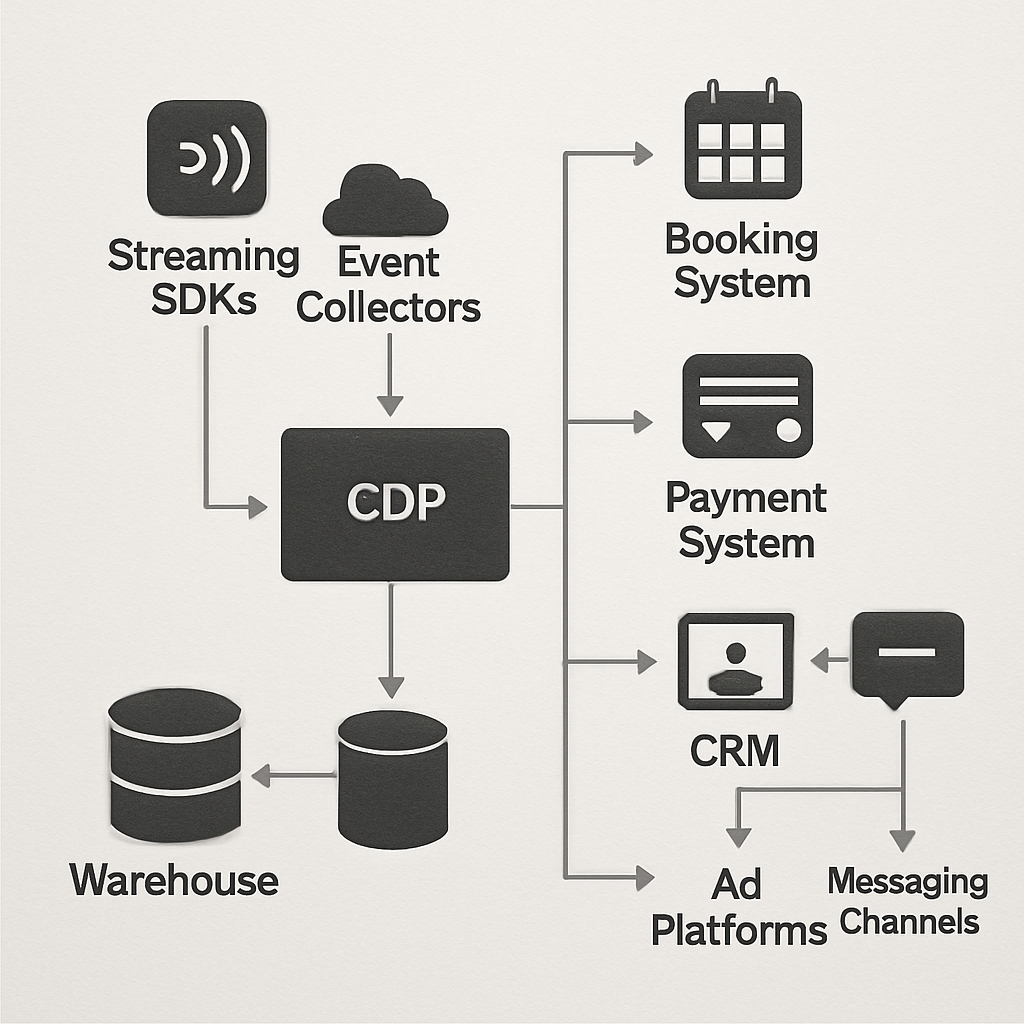
Pattern: Capture web and mobile sessions with SDK/streaming for immediate activation, accept server-side transactional events from booking and payments via webhooks, and run scheduled batch ingest for legacy systems and full-history loads into a warehouse (BigQuery, Snowflake or Redshift). Then use reverse ETL (Hightouch, Census) to push audiences back to CRM and ad platforms for operational workflows.

Concrete example: A regional fitness chain uses RudderStack to ingest real-time app events and Stripe webhooks for payments. Daily Fivetran loads feed their BigQuery warehouse for long-term cohort analysis, while Hightouch syncs targeted retention audiences to Salesforce and Facebook Ads. This mix lets staff send immediate appointment reminders while keeping revenue attribution in the warehouse.

Judgment: For most mid-size B2C teams a hybrid approach yields the best return: invest in streaming for high-value, low-latency actions and rely on batch for scale and correctness. Over-investing in universal real-time capture is expensive and often unnecessary.

Design your pipelines so the CDP can produce a single customer view without creating a single point of failure; build fallbacks that serve stale-but-correct profiles when streaming is disrupted.

Operational checklist: enforce schema contracts, add replayable ingestion, implement idempotency for activations, and set cost alerts on per-event pipelines before you enable broad real-time campaigns.

Identity Resolution and Unified Profile Strategy

Identity resolution is the single feature that determines whether your CDP integration, customer data platform yields reliable personalization or just noise. If you fail to define clear matching rules and merge policies up front, downstream segments, activation lists and attribution will be inconsistent and expensive to debug.

Fundamental choices and tradeoffs

Decide early between a conservative, deterministic-first approach and an aggressive probabilistic strategy. Deterministic matching (verified email, authenticated customer_id, phone) gives predictable merges and a low false-positive rate. Probabilistic matching (device fingerprints, IP/time heuristics) increases coverage but raises the chance of incorrect joins and complicates consent handling. The tradeoff is simple: coverage versus trustworthiness.

  • Merge policy checklist: prefer verified identifiers, tag source provenance for every trait, never overwrite a verified identifier with an inferred value, keep a timestamped audit trail for merges
  • Profile composition rule: store payment processor ids (Stripe/PayPal) as financial handles, not canonical identities; use them for revenue attribution only
  • Consent propagation: treat consent flags as first-class profile attributes and propagate them to activation connectors immediately

Concrete example: A family entertainment center used a CDP to stitch online bookings, in-venue POS, and loyalty records. They implemented deterministic joins on email and loyalty_id first, then layered a probabilistic pass to capture kiosks and guest checkout. The result: immediate improvement in campaign precision and a noticeable drop in manual deduplication work for guest services, while the product team tracked a small set of likely false-positives for human review.

You must plan for reversibility. Overmerging is common when teams prioritize match rate over accuracy. Always build an unmerge mechanism and surface a merge_confidence score on profiles so marketing and ops can opt certain customers out of automated workflows until their confidence crosses a threshold.

Practical limitation: probabilistic stitching will never reach deterministic accuracy and can increase privacy risk under GDPR/CCPA if identifiers are inferred without explicit consent.

Operational deliverable: ship a profile contract document that specifies primary identifiers, the merge priority order, conflict resolution rules, retention for PII, and the fields to propagate to activation systems. Make this contract part of your integration acceptance criteria.

Next consideration: run a 7-day match-rate experiment on your prioritized sources, capture merge confidence, and freeze activation on any segment that includes low-confidence profiles until you fix the root joins. For integration references see Gleantap integrations and Segment docs.

Data Modeling, Governance, Privacy and Security

Start with a defensive data model. If profiles contain inconsistent fields or unpredictable event attributes, every activation becomes a risk — wrong offers, suppressed messages, or worse, privacy errors. Design a canonical profile shape and minimal event schema before wiring feeds into your CDP integration, customer data platform.

Schema design and practical modeling choices

Canonical fields over free-form attributes. Define a short list of required profile fields (primary contact handle, verified identifiers, consent state, lifecycle status) and an extensible but governed bag for optional traits. Use snake_case names, a firm timestamp convention (iso8601), and a small vocabulary for event types to avoid downstream mapping work.

Tradeoff to accept: heavy normalization reduces activation errors but makes rapid feature additions slower. If product marketing frequently asks for new traits, expose a controlled feature flag process that lets engineering add attributes after a one-week review rather than allowing ad-hoc fields.

Governance, consent flows and operational controls

Governance is operational work, not paperwork. Implement automated checks: schema-contract testing on ingest, field-level validation (format, length), and a daily profile health job that flags profiles with missing legal-required attributes. Put the results on a small dashboard that ops reviews weekly.

  • Consent handling: record consent timestamp, source, and scope as immutable fields; propagate suppression lists immediately to downstream systems.
  • Data minimization: prefer tokenization or pseudonymization for activation use; retain raw PII only where required and limit access.
  • Retention and purge: automate deletion jobs with verifiable logs and a replay-safe tombstone marker rather than blind deletes.

Practical limitation: aggressive redaction reduces personalization. Tokenization or hashed identifiers let you run lookups and activations without exposing raw PII, but some vendors require cleartext for certain features (for example, carrier-level SMS delivery checks). Expect occasional tradeoffs where you must accept vendor constraints or replace the vendor.

Concrete example: A multi-location fitness brand kept full emails for billing but wrote a service to serve tokenized email hashes for marketing activations. Consent flags in the CDP were the single source of truth and were pushed to Twilio and Salesforce via sync jobs. When a member requested deletion, the system recorded a tombstone, removed raw email from storage, and pushed a deletion event to downstream connectors — that auditable flow avoided a compliance incident during a privacy audit.

Security measures that actually matter: enforce transport and at-rest encryption, implement field-level encryption for high-risk attributes, rotate and scope API credentials, require MFA for console access, and run quarterly access reviews. SOC2 or ISO certification is useful but treat those reports as hygiene — your alerting, key management and data flows are what prevent breaches.

ControlWhere to implementWhy it matters
Field-level tokenizationIngest service / CDP connectorAllows activations without exposing raw PII
Consent propagationCDP mapping + reverse ETL jobsPrevents sends to suppressed contacts and legal exposure
Audit trail & tombstonesProfile store + warehouseProvides verifiable deletion/compliance evidence

Key judgment: do not treat privacy as an API toggle. Early investment in tokenization and automatic suppression propagation costs time up front but prevents expensive rewrites and legal risk later.

Operational metric to monitor: track consent propagation latency (time from a consent change to suppression in all activation targets), percentage of profiles with tokenized PII, and the success rate of deletion propagation. Use these to gate activation rollouts.

Activation, Orchestration and Reverse ETL

Direct point: Activation and orchestration are the operational surfaces where a CDP delivers business value — and reverse ETL is the practical plumbing that makes those values visible in CRM, ad platforms, and messaging tools. Treating reverse ETL as an afterthought turns your CDP into a reporting store; treating it as the integration budget item gets you automated outreach, better handoffs to sales, and measurable lifts.

Activation needs are simple in description and fiendish in execution: consistent audience logic, reliable delivery, and traceable outcomes. The engineering problems you will hit first are mapping schema differences, enforcing idempotency for repeated syncs, and ensuring consent/deletion flows travel with the profile to every downstream write target. Practical solution: centralize audience definitions in the CDP, export attribute snapshots rather than raw event streams, and enforce write contracts on each destination.

Design rules that prevent common failures

  1. Audience-as-code: store segment logic in the CDP and version it; avoid recreating segments in multiple systems.
  2. Snapshot syncs for enrichment: push an attribute set (customerid, tier, lastactive, churnscore, consentstate) at controlled intervals instead of row-level event writes.
  3. Destination contracts: require a field-level spec for each target (CRM, ad platform, ESP) including idempotency key and allowed write operations.
  4. Audit-first pipelines: always emit a reconciliation record to your warehouse so you can compare intended vs applied changes.

Tradeoff to accept: high-frequency reverse ETL (near real-time) reduces latency but multiplies failure modes and cost. For many mid-market B2C teams the sweet spot is sub-hourly enrichment for CRM and minute-level webhooks for critical transactional triggers (bookings, cancellations). Use batch backfills for cohorts and daily revenue syncs.

Concrete example: When a member cancels a class, the CDP marks the profile with churnrisk=true and lastcancellation timestamp. A reverse ETL sync (using Hightouch or Census) writes a field snapshot to Salesforce within 5 minutes so the membership team sees the change in the contact record, while a webhook fires a conditional Twilio SMS for immediate retention outreach. The two paths — CRM enrichment and real-time messaging — are treated separately but driven from the same authoritative profile.

Important: reverse ETL is state synchronization, not an event bus. Design it to correct state in destination systems rather than replay every event.

A frequent misunderstanding is that more destinations equals more value. In practice, more destinations without clear field contracts create data drift and compliance risk. Limit initial write targets, prove the closed-loop measurement (send → engagement → CRM update → pipeline movement), then scale. Use Gleantap integrations as a reference for connector capabilities and consent propagation behavior.

Operational deliverable: a reverse ETL runbook that lists each destination, the exact fields to write, sync frequency, idempotency key, retry policy, and GDPR/CCPA handling steps. Ship this before you enable any automated writeback.

Implementation Roadmap, Testing and Measurement

Start with a gated pilot, not a big-bang rollout. Build a short, measurable sequence of work that proves ingestion, identity stitching, and one activation path before scaling to every source and channel.

60–90 day phased roadmap (practical cadence)

  1. Phase 0 — Prep (days 1–7): finalize owners, freeze the canonical profile schema, and produce a minimal event catalog that lists the one-time fields required for target activations. Assign a single data owner and an integration engineer.
  2. Phase 1 — Core ingestion (weeks 2–4): wire authoritative sources via webhooks or API (booking, payments, analytics), implement basic transformation and tokenization, and run a 7-day ingest sanity check to validate timestamps, IDs and duplicate rates.
  3. Phase 2 — Identity and shallow activation (weeks 5–8): enable deterministic joins, tag merge confidence, and switch on one low-risk activation (for example, appointment reminders via Twilio or a CRM enrichment sync). Keep a canary cohort under manual review.
  4. Phase 3 — Pilot measurement and hardening (weeks 9–12): run lift tests using holdouts, reconcile activation logs with warehouse records, formalize retention/cleanup jobs, and document runbooks for downstream owners before wider rollout.

Roles that make this work: dedicate a data owner (business lead), an integration engineer, a privacy officer, and a measurement analyst. Decision bottlenecks occur when ownership is split; designate who can green-light go/no-go gates for each phase.

Testing and validation strategy

Tests to run (practical list): contract validation for all incoming payloads, identity merge simulations with synthetic edge-cases, high-volume ingestion stress runs, end-to-end activation dry-runs (messages written to a sandbox), and reconciliation jobs that compare intended writes to applied changes in destinations.

Important tradeoff: extensive test coverage reduces risk but slows time-to-value. Use progressive exposure: run exhaustive tests in staging, a short canary on real traffic, then expand only after acceptance criteria are met. Production-only testing is risky; over-testing in staging can obscure environment differences — include a brief real traffic canary step.

Measurement approach: treat campaigns as experiments. Use randomized holdouts or geo-based controls, instrument a small set of primary KPIs (identity coverage, ingestion latency percentiles, profile completeness, and activation delivery reliability), and capture secondary business outcomes (engagement, conversion, retention) with attribution windows tied to the activation timeline.

Concrete example: A regional wellness studio implemented the pilot above: they ingested booking webhooks and Stripe events, enabled deterministic joins on verified email, and ran a two-week holdout where the CDP-driven SMS workflow was only applied to half of overdue-booking customers. The team used reconciliation logs to find mapping errors, corrected merge rules, and then expanded the workflow after the canary showed improved follow-up speed and clearer CRM handoffs.

Common mistake: equating a high raw event volume with readiness. The right signal is consistent, attributable profiles and reliable delivery to one channel — not raw throughput.

Pilot acceptance checklist: owners assigned; canonical schema validated; identity match coverage agreed with stakeholders; successful canary activations in sandbox and production; reconciliation checks passing for 48 hours; documented rollback and suppression procedures.

Next consideration: pick the single activation and the single attribution method you will use to declare pilot success, then lock both before you write more connectors.

Real World Integration Examples, Partner Matrix and Appendix Guidance

Direct point: Integration choices define how quickly your teams can act on signals. Pick patterns and partners that reduce friction for identity resolution, consent propagation and downstream writes — not the ones with the longest connector list.

A few realistic mappings you should have sketched before any engineering work: link e commerce systems to analytics and personalization (Shopify → GA4 + CDP for product affinity), funnel payment events into revenue attribution and billing reconciliation (Stripe → CDP → warehouse), and make booking/attendance the source of truth for lifecycle state (Mindbody/Zen Planner → CDP → CRM + messaging). These are the practical paths that make CDP integration, customer data platform projects operational rather than theoretical.

Concrete use case

Concrete example: A regional retail chain used Fivetran to backfill two years of Shopify orders into BigQuery, captured storefront events with Segment for session-level personalization, and set up Hightouch to sync a churn-risk trait into Salesforce hourly. The CDP served as the authoritative profile; marketing used the same segment logic to run personalized email in Braze and targeted ads through Facebook. The team limited writebacks to two systems for the first 60 days to keep reconciliation manageable.

Key tradeoff to plan for: Real-time activations cost more and require strict schema discipline and monitoring. If your objective is predictable, auditable campaigns, start with snapshot-based reverse ETL and one real-time webhook flow for critical actions (cancellations, refunds). Scale low-latency pathways only after match-rate and consent propagation are stable.

VendorTypical role in a CDP stackPractical tradeoff / tip
FivetranManaged batch ingestion to warehouseReliable for historical loads; limited control over transform timing
SegmentStreaming and client SDK captureLow latency for personalization; higher cost per event and schema discipline required
RudderStackOpen-source friendly streaming alternativeGood for self-hosting teams; more ops overhead
Hightouch / CensusReverse ETL / audience syncMakes CRM and ad syncs simple; treat them as state syncs, not event buses
BrazeEmail / in-app orchestrationFeature-rich messaging; ensure consent flags reach Braze before sends
TwilioSMS / Voice deliveryFast and reliable; carrier-level constraints may require cleartext phone numbers
Snowflake / BigQuery / RedshiftLong-term analytics and reconciliationEssential for attribution; expect storage and compute tradeoffs
Shopify / Stripe / MindbodyAuthoritative sources (orders, payments, bookings)Treat as primary identifiers — map their IDs carefully and avoid overwriting verified fields

Judgment: Avoid the temptation to connect every downstream tool at once. A tightly scoped matrix of source → CDP → one analytics sink → one activation sink reduces debugging time and forces you to solidify identity, consent and reconciliation practices before scale.

Appendix guidance you should include with any integration handoff

  • Event mapping CSV: columns for sourceevent, canonicalevent, requiredattributes, samplepayload, latencyrequirement, and consumernotes.
  • API readiness checklist: authentication method, scopes, rate limits, retry behavior, expected error codes, idempotency key use, and backfill endpoints.
  • Monitoring checklist: ingestion error rate, schema drift alerts, profile match-rate trend, consent propagation latency, and reconciliation delta between intended vs applied writes.

Operational limitation to accept: Many vendors promise universal reconciliation; in practice, reverse ETL will be eventually consistent. Design business processes that tolerate short windows of inconsistency and build reconciliations to correct destination state.

Appendix deliverable: ship a single ZIP containing the event mapping CSV, API checklist, a short partner matrix (this table), and a runbook that lists rollback steps and contact owners. Make that ZIP the handoff to operations.

Frequently Asked Questions

Straight answer up front: these are the operational questions that stall most CDP integration, customer data platform projects — not the marketing pitch. The answers below focus on tradeoffs, failure modes, and what to lock down before you flip switches in production.

How long will a realistic pilot take? Expect a focused pilot that proves ingestion, identity stitching and one activation channel to take somewhere between six and twelve weeks depending on engineering bandwidth and data cleanliness. The variable that stretches timelines fastest is messy identifiers and missing consent metadata; clean those first or budget extra time.

Which sources cause the most headaches? Legacy booking and point-of-sale systems, custom databases without stable APIs, and vendor exports that strip timestamps or identifiers create the most friction. When a source is hard, plan for a small middleware service that normalizes payloads, enforces timestamps, and issues retries rather than trying to bolt the raw export straight into the CDP.

Batch versus streaming — how to decide? Use streaming for actions that require sub-minute response (cart abandonment, urgent retention nudges). Use batch for historical joins, large backfills and low-value syncs. Most teams benefit from a hybrid approach where streaming covers high-value real-time paths and batch handles scale and reconciliation.

Can a CDP replace our data warehouse? No. Treat the CDP as the operational profile and activation engine; treat the warehouse as the long-term analytic store and reconciliation source. You will need both and should design reverse ETL and export jobs that keep them consistent.

How do we correctly handle consent and deletion requests? Record consent scope, source and timestamp on the profile. Automate suppression propagation to every activation target and create auditable tombstone records in your warehouse. Manual propagation or one-off scripts are the usual cause of compliance incidents.

What metrics prove the integration is working? Track identity coverage (percentage of profiles with at least one verified identifier), ingestion latency percentiles, reconciliation deltas between intended and applied writes, and early business signals tied to the pilot activation (open rate lift, conversion or booking recovery). Avoid judging readiness on raw event volume alone.

Vendor lock-in and data access — what should we watch for? Prioritize vendors that let you export raw event streams and profile snapshots to a warehouse (for audit and long-term analysis). If a connector is proprietary or limits exports, treat it as a tactical integration and avoid embedding critical business logic inside that vendor.

Concrete example: A mid-size wellness operator ran a pilot that captured bookings via server webhooks, payments via Stripe events, and session data via a streaming SDK. They prioritized deterministic joins on verified email and performed two canary runs: first with CRM enrichment only, then with real-time SMS for cancellations. The staged approach exposed mapping errors early and kept the membership team from sending incorrect messages during the early weeks.

Quick rule of thumb: freeze your merge rules and consent handling before you enable any automated writebacks. Small identity fixes later are costly — larger, controlled fixes are cheaper and safer.

Common misunderstanding: teams assume higher match rates automatically mean better personalization. In practice, aggressively increasing coverage with probabilistic joins often introduces false positives that reduce campaign performance and increase support work. Favor deterministic joins for revenue-driving segments and gate lower-confidence profiles out of automated flows.

Next actions you can implement this week: 1) run a 7-day export of your top three sources and compute overlap on verified identifiers; 2) draft merge-priority rules and a simple unmerge process; 3) configure one snapshot reverse ETL to a CRM and a single real-time webhook for an urgent trigger (cancellations or refunds). These three steps get you from exploration to a safe, measurable pilot fast.