
 Sarah Kim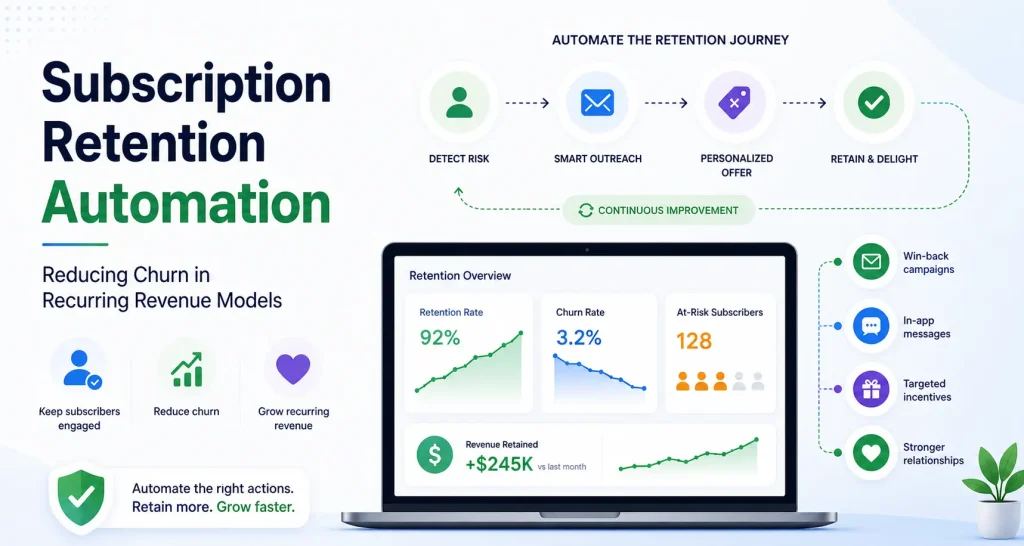
Subscription retention automation turns predictable signals, like billing events, product usage, and engagement, into timely personalized interventions that stop churn before it bleeds MRR. Customer Retention Automation: Keeping Customers Without Constant Promotions shows marketing and retention leaders at B2C subscription businesses how to design, implement, and measure automated retention programs using data unification, predictive scoring, multi-channel orchestration, and iterative testing. Expect concrete playbooks for payment failures, engagement decay, renewals, KPI targets, compliance checkpoints, and a phased roadmap you can run with existing teams.
1. Build the business case for retention automation
Start with money, not features. Executives will ask for projected MRR impact and payback; build the case with simple, verifiable calculations tied to your current billing base rather than vague uplift percentages.
Worked example: 2,000-member gym
Baseline assumptions: 2,000 members, average revenue per member (ARPM) $40/month, baseline monthly churn 5% (industry benchmarks available from ProfitWell and involuntary churn context from Recurly). Lifetime in months = 1 / monthly churn.
LTV math: at 5% monthly churn lifetime = 20 months → LTV = $40 * 20 = $800. If retention improves by 1 point (churn 4%) lifetime = 25 months → LTV = $1,000 (+25%). If you improve 3 points (churn 2%) lifetime = 50 months → LTV = $2,000 (+150%).
MRR after 12 months (no new acquisition): starting MRR = $80,000. With 5% churn MRR ≈ $80,000 * 0.95^12 = $43,232. At 4% churn ≈ $49,040. At 2% churn ≈ $62,776. A 1 point improvement produces ~13% higher MRR at month 12; 3 points produces ~45% higher MRR.
- Quick ROI check: prevented monthly churn MRR = total members delta churn ARPM. For a 1 point improvement: 2,000 0.01 $40 = $800 monthly retained MRR (=$9,600 annualized).
- Cost comparison: if an automation platform plus operational costs run $2,000/month, a 1 point retention lift covers most of that cost; a 3 point lift turns into material margin expansion.
- Practical constraint: these simplified calculations ignore new acquisition, seasonality, and reactivation — include those in an expanded model before quoting board-level numbers.
Where automation wins and where it doesn’t. Automated dunning, smart retry schedules and payment update links reliably recover involuntary churn; expect the fastest, highest-ROI wins here (see Stripe dunning best practices). Voluntary churn tied to product fit or onboarding requires product fixes or personalized offers; automation can prioritize and scale outreach but cannot substitute for a poor experience.
Trade-offs you must state up front: aggressive recovery spending on low-value subscribers inflates CAC-equivalent cost without improving unit economics; conversely, overly conservative thresholds miss recoverable revenue. Decide early whether your retention program targets pure MRR recovery, LTV optimization for high-value cohorts, or both — the tooling and human escalation flows differ.
Key takeaway: Build a two-line financial model (baseline churn, ARPM, membership count) and run 1 and 3 point retention improvements. Use that model to set target ROI and a 90-day proof milestone before expanding scope.
Next consideration: translate the model into measurable experiments — start with dunning automation and a held-out control so the dollar impact you present is actual recovered MRR, not an optimistic forecast.
2. Create the data foundation and single customer view
Start with the minimum set of truth. A workable single customer view (SCV) is not every signal you can collect — it is the smallest persistent profile that answers three operational questions: is the customer currently active and billable, are they likely to fail payment or disengage soon, and what is the highest-value recovery action available. Build toward richness, but deploy retention automation on a tight, reliable core first.
Priority integrations and why order matters
- Billing and payment processor (highest priority): integrate Stripe, Chargebee, or your billing system to capture payment status, tokenized payment method ID, decline codes, and retry schedules. Use webhooks for near real-time events.
- Usage and attendance systems: ingest POS check-ins, class bookings, or device events from Mindbody, Square, or your app to measure recent activity and decay.
- Engagement channels and consent records: connect email, SMS provider, and push systems to store opt-in status and message performance per subscriber.
- Support and NPS: ticket histories and NPS scores are high-signal predictors of voluntary churn and useful for escalation rules.
- Product metadata and lifecycle tags: membership tier, contract end date, promo flags, and acquisition cohort complete the profile for value segmentation.
Identity resolution tradeoff. Deterministic matching on payment token, membership ID, and verified email is reliable; probabilistic matching (phone + device fingerprints) increases coverage but raises false merges and privacy risk. Put deterministic links at the center of your SCV and only apply probabilistic joins for clearly marked, auditable use cases.
Minimum event schema your retention automations must consume
- customer_id (canonical), billing_id (processor token), email, phone
- payment_status (success / failed / disputed), last_payment_date, decline_code
- last_active_date, checkin_count_30d, bookings_30d
- membership_tier, monthly_price, contract_end_date, acquisition_channel
- consent_sms, consent_email, time_zone, preferred_channel
- support_tickets_30d, latest_nps, last_escalation_date
- predictive_score (place_holder), profile_updated_at
Practical constraint you need to accept. More fields improve predictive retention analytics, but every extra field increases integration work, maintenance, and audit surface for GDPR/PCI. Prioritize fields that directly map to automation triggers (payment_status, last_active_date, consent flags) and treat advanced signals as staged enrichments.
Concrete example: A boutique fitness studio streams Stripe webhooks into its engagement platform, merges them with Mindbody check-in events, and records consent from its SMS vendor. When a card declines, the SCV immediately surfaces last_active_date and NPS. The automated flow uses that combined view to either send an SMS with a payment-update link for recent attendees or route the account to a human for a recovery call if they are high value and low NPS.
SCV checklist (deploy first): billing webhooks, tokenized payment reference, last active timestamp, consent flags, membership tier, and a single canonical customer_id. Add attendance and support data in the second wave.
Operational judgment. Real-time updates matter for payment failures; hourly batches are fine for engagement scoring in many businesses. Aim for real-time billing + hourly usage sync. If you need vendor examples and connectors, see the integrations page at integrations and align your data retention policy with Stripe billing guidance to reduce PCI scope.
Focus first on reliability and legal safety: accurate billing identity + consent records give you an operationally useful SCV faster than trying to ingest every telemetry source at once.
3. Build a predictive churn score and value segmentation
Immediate priority: a predictive score is only useful when it changes who you contact and how. Build a score to triage resources — who gets an automated recovery sequence, who gets a human call, and who you let lapse. Treat the score as a routing decision, not a measurement vanity metric.
Signals to feed the model
- Billing signals: recent declines, number of retry attempts, payment method age, and tokenized issuer response codes (useful for diagnosis).
- Behavioral signals: frequency of visits/bookings over rolling windows, drop in session count, cancelled bookings, and decreasing engagement with app content.
- Product and lifecycle signals: months since signup, time to next contract renewal, active promotions on the account, and plan tier.
- Support and sentiment: recent tickets, complaint counts, NPS or survey trends, and escalations that indicate dissatisfaction.
- Value indicators: average monthly spend, tenure, and acquisition channel to estimate recovery ROI.
Practical insight: focus first on signals that map directly to actions. Payment decline codes and a recent steep drop in visits are actionable — you can send a specific reminder or trigger a coach outreach. Fancy behavioral embeddings help later; they do not replace clear, interpretable predictors for operational routing.
Model selection, trade-offs, and calibration
Start interpretable. Use a logistic regression or small decision tree to get calibrated probabilities and clear feature importance. These models are easier for ops teams to trust and to translate into thresholds for workflows. Move to gradient boosting only when you need marginal lift and have the data and monitoring resources to manage complexity.
Trade-offs to accept: interpretable models lose some accuracy but reduce hidden failure modes and labeling mistakes. Complex models require more frequent retraining, stronger validation against seasonality, and careful label hygiene so you do not teach the model to predict outcomes caused by your own retention interventions.
Confusion matrix explained: treat false positives (predict churn but customer stays) as a cost in outreach volume and potential channel fatigue; treat false negatives (missed at-risk customers) as lost recoverable revenue. Tune thresholds to balance these costs rather than to maximize generic accuracy; calibrate predicted probabilities so a 0.7 score actually corresponds to a meaningful failure probability in your business.
| Segment | Priority & action |
| High risk / High value | Immediate human outreach + tailored incentive; suspend automated discount blasts to avoid undermining negotiation leverage. |
| High risk / Low value | Automated multi-channel recovery sequence (SMS first for payment issues) with self-serve payment links and lightweight incentives. |
| Low risk / High value | Preventive engagement: personalized check-in, coach outreach, or usage nudges to protect long-term LTV. |
| Low risk / Low value | Low-touch lifecycle emails and standard renewal reminders; avoid high-cost escations. |
Concrete example: a regional fitness chain trained a logistic model using decline codes, missed bookings in the prior 30 days, average monthly spend, and recent support tickets. They set two thresholds: automated flows for score > 0.4 and human escalation for score > 0.75. Routing cut time wasted by front-line staff because only accounts with economic justification reached the phone queue.
Good models reduce wasted effort. Bad thresholds multiply it.
Operational rule: retrain models monthly in early stages, validate every time a major product or pricing change occurs, and map score buckets to explicit SLAs (e.g., human callback within 48 hours for top bucket). If you rely on billing event timing, combine near-real-time scoring with daily batch recalculation.
Next consideration: translate the score buckets into concrete automation playbooks and SLAs so the model drives behavior change, not just dashboards. When you do that, measure recovery lift with held-out cohorts and adjust thresholds to match your cost-to-recover profile.
4. Retention automation playbooks with channel sequences
Playbooks must be prescriptive. For each churn driver you need a clear channel sequence, timing, and a routing rule that converts a non-response into the next escalation step. Ambiguous flows produce inconsistent customer experiences and hide the real cost of human callbacks.
Payment failure (dunning) sequence
Core intent: recover revenue quickly with minimal friction while preserving payment card data security. Align your retry schedule with your processor; see Stripe billing guidance for recommended windows.
- 0–1 hour: send an SMS with a one‑tap payment update link for customers who consented to texts; include the failing card brand as a diagnostic cue.
- 4–12 hours: send an email with invoice, decline reason where available, and a direct update payment CTA; include timezone-aware send windows.
- 24–48 hours: attempt processor retry; if still failed, send a push or in-app banner reminding active users to update payment details.
- 72 hours: for accounts above an economic threshold, route to human outreach; for lower-value accounts, run a last-chance automated incentive (credit or limited access) before suspension.
Trade-off to manage: faster, SMS-led contact recovers more involuntary churn but raises opt-in and TCPA risk. Restrict aggressive SMS to accounts with clear consent and use email-first for ambiguous consent records.
Pre-renewal and cancellation prevention
Sequence principle: nudge early with usage evidence, then escalate to personalized offers. The content matters more than the channel—Tailor the message to recent behavior and the customers predicted recovery value.
- 30 days out: send an email with a usage summary and benefits the subscriber is about to lose.
- 7 days out: deliver an SMS reminder for opt-in customers and an in‑app modal for active users showing tailored incentives.
- 3 days out: for at-risk high value members, trigger a calendar invite for a 15-minute retention call or coaching session.
Limitation: incentives accelerate renewals but can teach price sensitivity. Use non-price levers (credits, concierge scheduling) for high-value cohorts and reserve discounts for price-responsive segments.
Engagement decay and reactivation
Signal window: detect drops in activity over 14–30 days and escalate based on lifetime value. Use behavioral nudges first; save monetary incentives for customers who respond to human outreach or multiple automated touches.
- Day 0 (drop detected): push or in-app personalized workout/class recommendations tied to recent behavior.
- Day 3: targeted email with a low-friction offer (free discovery class, trial add-on) and an easy booking CTA.
- Day 10: SMS reminder to rebook or a prompted coach outreach for premium tiers.
Practical insight: sequence effectiveness depends on accurate channel preference data in your SCV. If you dont have reliable channel preference, default to email then escalate to push for app-active users.
Winback and human escalation rules
Escalation logic: automate triage: require N non-responses or X failed retries before a human is assigned. Attach an economic threshold so phone time is used only where recovery ROI is positive.
Concrete example: A family entertainment center routes any account with a failed payment plus more than three missed visits in 30 days to a concierge team. The automated sequence sends two SMS and an email over 72 hours; if the customer still doesnt update payment, a staff member calls and offers a single-use play credit plus a scheduling assist to re-engage the family. The human touch both recovers payment and resets usage patterns.
Key operational rule: map every automated step to a measurable outcome and an explicit fallback — if no response after the defined attempts, the system must either pause further outreach or escalate to the correct team.
Practical constraint: run small, time-boxed A/B tests on sequencing and channel order. What wins in one market or price point often fails in another; iterate quickly and bake the best-performing sequence into your production playbooks.
5. Creative messaging examples and incentive strategies
Direct, contextual messages paired with tiered incentives outperform blanket discounting. Targeted copy that signals urgency for payment issues, value for waning engagement, and empathy for churn intent converts better and preserves margin when you segment by recoverable value.
Short message templates (use as starting points)
- Payment SMS (opted-in customers): Hi {first_name}, your card for {membership_name} failed. Update payment in 2 taps: {payment_update_link}. We saved your spots — need help? Reply HELP. Segment: recent attendees with active consent — high immediacy, low friction.
- Decline email (longer form): Hello {first_name}, we couldnt process your last payment for {billing_period}. Here is a secure link to update payment details and review recent visits: {invoice_link}. If youd like a call, book here: {calendar_link}. Segment: mixed-consent customers who prefer invoices and context.
- Pre-renewal SMS (7 days out): {first_name}, your plan renews soon. You’ve attended {visits_30d} sessions this month — want a quick schedule check or a credit to try something new? Reply YES to connect. Segment: at-risk but engaged members — nudge toward retention without price offers.
- Engagement push (app users): New classes matching your interests are live this week. Book now and get priority spots for your favorites. Segment: lapsed 14–30 day users who open the app regularly.
- Winback email (after automated attempts): We miss you, {first_name}. Here is a one-time complimentary session or an account credit to rediscover what you loved. No auto-renewal required. Redeem: {promo_link}. Segment: mid-value churned subscribers where experience incentives beat discounts.
- Human call script opener (high-value escalation): Hi {first_name}, Im calling from the membership team to help with your account and see how we can support your goals. I have a complimentary session and flexible scheduling options if youre interested. Segment: tenured high spenders or those with several recent support tickets.
Incentive tiers matter. Use non-price incentives first for high-value members: complimentary coaching, schedule concierge, or a session credit preserve perceived value. Save percentage-off discounts for lower-value, price-sensitive segments where the math supports payback.
- Experience incentives: free session, onboarding call, or priority booking. Best for high-LTV customers who respond to service-based retention.
- Account credits: small monetary credit applied to next invoice. Useful when recovering involuntary churn without resetting price expectations.
- Time-limited trial add-ons: short access to premium content or classes to re-engage behavioral patterns before offering price changes.
Trade-offs and practical limits. Repeated discounts train price sensitivity and increase future churn risk. Conversely, overly conservative incentive rules leave recoverable revenue on the table. The correct balance is operational: set a recovery budget per cohort and enforce economic thresholds for human escalation.
Concrete example: A retail subscription box operator detected payment failures combined with reduced site logins. They sent a brief SMS with a one-tap update link to low-value subscribers and an email plus a complimentary box upgrade offer to mid-value customers. For top-tier subscribers a concierge agent called and offered an exclusive product preview and scheduling help. The combined flow increased successful updates and reorders while keeping discount usage limited to lower-value segments.
Operational rule: A/B test templates and incentives with randomized holdouts. Track recovered MRR per dollar spent on incentives and adjust the tier thresholds when incremental LTV falls below your cost-to-recover.
Legal and channel considerations: Reserve SMS for consented accounts and keep copy transactional when handling failed payments to reduce risk under regulations like TCPA and local equivalents. When in doubt, default to email plus in-app prompts for ambiguous consent records.
Next consideration: define a committed monthly incentives budget, instrument attribution for every redeemed offer, and use that data to tighten which segments receive which incentive types.
6. Measurement, attribution, and experimentation
Start with the single question that kills debate: did this automation change recoveries or just shift activity earlier? Measurement for subscription retention automation must connect actions to dollars, not clicks.
Practical insight: use time-bound attribution windows tied to the customer lifecycle. For payment dunning, evaluate impact on revenue recovered within 30 days of the failure event. For engagement flows, measure changes to 30/90-day cohort retention and subsequent MRR contribution. Different flows need different windows — pick the shortest window that still captures meaningful revenue movement and stick to it.
Design rules for experiments
Experiment rule 1 — always include a control that receives standard care. A no-contact or baseline-treatment holdout is the only way to measure incremental lift. Make the control size large enough to detect your minimum meaningful uplift; compute Minimum Detectable Effect rather than guessing.
Experiment rule 2 — avoid cross-contamination. When testing channel order (SMS first vs email first), isolate geographic or acquisition cohorts so messages in one arm dont trigger responses in the other. If you cannot isolate, treat the test as operational, not causal.
- Statistical hygiene: run pre-checks for sample balance and seasonality, and lock assignment logic so users dont flip between arms when they interact on different devices.
- Operational cap: only route human escalation arms to live agents if you have surplus capacity; otherwise you risk test-induced SLA violations and biased results.
- Attribution note: attribute recovered revenue to the earliest eligible treatment that could reasonably have influenced the customer within your chosen window.
Instrumentation you cannot skip. Capture event-level payment_failed, payment_updated, retry_attempt, message_sent(channel), message_opened, and membership_status_change with consistent customer identifiers. Make these events idempotent and time-stamped in UTC so attribution logic is auditable.
Sample dashboard fields and a weekly retention report template
- Weekly dashboard fields: baseline monthly churn (cohorted), recovered MRR this week, dunning recovery rate (30-day window), win_back conversion rate, average incentive spend per recovered account, open/click rates by channel, and number of human escalations with outcome.
- Report actions column: for each metric show trend, likely cause, and one recommended action (e.g., tighten SMS consent filter, change retry cadence, increase/decrease incentive).
- Owner mapping: attach a single accountable owner for every metric (growth, billing ops, or support) to force follow-through.
Concrete example: A regional studio ran a randomized holdout for a new dunning SMS sequence. They assigned 10 percent of recent declines to control and tracked recovered revenue over 30 days. The SMS arm produced a clear lift in updates during the first 72 hours and a follow-on uplift in 90-day retention for those who updated on the first attempt. Because the test included a hard holdout, the team could confidently reallocate human follow-up time to other cohorts.
Trade-off and limitation: causal experiments are the gold standard but take time and scale. If you lack sample size, use quasi-experimental methods (time series with controlled seasonality) but treat results as directional. Beware of confounding promotions or product changes during tests — they will invalidate attribution.
Prioritize repeatable, auditable signals over noisy vanity metrics. If you cant tie a test to cohort MRR or recovery rate, you haven’t proven value.
Operational mandate: run at least one randomized holdout for every major automation before full rollout. Use the holdout to set realistic expectations for recovery lift and to calibrate model thresholds and incentive budgets.
Next consideration: once a winning sequence is identified, convert it into a monitored playbook with automatic alerts for drift and quarterly re-tests to ensure lift persists as behavior and payment landscapes change.
7. Implementation roadmap and operational checklist
Execution beats perfection. A short, disciplined rollout with clear owners and measurable gates will out-perform an open-ended build. Treat the first 90 days as a project to prove recovery economics and establish repeatable operations, not to finish every integration or model variant.
Phase plan and practical timeboxes
- 0–30 days — Launch minimal recoveries: Stand up automated card-decline handling (one‑tap payment update link), create 2–3 at‑risk segments, and instrument basic activity events. Owner: billing ops + growth. Why first: payment-triggered automations unlock immediately recoverable revenue and short feedback loops. Consideration: limit SMS to confirmed opt-ins to avoid regulatory exposure; default to email/in-app otherwise.
- 31–60 days — Add intelligence and personalization: Deploy a simple churn score (rules or logistic regression), attach value tiers, and run A/B tests on sequencing and message timing. Integrate the POS or class booking system to improve decay signals. Owner: data engineer + retention lead. Trade-off: added sophistication increases maintenance; keep models interpretable early to avoid operational mistrust.
- 61–90 days — Scale and govern: Enable multi‑channel orchestration, formalize human escalation SLAs, and bake recovery metrics into monthly KPIs. Establish an incentives budget and audit logging for consent and payment interactions. Owner: head of growth + operations. Gate for scale: evidence from a randomized or controlled test showing positive recovered revenue per dollar spent on incentives.
Operational checklist (task, owner, estimate, dependency)
- Billing webhook wiring: connect processor webhooks (Stripe/Chargebee) — Owner: billing ops — ETA: 3–7 days — Depends on: access to merchant account and webhook endpoint.
- Payment update UX: generate secure one‑tap update link and landing page — Owner: product + engineering — ETA: 5–10 days — Depends on: tokenized payment approach from processor.
- Consent audit: reconcile SMS/email opt-ins and record timestamps — Owner: compliance — ETA: 4 days — Depends on: marketing platform exports.
- Basic churn score: implement rules or small model and expose routing flag — Owner: data scientist — ETA: 10–14 days — Depends on: clean event stream for lastactive and paymentstatus.
- Engagement events: instrument check-ins/bookings into SCV — Owner: integrations engineer — ETA: 7–14 days — Depends on: access to POS/Mindbody APIs.
- Human escalation playbook: script, SLA, and economic threshold — Owner: retention manager — ETA: 3–5 days — Depends on: agreed recovery budget and staffing availability.
- Monitoring & alerting: dashboards for recovered revenue, message throughput, and consent violations — Owner: analytics — ETA: 5–8 days — Depends on: event instrumentation and BI access.
Practical constraint: human bandwidth is finite. Set explicit economic thresholds for live callbacks and automate low‑value recoveries. Teams commonly over-index on phone outreach because it feels effective; in practice, that wastes time unless paired with a clear ROI gate.
Concrete example: A boutique fitness studio completed wiring Stripe webhooks and a one‑tap payment update page in 21 days, then used a simple score to route only accounts above a recoverable value threshold to a concierge call team. Within six weeks the studio reduced manual follow-ups by half and reallocated staff time to retention coaching, while still covering the automation cost from recovered invoices.
Focus on measurable gates: working payment updates, a functioning holdout for testing, and a defined SLA for human escalations. Scale only after those three are stable.
Go/no-go checklist for scaling: live dunning automation with idempotent events; randomized holdout showing positive net recovered revenue; documented consent records for messaging; SLAs and staffing confirmed; incentives budget and tracking in place. If any item is missing, hold expansion and fix that gap.
Frequently Asked Questions
Direct answer up front: these FAQs focus on operational trade-offs, common failure modes, and simple next steps you can act on this week to make subscription retention automation actually move MRR.
What exactly is subscription retention automation versus basic email reminders?
Short version: subscription retention automation ties billing, behavior, and value signals into rules and scores so messages are timely, prioritized, and channel‑aware — not just one-size email blasts. That routing and decision logic is what separates routine reminders from recoverable revenue.
How much churn reduction should I expect from automation?
Reality check: outcomes vary by business mix and execution. In practice, the clearest and fastest returns come from fixing involuntary churn with a proper dunning sequence and payment update UX. Expect meaningful recoveries from those fixes before you see steady gains from engagement playbooks.
Which integrations should I prioritize first?
Integration priority: wire real-time billing events first, then the single best engagement signal you have (check-ins, app opens, or bookings). You can refine scores later; without reliable payment and one behavioral feed your automations will misroute follow-ups and waste budget. See Gleantap integrations for connector examples and Stripe billing guidance for dunning alignment.
When should I use discounts versus non-monetary incentives?
Practical rule: treat incentives as an economic lever, not a reflex. Use concierge time, free sessions, or account credits for high-LTV customers to preserve price integrity; use discounts sparingly for price‑sensitive, low-recovery-value segments. Lock these rules into your routing thresholds so humans dont burn budget where it wont pay back.
What compliance traps should I watch for with SMS and payment outreach?
Hard limit: only use SMS sequences where you have provable consent and clear opt-out handling. Keep failed-payment messages transactional in tone to reduce regulatory risk, and retain consent logs auditable for TCPA/GDPR checks. When in doubt, default to email plus in-app prompts until consent is verified.
How often should predictive models be retrained and monitored?
Operational cadence: retrain monthly at minimum in early stages, and introduce a simple drift monitor (score distribution and recovery lift) on a weekly cadence. If you change pricing, product bundles, or acquisition channels, trigger an immediate retrain; models packaged without drift checks are what create unexplained SLA misses.
How do I prove the automation actually moved revenue?
Do the hard thing: run randomized holdouts for each major flow (dunning, reactivation, high-touch offers). If sample sizes are small, run sequential pre/post tests with conservative inference and treat results as directional until you can randomize. Attribution without a control is guesswork.
Concrete example: a six-location studio deployed a one-tap payment update link and assigned 15 percent of declines to a holdout. The automated sequence recovered enough invoices in the first month to justify routing only top‑value accounts to phone callbacks; staff time fell and recovered MRR rose in parallel, which made the case for expanding the orchestration to engagement flows.
Key FAQ takeaway: prioritize dunning + payment UX first, protect human bandwidth with economic thresholds, and require a control before you declare a sequence successful. Those three controls prevent wasted spend and overstated wins.
Next actions you can do this week: 1) Verify your billing webhooks and add a one‑tap payment update link, 2) create a 10–15 percent holdout for new dunning messages, and 3) set an explicit dollar threshold for routing accounts to human callbacks. These moves capture the highest‑velocity, lowest‑risk recoveries.


Ready to Run Successful Marketing Campaigns and Grow Your Business?
Gleantap helps you unify customer data, track behavior patterns, and automate personalized campaigns, so you can increase repeat purchases and grow your business.
Ready to Run Successful Marketing Campaigns and Grow Your Business?
Gleantap helps you unify customer data, track behavior patterns, and automate personalized campaigns, so you can increase repeat purchases and grow your business.