
Fitness Franchise Marketing Software: What Multi-Location Gym and Studio Brands Need From HQ to Each Location
 Divya Ghughatyal
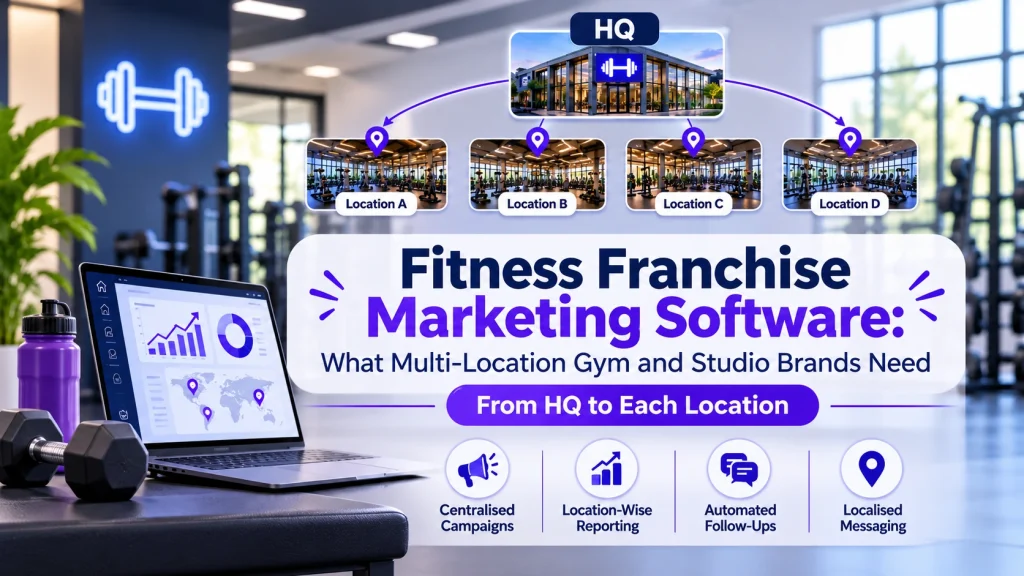
Fitness franchise marketing software lets headquarters build campaigns and automations once and run them at every location, with local phone numbers, offers and staff inboxes, while HQ sees lead follow-up, presale and retention results by location. It should sync with each location’s booking system, Mindbody, ABC, ClubReady or similar, and reply to new leads in under a minute.
What Is Fitness Franchise Marketing Software?
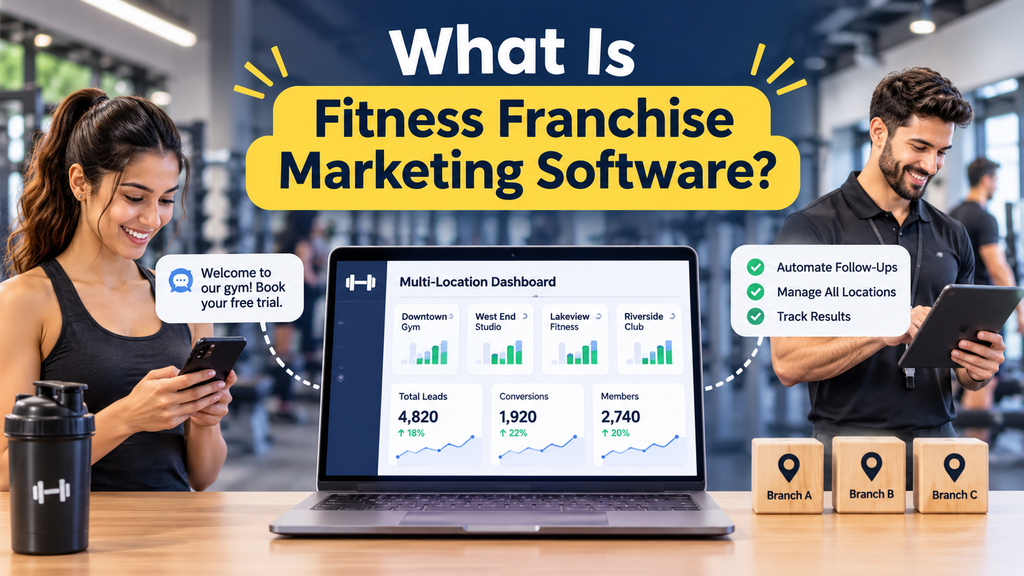
Franchise marketing software is the layer between your booking system and your members. Your booking system, Mindbody, ABC Fitness, ClubReady, WellnessLiving, Mariana Tek, tracks who bought, booked and attended. Marketing software turns that data into follow-ups: the text that fires when someone fills in the “join” form at 9 p.m., the reminder before a membership lapses, the review request after a member’s first class.
For a fitness franchise, the job has two layers. HQ sets the brand rules once, message tone, offer caps, SMS consent language. Each location runs its own version: local address, local phone number, local offer. Both need reporting, HQ in aggregate, each location in detail. See how the best franchise software for multi-location businesses handles this split.
Without a tool built for this model, HQ builds campaigns that never get sent and nobody can tell which gym is following up on leads. Using CRM in franchise management covers how the data layer should work before you pick a platform.
Why Franchise Marketing Breaks Between HQ and the Front Desk

Here is the most common story. HQ hires a marketing director, builds a solid 60-day member journey, and trains regional managers on the playbook. Six months later, three out of ten locations are running it. The other seven never connected their local login, changed the offer without telling anyone, or simply forgot.
This is not a people problem. It is an architecture problem. When every location has to opt in to run a campaign, most won’t. When HQ can’t see which locations followed up on leads, there’s no way to know where revenue is leaking. When each gym manages its own SMS consent and local phone number independently, compliance becomes a game of telephone.
The gap between what HQ intends and what happens at the front desk is where fitness franchise revenue goes. The fix is software built on a parent/child model that runs the playbook whether or not the front desk does anything.
The Parent/Child Setup: What HQ Controls, What Each Location Controls
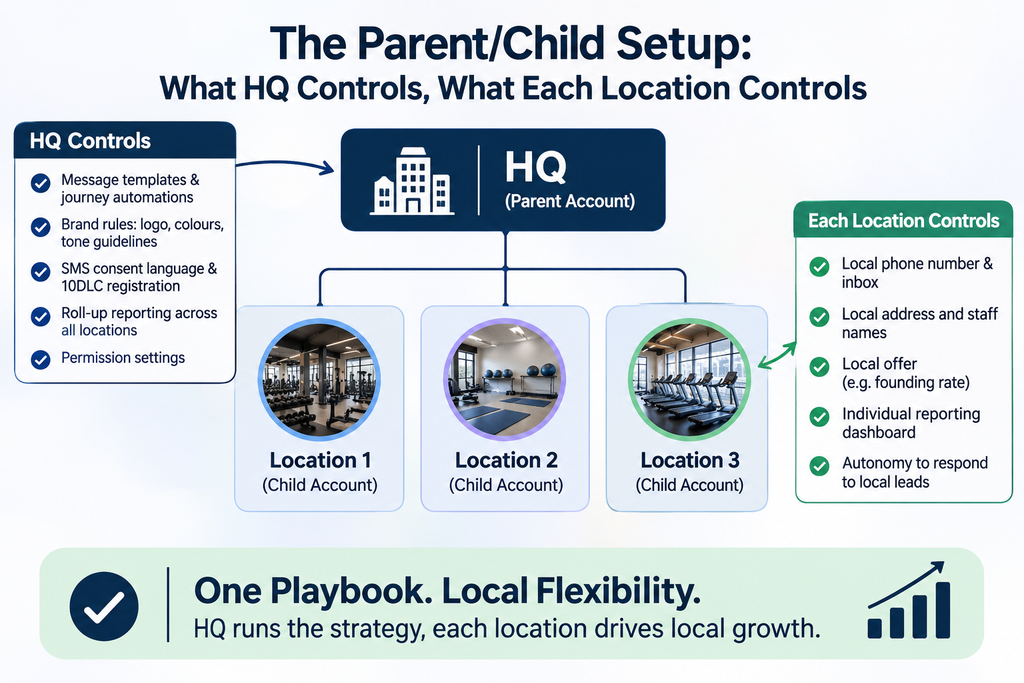
A parent/child model splits ownership cleanly, it is what separates purpose-built franchise marketing software from a standard CRM someone has to configure 30 times. For the broader context, using CRM in franchise management: a complete guide is a good primer.
HQ (the parent account) owns:
- Message templates and journey automations
- Brand rules: logo, colors, tone guidelines, offer caps
- SMS consent language and 10DLC registration
- Roll-up reporting across all locations
- Permission settings for what franchisees can and cannot change
Each location (a child account) gets:
- Its own local phone number and inbox
- Its own staff names and assignments
- Its local offer (founding rate for a new opening, class-pack promotion for an open gym)
- Its own reporting dashboard, leads, conversions, revenue
- Autonomy to respond to inbound messages without touching HQ’s templates
The locked vs. editable distinction makes this work. Brand colors and SMS disclosures are locked. The local address, staff name and offer are local fields each franchisee fills in.
HQ builds a journey once: “New lead → intro text from [local staff name] in under 60 seconds → tour invite → founding-member offer → reminder before expiry → welcome sequence.” Every location runs it automatically. HQ sees aggregate performance; each location sees its own numbers.
That is the model. Everything else in this article is a specific application of it. For a vendor comparison, see the best CRM platforms for multi-location businesses in 2025.
Presale Playbook for a New Location

Every new studio in a franchise network faces the same problem: bills start on day one, revenue starts on opening day, and the gap is funded by founding members.
Paid ads bring some of them. The rest come from referrals, waitlist follow-up and fast responses to inquiries, and fast means under 60 seconds. A lead who fills in a form and waits four hours for a reply has usually moved on.
Here is what a presale journey looks like in a parent/child setup, with the timings that work:
| Stage | Timing | Action |
| Lead comes in (ad, referral, event) | Day 0 | Auto-text from local staff name: “Hi [First Name], I’m [Staff] at [Studio]. Are you free for a 5-minute chat this week?” |
| No reply | Day 1 | Second text with founding offer details + link to book tour or call |
| Email follow-up | Day 2 | Studio photos, trainer bios, founding-member story (“only 200 spots at this rate”) |
| Final nudge | Day 4 | “Founding rate closes [date], want me to hold a spot?” |
| After tour or call | Within 1 hour | Founding offer sent personally by staff |
| 24 hours before offer expires | Day of | Reminder text from staff |
| Join | Same day | Welcome sequence: what to expect, how to book first class, who to contact |
The key variables are urgency (fixed founding spots or a rate that steps up at milestones) and speed of first response. HQ sets these rules once, every new location inherits the journey with its own local number and staff name already filled in.
For HQ, presale performance becomes comparable across openings. If location 12 converts 18% of presale leads and location 15 converts 9%, that is a signal, market, offer or follow-up is different, and the reporting makes it visible. Gleantap’s AI agent handles the first reply in under 60 seconds automatically, so the window stays open even when the front desk is buried in build-out.
Growing Open Locations: Utilisation, Rebooking, Retention, Reviews
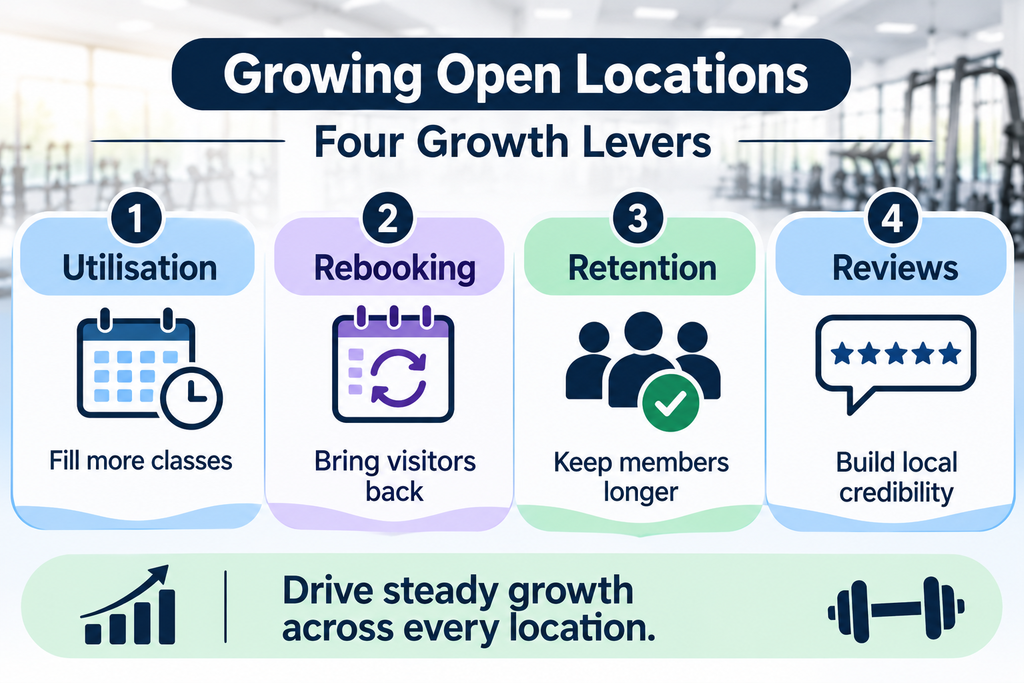
Once a location is open, four levers drive growth.
Utilisation (class fill rate). If a class is under 60% full 48 hours out, an automated message goes to members who have taken that class before and haven’t booked this week. No manual work from the front desk, the journey fires when the condition is met.
Rebooking after first visit. First-time visitors who don’t return within 10 days rarely become members. A text 24 hours after a first visit, “How was your class? Want to grab a spot for next week?” with a direct booking link, is one of the highest-ROI automations in fitness.
At-risk and win-back. Members who dropped from 4+ visits a month to once or zero are signaling they might cancel. An automated check-in, “We’ve missed you. Is there anything we can do?”, catches some before they churn. Win-back journeys for cancelled members can fire at 30 and 60 days.
Review requests by location. A franchise with 30 locations has 30 separate Google Business profiles. An automated message after a member’s fifth visit, with a direct Google link, from the local number, generates reviews without the front desk having to remember.
All four work from booking-system data. When Gleantap syncs with Mindbody, ABC, ClubReady, WellnessLiving or Mariana Tek, visit data and membership status flow in automatically. The AI agent handles inbound messages so no lead or at-risk flag goes unanswered. See the full fitness CRM overview for how this applies to gym and studio brands.
One View Across Locations: Reporting HQ and Franchisees Both Trust
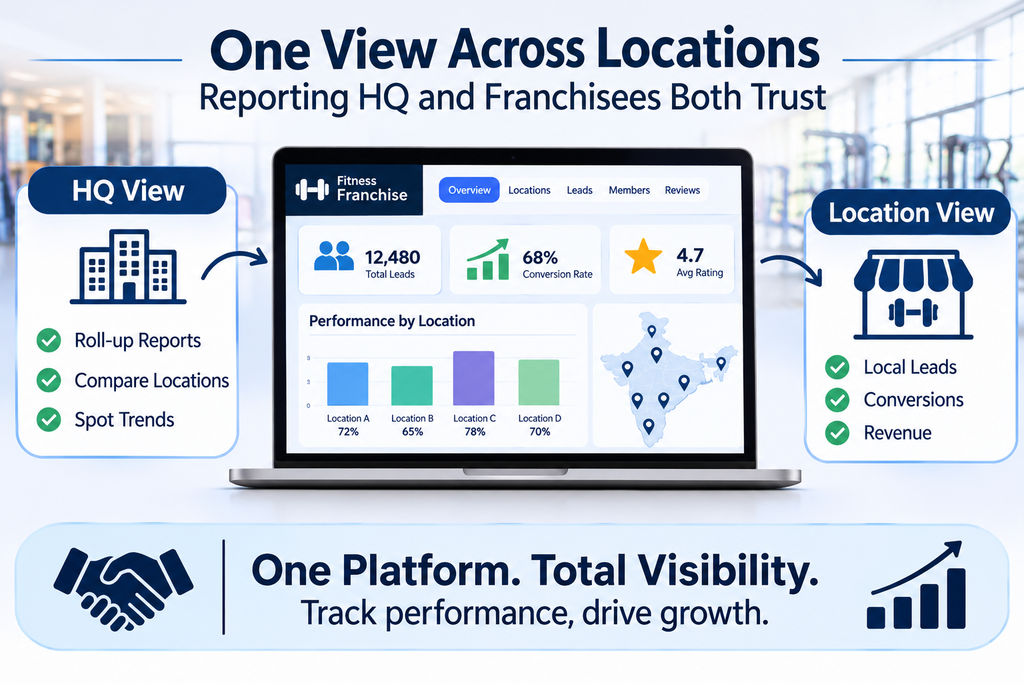
Different locations often run different software versions, some on Mindbody, some on ABC, some on a system the franchisee chose before joining the brand. Getting one clean view across all of them requires data normalisation.
A marketing platform connecting to multiple booking systems maps their different field names, member status codes and transaction types to a single consistent schema. When a “trial member” in Mindbody and a “prospect” in ClubReady are treated as the same funnel stage, HQ can finally compare locations that run different backends.
The reporting layer that matters for a franchise has two views:
HQ roll-up: leads, conversion rates, presale progress, at-risk counts and response time by location, so a marketing director can spot which gyms need support.
Location dashboard: individual leads, conversation history, journey stage, upcoming automations and membership status from the booking system.
Both views come from the same data. When HQ and a franchisee see different numbers, trust breaks down. For a wider platform comparison, see the best CRM platforms for multi-location businesses in 2025.
Checklist: Choosing Fitness Franchise Marketing Software
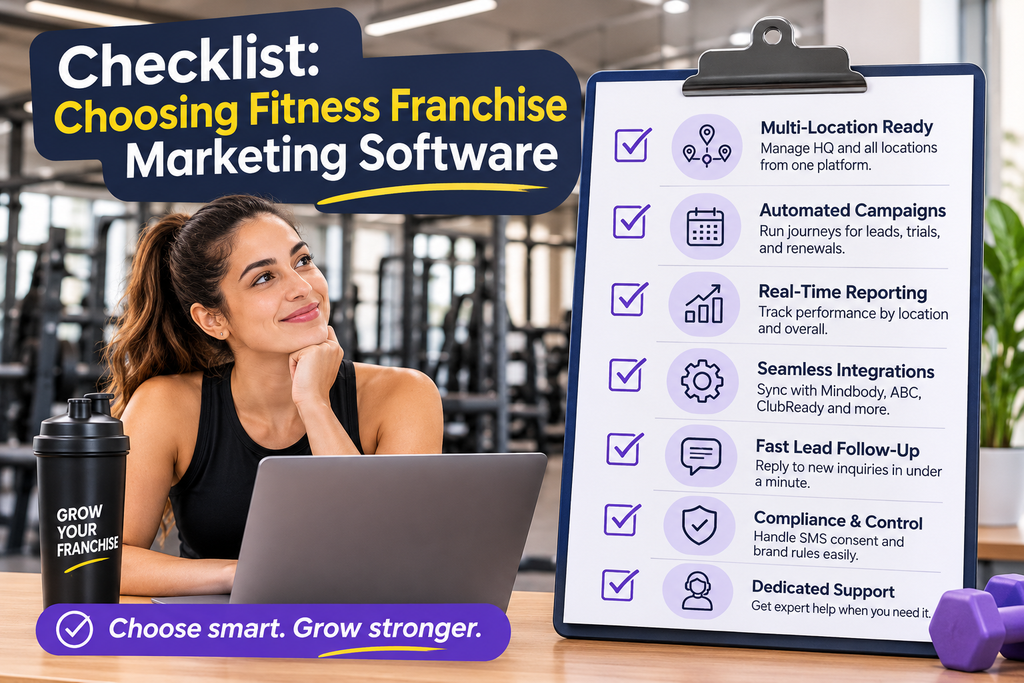
When evaluating platforms for a fitness franchise, test for these specifically:
- Parent/child template model. Can HQ create automations that all locations inherit, with locked brand elements and editable local fields (address, local number, local offer)?
- Per-location phone numbers and inboxes. Does each location get its own SMS number and two-way conversation inbox, so members text their local gym, not a shared brand number?
- Booking system sync. Does it connect natively to Mindbody, ABC Fitness, ClubReady, WellnessLiving and Mariana Tek? Can it handle locations on different systems within the same franchise?
- AI lead reply speed. Can it respond to new leads automatically in under 60 seconds, any time of day? Manual response from the front desk should be an enhancement, not the default.
- Roll-up and per-location dashboards. Can HQ see aggregate performance by location alongside drill-down detail? Can franchisees see only their own location’s data?
- Permission levels for franchisees. Can you define what franchisees can edit (local offer, staff names) and what they cannot (brand templates, SMS consent language, pricing)?
- SMS compliance infrastructure. Does the platform handle 10DLC registration, consent capture and opt-out management per location, with quiet-hours rules applied automatically?
Gleantap is built for this model. It connects to Mindbody, ABC, ClubReady, WellnessLiving and Mariana Tek, replies to leads in under 60 seconds with AI, and surfaces roll-up reporting alongside per-location dashboards. Brands report 2.1x more conversions, 30% more inquiries converted, and $158K added revenue per location on average. G2: 4.5/5 (19 reviews). Capterra: 5.0/5 (7 reviews). See pricing or the best franchise software for multi-location businesses comparison.
See an HQ dashboard and a location inbox side by side in a 20-minute demo.
FAQ
Can each location have its own phone number?
Yes. Each location gets a dedicated local number for outbound and inbound SMS. Members reach their own studio’s inbox, not a shared brand queue.
Can franchisees edit campaigns?
That depends on what HQ allows. HQ can lock brand templates so franchisees cannot change message content, timing or offer caps, but franchisees can fill in local fields like address, staff names and location-specific promotions.
Does it work if locations use different booking systems?
Yes, as long as the platform integrates with each system natively. Gleantap connects to Mindbody, ABC Fitness, ClubReady, WellnessLiving and Mariana Tek, so locations on different backends still roll up into one HQ dashboard.
How do we handle SMS consent across locations?
Consent must be captured at the location level, opt-in at Location A does not cover messages from Location B. Good franchise marketing software ties consent to each location’s number, applies quiet-hours rules per time zone, and handles opt-outs automatically. 10DLC registration should be handled at the brand level by the platform, not by individual franchisees.
What does it cost per location?
Plans start at $299/month per location. Full details on the pricing page. Schedule a demo to see an HQ dashboard and location inbox side by side in 20 minutes.
Recent blog posts
Back to blog


Ready to Run Successful Marketing Campaigns and Grow Your Business?
Gleantap helps you unify customer data, track behavior patterns, and automate personalized campaigns, so you can increase repeat purchases and grow your business.
Ready to Run Successful Marketing Campaigns and Grow Your Business?
Gleantap helps you unify customer data, track behavior patterns, and automate personalized campaigns, so you can increase repeat purchases and grow your business.