
 Divya Ghughatyal

Salon marketing software works alongside your booking system to handle everything between appointments. Your booking app manages schedules and reminders; a marketing layer answers new enquiries instantly, sends rebooking texts when a client’s usual service interval passes, asks for reviews after the right visit, and wins back clients who haven’t returned in 8–12 weeks – all from one inbox.
What Is Salon Marketing Software?

Salon marketing software is a layer that sits on top of your existing booking system – Zenoti, Mindbody, Square, WellnessLiving, or whichever app you already rely on – and automates the client communication that happens between appointments. Instead of replacing your scheduler, it fills the gaps your scheduler was never designed to fill: responding to after-hours enquiries, prompting rebookings based on each service’s cycle, recovering lapsed clients, generating reviews, and pulling every conversation into a single inbox.
The booking system owns the appointment. The marketing layer owns the relationship between appointments.
What Your Booking System Already Does
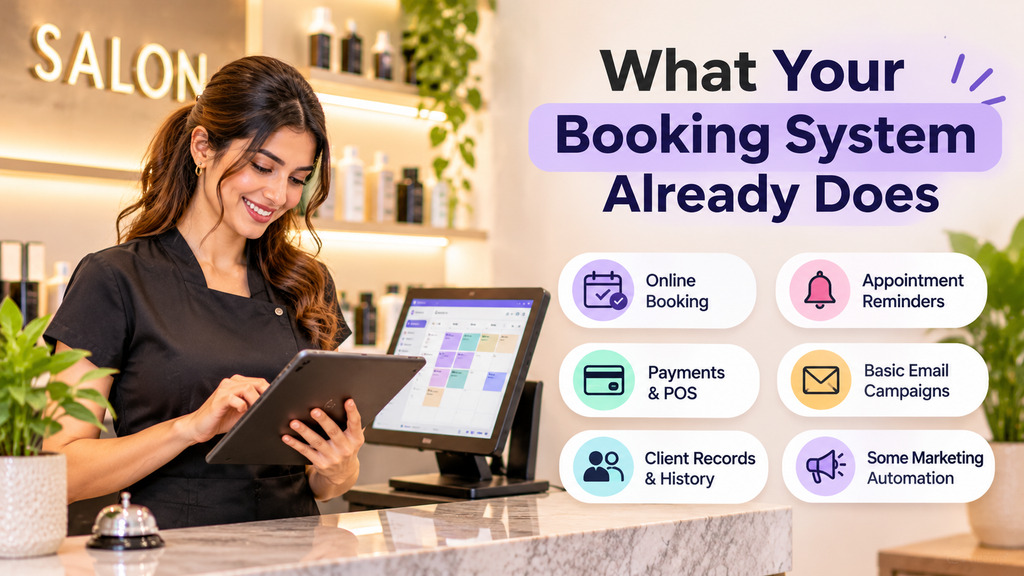
Credit where it’s due. As of November 2026, most salon and barbershop scheduling apps handle:
- Online booking from your website, Google, and (in some cases) Instagram.
- Appointment confirmations and reminders via email or text.
- Point-of-sale and payment processing at the front desk.
- Basic email campaigns – think newsletters and holiday promos.
- Client records with visit history and service notes.
- Some level of marketing automation – Mindbody now partners with Attentive for email and SMS, WellnessLiving recently launched its Marketing Suite, and Zenoti offers Advanced Marketing on higher tiers.
If these features keep your salon spas running smoothly, great. But the problems that cost revenue tend to live between appointments.
The 5 Gaps Between Appointments
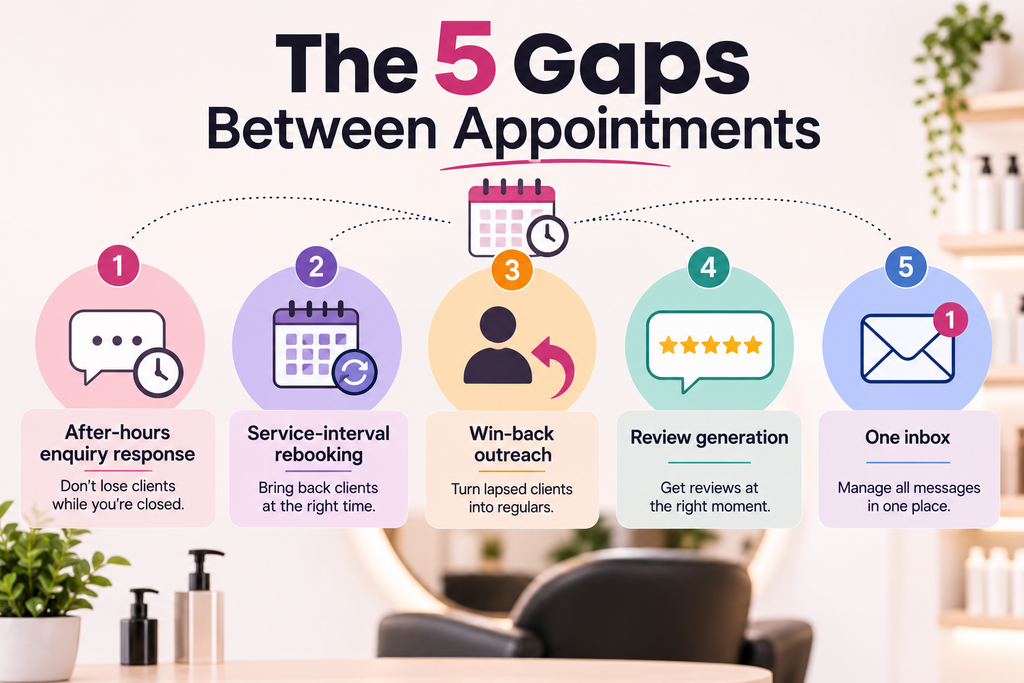
Five areas where bookings slip through the cracks.
1. After-hours enquiry response
A potential client DMs your Instagram at 9 PM asking about balayage pricing. Nobody replies until the next morning. By then, they’ve booked somewhere else.
Salon enquiries peak in the evening, when the front desk is closed. An ai agent built into your marketing layer replies in under 60 seconds – answering questions, sharing your booking link, and handing off to your team when a human is needed.
2. Service-interval rebooking
Your booking system reminds clients about appointments already on the calendar. But what about the client who walked out after a colour six weeks ago and never rebooked? Salon marketing software tracks service history and sends a rebooking text when the usual interval passes with no future booking. (Intervals below.)
3. Win-back outreach
A client who hasn’t been in for 8–12 weeks is drifting. At 16 weeks, they’re nearly gone. An automated win-back sequence – a friendly text, then a follow-up with a small incentive – brings a meaningful share back before they find a new stylist.
Retention math: if your salon has 1,000 active clients and you recover one extra visit per year from each, that’s 1,000 additional appointments. Multiply by your average ticket (plug in your own number) and the impact is hard to ignore.
4. Review generation after the right visit
A first-time trim client? Too early to ask for a review. A regular who just got a full colour transformation? That’s the moment. The best salon marketing software sends review requests by text within an hour of checkout, timed by visit type and client history – not blasted after every appointment.
5. One inbox for texts, DMs, and web chat
Your front desk juggles DMs, texts, web chat, and email from different screens. Messages get missed. A marketing layer with an omnichannel inbox pulls every conversation into one place so nothing falls through.
Rebooking by Service Interval

When a client’s service interval passes with no future booking on file, that’s the trigger for a rebooking text.
| Service | Typical interval | Rebooking text trigger | Example message |
| Colour / highlights | Every 6–8 weeks | Day after the interval with no booking | “Hi Sarah – 7 weeks since your last balayage. Ready to refresh? [booking link].” |
| Cut / trim | Every 4–6 weeks | Day after the interval with no booking | “Hey Marcus – 5 weeks since your last cut. Want to get on the calendar? [booking link].” |
| Nails (gel / acrylic) | Every 2–3 weeks | Day after the interval with no booking | “Hi Jen – your gel set is 3 weeks old. Book your fill before they start lifting! [booking link].” |
| Lash extensions | Every 3–4 weeks | Day after the interval with no booking | “Hey Priya – almost 4 weeks since your lash fill. Let’s keep them full! [booking link].” |
These are guidelines – good salon marketing software lets you set custom intervals per service.
Text or Email? What Works for Salon Clients
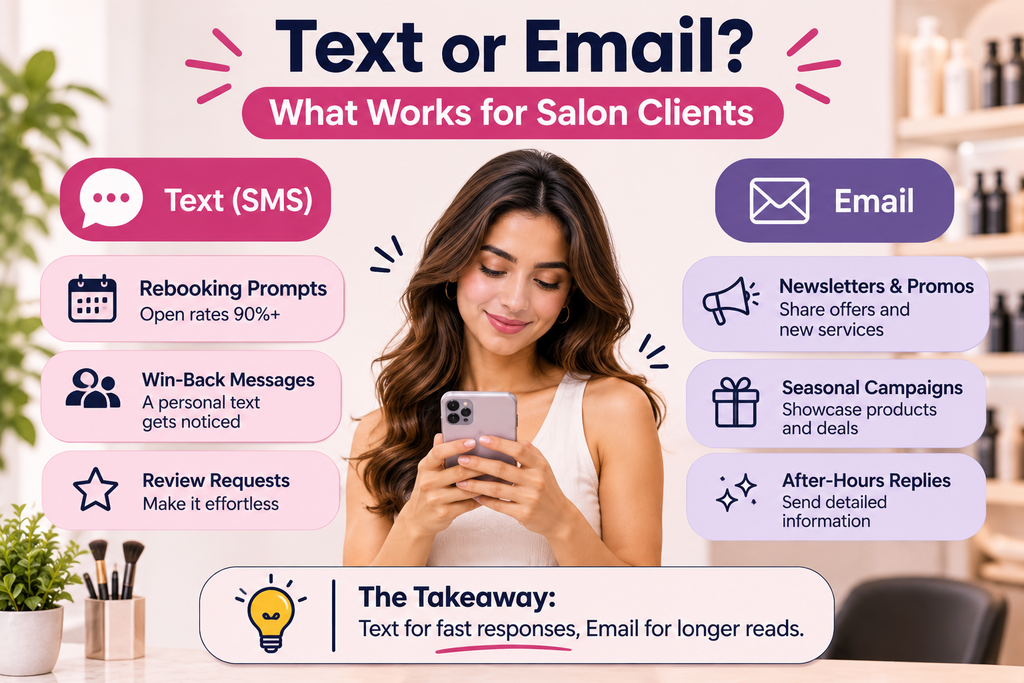
Text message marketing for salons outperforms email for time-sensitive, one-to-one messages. But both have a role.
- Rebooking prompts → Text. Open rates on SMS run above 90%, and a booking link in a text gets tapped far more often than one buried in an email inbox.
- Win-back messages → Text first, then email as a follow-up. A short, personal text from the stylist’s name cuts through in a way that a branded email often doesn’t.
- Review requests → Text. Clients are most likely to leave a review in the moment, right after their appointment, and a text with a direct Google review link makes it effortless.
- Newsletters, promotions, and seasonal campaigns → Email. Longer-form content with images – new services, holiday gift-card offers, product launches – works better in a designed email.
- After-hours ai agent replies → Whichever channel the client used. If they messaged on Instagram, the reply goes to Instagram. If they texted, it replies by text.
The takeaway: text for anything that needs a fast client response, email for anything that needs a longer read. Smart marketing for beauty salon operations uses both, triggered by the right moment.
Checklist: Do You Need a Marketing Layer?

Hold this against what you have today. If the right column has gaps, a dedicated salon client retention software layer fills them without replacing your booking app.
| Your booking system probably covers… | A salon marketing layer adds… |
| Online booking from your website and Google | Instant AI reply to after-hours enquiries on Instagram, web chat, and text – under 60 seconds |
| Appointment confirmation and reminder texts | Rebooking prompts tied to each service’s interval (not just the next scheduled visit) |
| Basic email blasts and newsletters | Automated win-back sequences for clients with no visit in 8–12+ weeks |
| Client records with visit history | Behaviour-based segmentation – e.g., “coloured hair, no visit in 7 weeks, no future booking” |
| Some SMS and email marketing tools (varies by plan and provider) | Timed review requests sent after the right visit type, not every appointment |
| POS, payments, and checkout | One unified inbox: texts, Instagram DMs, Facebook messages, web chat, WhatsApp, and email in a single view |
Feature availability in booking systems varies by provider and pricing tier, as of November 2026. Check your specific plan’s feature set.
If three or more right-column gaps are real for your salon, a marketing layer is worth evaluating. Pricing for dedicated salon CRM tools typically starts from $299/mo for a full-featured plan.
FAQ
Do I have to switch from my booking app?
No. Salon marketing software works alongside your booking system. Platforms like Gleantap integrate directly with Zenoti, Mindbody, Square, and WellnessLiving – client data and service records sync automatically. You keep the scheduler your team knows and add a marketing layer on top.
Is texting clients allowed (consent)?
Yes, with proper consent. Under the TCPA and carrier guidelines, businesses need written opt-in before sending marketing texts. Most salon marketing platforms collect consent at booking or check-in. Promotional texts – rebooking nudges, offers, review requests – require explicit opt-in. Your software should manage opt-in, opt-out, and compliance records for you.
How much does salon marketing software cost?
It depends on scope. Basic email add-ons can start under $100/mo. Full-featured platforms with AI replies, omnichannel inbox, rebooking automation, and review management typically start from $299/mo per location. Gleantap’s all-in-one plan starts at $299/mo and includes automated rebooking, win-back sequences, review generation, and AI replies across every channel. For many salon spas, the revenue recovered from lapsed clients exceeds the cost within months.
Does it work for barbershops and med spas?
Yes. The core workflow – rebooking by service interval, win-back outreach, review requests, and after-hours replies – applies to barbershops, day spas, and med spas alike. For med spas specifically, look for a platform that is HIPAA compliant, since you may be handling protected health information. Gleantap, for instance, is HIPAA compliant and supports med spa workflows alongside standard salon and barbershop marketing.
Ready to see it in action? Keep your booking system. See your rebooking and win-back texts running in a 20-minute demo.


Ready to Run Successful Marketing Campaigns and Grow Your Business?
Gleantap helps you unify customer data, track behavior patterns, and automate personalized campaigns, so you can increase repeat purchases and grow your business.
Ready to Run Successful Marketing Campaigns and Grow Your Business?
Gleantap helps you unify customer data, track behavior patterns, and automate personalized campaigns, so you can increase repeat purchases and grow your business.