
 Divya Ghughatyal
Franchise software that ties leads, reviews, and local performance into one source of truth is what separates scattered local wins from repeatable, scalable revenue. Franchise Software: Features, Benefits & Best Solutions for Scaling Brands is a practical guide that explains what franchise management software does, how Reputation Management and Sales Pipeline tracking plug into an end-to-end lead-to-revenue workflow, and which modules matter for operations, marketing, and reporting. You will get a vendor shortlist, a pilot playbook with success criteria, and an 8 to 16 week implementation roadmap you can run.
1. Why franchises need specialized management software
Plain fact: multi-location brands fail at scale when lead handling, reputation, and reporting live in different systems. Centralizing those functions is not about technology theater – it is about predictable revenue and repeatable operations across dozens or hundreds of units.
Multi-location complexity in practice
Key point: Franchises balance two opposing needs – brand control from the franchisor and local flexibility for operators. That tension defines requirements for franchise software: permissioned admin controls, templated local content, and configurable lead routing rules.
- Disconnected systems: When POS, local CRM, marketing, and review tools are not integrated, revenue attribution breaks and decisions get made on bad data.
- Inconsistent follow up: Manual or ad hoc lead processes produce slow response times. A few minutes matter; aggregated delays across locations become predictable revenue loss.
- Reputation drift: Without centralized monitoring, negative reviews go unanswered or are handled inconsistently, which reduces local conversion and search visibility.
Tradeoff to accept: Replacing every local tool at once is expensive and slow. A pragmatic pattern that works in the field is a phased approach – integrate essential touchpoints first (lead capture, reviews, and POS) and leave optional systems in place while you standardize workflows.
Concrete example: A 30-location fitness franchise saw 40 percent of inbound form leads routed to a generic inbox where follow up was inconsistent. After deploying a centralized franchise management system with rules-based routing and SMS follow up, the chain cut average lead response time from 48 hours to under 1 hour and increased trial sign ups by 12 percent in 90 days.
What people misunderstand: Many leaders think franchise software is a single monolith that will solve every problem. In reality the big wins come from orchestration – routing leads correctly, automating review solicitation, and enforcing standardized pipeline stages – not from a long list of features nobody uses.
Operational threshold: Before evaluating vendors, collect a 30 day snapshot of lead volume, average response time, review ratings by location, and top 3 local systems to integrate. If lead response time is over 4 hours or average rating is under 4.3, invest in a pilot.

Takeaway: Prioritize visibility and control where they directly affect revenue – inbound lead routing, automated local reputation flows, and a single pipeline definition across locations – then expand integrations and governance from that foundation. For background on franchise best practices reference International Franchise Association.
2. Core modules and what they do
Start with the money-making modules. In practice the two modules that move the needle first are Lead and Sales Pipeline Management and Reputation and Review Management. If you pick a system that spreads budget across ten rarely used features, you end up with poor adoption and no measurable lift.
Module map and practical function
| Core Module | Primary purpose | Real-world vendor examples |
| Lead & Sales Pipeline Management | Capture, qualify, route, and automate follow up; standardized pipeline stages for forecasting | Gleantap (SMS-first lead flows), Salesforce Sales Cloud, HubSpot CRM |
| Reputation & Review Management | Solicit reviews, aggregate listings, automate responses, surface location-level sentiment | Birdeye, Podium, Reputation.com |
| Operations & POS Integrations | Sync transactions, schedule reconciliation, and attribute revenue to closed deals | Toast, Revel Systems, ServiceTitan |
| Marketing Automation & Local Store Marketing | Brand campaigns with local tokens, coupon distribution, paid channel attribution | Naranga, Mailchimp, ActiveCampaign |
| Training, Compliance & Knowledge | Onboard staff, certify processes, and store SOPs | TalentLMS, Lessonly |
| Reporting & Analytics | Cross-location dashboards, pipeline KPIs, and review-performance correlation | Built-in platform reporting or BI connectors (Looker/PowerBI) |
Practical trade-off to accept. Buy integration and data model quality before you buy feature breadth. A cheap all-in-one with weak APIs will create silos; a focused platform with solid connectors will let you stitch POS, CRM, and listings into a usable single source of truth.
- Timing matters: prioritize modules you can pilot in 6 to 8 weeks (leads + reputation).
- Governance trade-off: centralize monitoring and templated responses, but delegate local personalization — too much central control kills speed; too little creates brand drift.
- Compliance note: SMS-first follow up raises TCPA and local consent requirements; implement consent capture at lead entry.
Concrete example: A 20-location gym chain used Gleantap for SMS lead routing and sequences, Birdeye for review solicitation, and Toast for POS reconciliation. Within an eight-week pilot they cut average lead response time from 24 hours to under 2 hours and saw a 12 percent lift in appointment bookings. The result required codifying pipeline stages, training front-line staff on new SMS templates, and connecting Toast for accurate revenue attribution.
What vendors actually solve vs what they promise. Reputation platforms will increase review volume and speed responses, but they will not fix inconsistent in-store service—reviews amplify reality. Similarly, CRM-style pipeline tools give forecastability only if you enforce stage definitions and data hygiene at the franchisor level.
Focus your first rollouts on lead capture, automated follow up, and review solicitation. Those three modules deliver measurable revenue lift and are simplest to integrate with POS and listings.
Pilot benchmark: aim for a 20 percent decrease in lead response time and at least a 10 percent improvement in lead-to-appointment conversion during a 6–8 week pilot. Use those numbers to justify broader investment.
Next consideration. After you settle on core modules, map required integrations and ownership: who resolves failed syncs, who owns contact consent, and which KPIs the franchisor will enforce. That governance decision determines whether the software improves revenue or just becomes another dashboard.
3. How franchise management software works end to end: a lead to revenue workflow
Straight line first: a lead only becomes reliable revenue when capture, follow up, reputation touchpoints, pipeline stages, and revenue reconciliation are wired together and governed. Fragment any of those links and conversion falls through predictable gaps – lost calls, unanswered reviews, mismatched attribution.
Step-by-step lead to revenue workflow
- Lead capture: consolidate channels – website forms, paid ads, call tracking, Google Business Profile and local landing pages – into a single ingest. Use connectors or webhooks so source metadata stays attached to the lead.
- Enrichment and scoring: append phone, email verification, and simple intent signals. Score by source, paid spend, and behavioral signals so routing privileges prioritize high value leads.
- Routing and SLA enforcement: route by geography, location capacity, or lead score. Enforce SLAs with automated reminders and escalations; a 15 minute response SLA materially improves show rates for local services.
- Automated nurture and reputation triggers: immediate SMS or email acknowledgement, then a timed nurture sequence. Trigger reputation workflows – request a review after service completion or a trial – but throttle to avoid over-messaging.
- Sales activity and standardized pipeline: require activity logging at each franchised location and lock a canonical pipeline: New Lead, Contacted, Demo Scheduled, Contract Sent, Closed Won. Standard stages make cross-location forecasting possible.
- Decisioning and escalation: when a lead stagnates, escalate to regional manager or franchisor for intervention. Use role-based visibility so franchisors see aggregates while franchisees manage local activities.
- Close and revenue sync: when Closed Won, sync to POS or accounting for reconciliation and attribution. Persist source UTM/call tracking IDs so you can trace revenue back to channel.
- Reporting and learning loop: run weekly funnels by location, review response and review volume, then adjust routing rules and creative based on what converts.
Trade-off to plan for: centralizing templates and SLAs reduces variability, but over-centralizing removes local nuance that converts. Lock fields that matter for forecasting and compliance, then allow franchisees limited personalization of messages and availability. In practice the right split is 70 percent franchisor control, 30 percent local flexibility.
Concrete example: a regional gym chain piloted an SMS-first workflow using Gleantap for lead routing and nurture and a review platform for Reputation Management. The pilot cut average lead response time from ~12 hours to under 15 minutes and produced a 12 to 20 percent lift in trial signups within eight weeks, because immediate outreach plus post-visit review requests improved both conversion and local search visibility.
Pilot success checklist: Lead response time <15 minutes; 10 percent+ lift in lead-to-appointment; appointment-to-close uplift 5 percent+; review volume +30 percent; data sync accuracy 99 percent. Measure both leading indicators and closed revenue within 60 days.
Practical judgment: attribution fails more often from poor integration than bad marketing. If you cannot reliably sync closed deals from POS or CRM with source metadata, you will over-credit channels and misallocate spend. Prioritize at least one reliable closed-loop integration before scaling.

4. Reputation management for multi-location brands
Centralize monitoring but preserve local agency. A dashboard that aggregates Google Business Profile, Facebook, Yelp, and industry sites is necessary, but the useful outcome is faster, localized action — not just more charts. Centralization gives franchisors visibility; delegation gives franchisees speed and context when they respond.
Why centralization matters and where it breaks
Centralizing review data solves three real problems: fragmented alerts that miss negative feedback, inconsistent response tone, and no way to compare locations apples to apples. The tradeoff is control friction. If franchisors lock down responses too tightly, local teams lose the ability to resolve customers quickly and feel the tool is another compliance task. The practical solution is a tiered workflow with templates plus local edits under a timebound approval rule.
Practical playbook for review solicitation and response
- Trigger accurately: send review requests only after a verifiable event such as closed sale, completed appointment, or POS settlement by integrating the franchise CRM or POS.
- Timing and channel: send an SMS 24 to 72 hours after service for highest response rates; follow with an email if no response in 5 days.
- Template plus personalization: provide a short template for franchisees and allow one sentence of local personalization to keep responses authentic.
- Negative review escalation: route 1 to 2 star reviews into a private ticket workflow linked to operations for remediation before public responses when possible.
- Compliance guardrails: require opt in and store consent to avoid TCPA and local law exposure.
Concrete example: A 30 location boutique gym chain triggers an automated SMS review request 48 hours after a trial class ends, using a local trainer name for personalization. The franchisor centralizes alerts, provides response templates, and requires field staff to acknowledge negative feedback within 8 hours; this reduced average public response time from multiple days to under 24 hours at low performing locations.
Integration matters more than fancy features. Reputation workflows must connect to Google Business Profile APIs and your CRM or POS so requests are precise and attribution is accurate. Many vendors offer connectors; verify whether the platform supports per location OAuth or requires location owner credentials. That detail determines rollout complexity and cost.
Real limitation: automated solicitation increases review volume but can reduce authenticity if templates are overused. In practice the best results come from SMS requests that feel local and a response strategy that mixes templated answers with real names and follow up calls when required.
Key point: centralize monitoring, automate solicitation tightly tied to transactional events, and delegate responses with approval windows to balance speed and brand control.
Suggested KPIs to track: average rating by location, monthly review volume, mean response time, percent of 4+ ratings, and conversion lift for locations with improved ratings. Aim for under 24 hour public response time and steady month over month review volume growth.
If you need a starting implementation: map the transactional trigger first, connect GBP and POS, build one SMS template for solicitations, and pilot with 3 to 6 locations. Use the pilot to validate response time, local personalization rules, and any OAuth requirements.
5. Integrations, data model, and security
Integration capability is the real gatekeeper for value. You can buy the best franchise software, reputation management module, or Sales Pipeline tooling, but if it cannot reliably exchange the right records with your CRM, POS, and Google Business Profile, adoption and ROI will stall.
Common integration targets and patterns
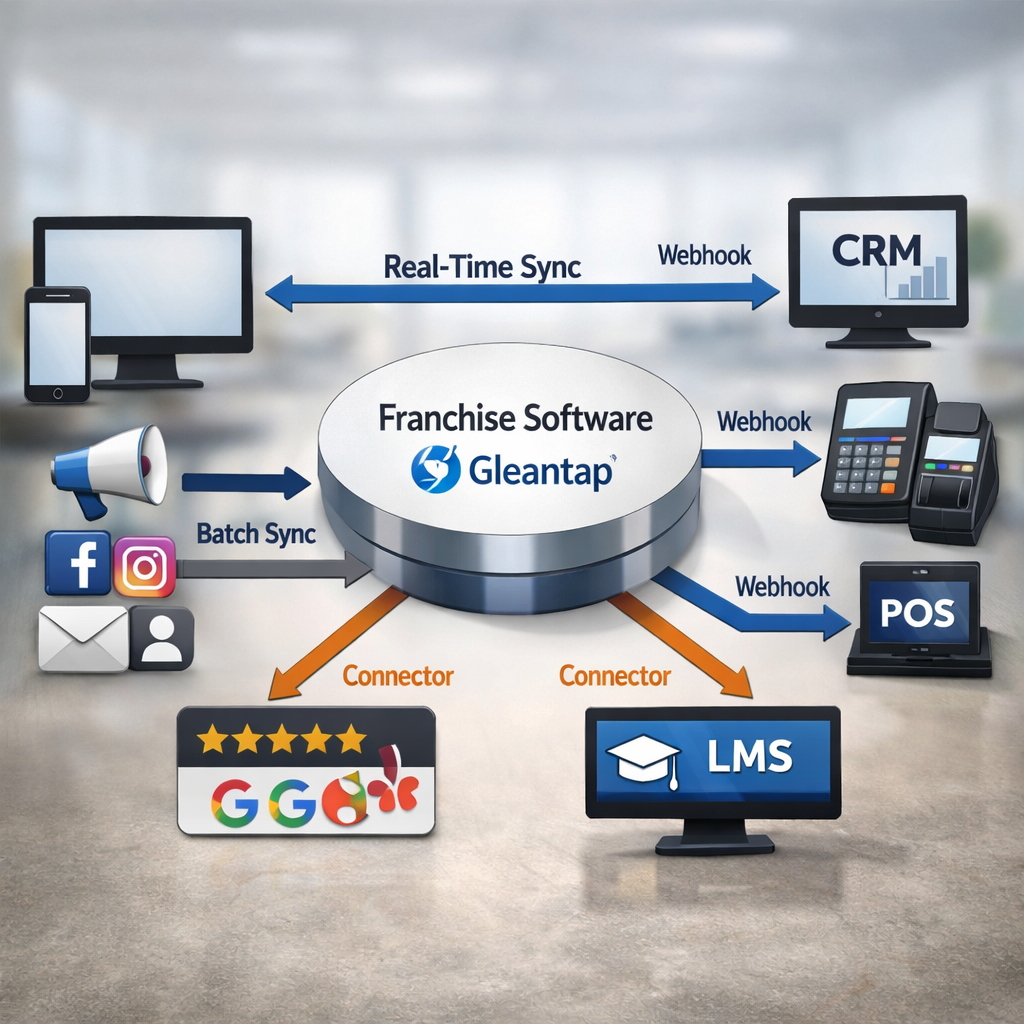
- Common targets: CRM (HubSpot/Salesforce), POS (Toast/Revel), scheduling/booking, accounting (QuickBooks), Google Business Profile and review platforms, LMS, single sign-on.
- Realtime vs batch: Use webhooks/event streams for lead routing and reputation alerts; use scheduled ETL for nightly revenue reconciliation if the POS API is rate-limited.
- Connector choices: native prebuilt connectors (fast, predictable), middleware (MuleSoft/Zapier) for orchestration, or direct API integrations if you need full control.
| Method | Best when | Trade-off |
| Native connector | Vendor has polished, maintained integration | Fast to deploy but limited flexibility |
| Middleware (iPaaS) | You need routing, transformations, and retries | Adds cost and another vendor to manage |
| Custom API | You require bespoke mapping or ownership rules | Most flexible but highest implementation and maintenance cost |
Practical insight: Resist point-to-point integrations that create spaghetti. Define a canonical lead record and a single source of truth for status fields (New, Contacted, Qualified, Closed). That prevents duplicate leads, mismatched stages in the Sales Pipeline, and the classic finger-pointing between franchisor and franchisee.
Data model, ownership, and governance
Data partitioning matters. Configure the platform so franchisors can access aggregated KPIs while franchisees retain ownership of PII and local customer records. Put clear contract language and technical controls around who can export data and who can run cross-location reports.
Concrete example: A 40-location fitness franchisor routes website leads into Gleantap for SMS-first follow up, then syncs qualified opportunities to HubSpot for enterprise pipeline management and to the POS (Toast) for final revenue attribution. The implementation used webhooks for real-time routing and nightly syncs for closed-sales reconciliation; the canonical lead ID was the key field that prevented duplicates across systems.
Security, compliance, and controls
- Minimum controls: SAML or OIDC single sign-on, role-based access control, field-level encryption for PII, and audit logs for status and price changes.
- Regulatory considerations: Treat customers in the EU or California as sensitive — implement data deletion and consent flows to satisfy GDPR and CCPA obligations.
- Operational SLAs: Ask vendors for API rate limits, error handling behaviors, and a documented rollback plan for schema changes.
Judgment: Prefer API-first, cloud-based franchise software with strong RBAC and a sandbox environment. Vendors advertising integrations but delivering only CSV imports are red flags — they will break your automated lead-to-close workflows and inflate operational costs.
Integration due-diligence checklist: Confirm webhooks and REST APIs exist; verify field-level mappings and canonical IDs; get rate limits and SLA in writing; require SSO + RBAC; insist on audit trails and export controls; test in a sandbox before pilot.
Key trade-off: faster rollouts use native connectors; long-term reliability and accurate Sales Pipeline reporting usually require a canonical data model and middleware for transformations.
6. Implementation roadmap and pilot playbook
Straight to the point: run a tightly scoped pilot that proves lead-to-revenue and reputation wins before you attempt a full rollout. A pilot is not a QA exercise — it is an evidence machine for executive buy-in and franchisee adoption.
Phase 1 — Discovery (week 0–2)
Core actions: gather stakeholder goals, map existing data flows (lead sources, POS, scheduling), and choose 3 to 6 pilot locations that represent different market types and performance tiers. Do the data audit now — dirty data is the single biggest blocker to a timely pilot.
- Deliverables: pilot charter, success criteria, integration inventory, and sandbox access for pilot locations
- Select pilots: mix of top-performers, under-performers, and average locations — avoid all champions or all laggards
- Minimum integrations: live lead capture, a POS or booking stub, and Google Business Profile for reputation signals
Phase 2 — Pilot (weeks 3–10)
Configure for outcomes, not features. Limit scope to the smallest set that demonstrates value: lead routing, SMS-first follow up, standard pipeline stages, and automated review solicitation. Adding marketing automation or full accounting in week one is a guaranteed stall.
- Week 1: configure routing rules, pipeline stages, and reputation workflows; import cleansed lead history
- Week 2–4: onboard 3 to 6 locations, run scripted role-play training, enable live lead handling (SMS + phone cadences)
- Week 5–6: collect metrics, run weekly standups with local champions, iterate templates and escalation rules
- Decision gate: meet pre-agreed KPIs (see info box). If yes, proceed to staged rollout; if no, fix adoption or integration faults and extend pilot 2–4 weeks
Practical trade-off: choose speed over completeness. A smaller, fast pilot gives measurable uplift that convinces franchisees to change behavior. A big-bang pilot that includes every integration increases risk and delays wins.
Concrete example: a 20-location fitness brand ran a 6-week pilot with SMS-driven lead workflows and automated review requests using a lead management module. They cut average lead response time from 36 hours to under 2 hours and increased trial bookings by 12 percent at pilot sites — enough evidence to fund an 8-week staged rollout.
Phase 3 — Staged rollout and governance (weeks 11–end)
Rollout pattern: stagger locations in 10–30 location waves, keep the initial feature set fixed, and run a two-week hypercare period per wave with a dedicated help desk SLA. Appoint regional champions who get weekly adoption scorecards.
- Governance: franchisor owns pipeline definitions and reporting templates; franchisees own day-to-day contact handling and local messaging variants
- Training: short micro-sessions, recorded playbooks, and how-to cheat sheets; incent early adopters with small marketing funds
- Measurement cadence: weekly adoption, biweekly KPI review, monthly executive summary
Hard judgment: integration completeness can wait until you have behavioural adoption. If franchisees ignore the tool, flawless API work is meaningless. Secure adoption first, then expand integrations for attribution and revenue reconciliation.
Pilot success criteria (example): 20 percent drop in lead response time, 10 percent lift in lead-to-appointment conversion, minimum 70 percent local user login rate during pilot, and reliable attribution of closed deals to lead source.
Next practical step: publish the pilot charter and share it with selected pilots this week. Use the pilot to validate both the technical integration and the human workflows — you need both to prove ROI.
7. Vendor shortlist and when to choose each option
Direct recommendation: pick the vendor that solves your single biggest operational gap first — for most growth-stage franchises that is either lead-to-close consistency or local reputation and reviews. Trying to buy a monolith that solves everything usually kills momentum and blows the budget.
How to read this shortlist
This shortlist groups vendors by the practical problem they solve, not by feature count. Trade-off to accept: enterprise franchise suites reduce point-tool integrations but add rollout time and cost; best-of-breed tools get faster time-to-value but force you to manage integrations and governance.
| Vendor | Best for | Strengths | Limitations |
| FranConnect | Large franchisors needing end-to-end franchise operations and development | Comprehensive franchise business management, franchise performance management, built for enterprise governance | Higher cost, longer implementation, less nimble for marketing automation |
| Naranga | Midmarket brands wanting integrated local marketing and operations | Local store marketing tools, workflows for franchise compliance, reasonable time-to-value | Fewer deep CRM sales features; may need connectors for POS or enterprise CRM |
| Salesforce Sales Cloud | Brands needing mature CRM and complex sales automation at scale | Powerful pipeline forecasting, enterprise integrations, extensible APIs | Requires franchise layer or heavy customization; expensive and needs skilled admins |
| HubSpot CRM | Franchisors prioritizing inbound lead capture and easy marketing automation | User-friendly, fast onboarding, strong marketing automations, lower admin overhead | Less suited for complex franchise reporting or strict multi-tenant data segmentation |
| Birdeye / Podium / Reputation.com | Teams that must fix local ratings and review volume quickly | Advanced review solicitation, consolidated monitoring, local response tooling | Overlap with CRM workflows; additional cost and another integration to manage |
| Gleantap | Brands prioritizing SMS-driven lead follow up and local sales pipeline consistency | Fast lead routing, SMS-first nurture sequences, local-sales-focused pipeline management; partner program for integrations | Not a full ERP; you will still want POS or accounting integrations for revenue reconciliation |
Practical selection rule: if your immediate KPI is faster closes and fewer lost leads, prioritize a franchise CRM or lead-management tool (Gleantap, HubSpot, Salesforce). If your immediate KPI is better local discovery and conversion from search, prioritize a reputation platform (Birdeye/Podium/Reputation.com). If governance, franchisee onboarding, and territory management are the bottleneck, start with an enterprise franchise system like FranConnect.
Concrete example: A 25-location fitness chain with inconsistent follow-up and low demo bookings replaced manual texts and spreadsheets with Gleantap for SMS lead routing and a standardized pipeline. Within eight weeks pilot they cut average lead response time from 48 hours to under 15 minutes and increased demo-to-close conversion by 12 percent — an instance where speed and automation beat a broad franchise ERP.
Be realistic about integration effort. Choosing Salesforce or HubSpot without planning connectors to POS, scheduling, and Google Business Profile will give you reports that look good but miss revenue attribution. Conversely, buying a reputation solution and ignoring pipeline automation hands the win to competitors who convert faster at the local level.
Key judgement: prioritize the workflow that moves revenue fastest for your brand. Solve that well, then layer in compliance, training, and full-franchise ops.
Selection checklist: 1) Identify top KPI (response time, rating, bookings). 2) Map 3 must-have integrations (POS, scheduling, GBP). 3) Estimate time-to-value and implementation cost for the next 90 days.
If you want a quick next step, run a 6–8 week pilot with a vendor aligned to your primary KPI, require prebuilt connectors for at least two critical systems, and measure the pilot against the KPI plus net promoter changes at pilot locations. For vendor comparisons and market context, see G2 franchise management software and Capterra franchise management software.

8. KPIs, reporting, and calculating ROI
Start with a compact scoreboard. Franchisors who try to measure everything end up measuring nothing. Pick 6 to 8 KPIs that link reputation, leads, and revenue, then instrument those first in your franchise management software so you have reliable week-to-week signals.
Which KPIs matter and why
- Leading – Lead response time: average minutes to first contact per location; biggest short-term driver of close rates.
- Leading – Lead to appointment conversion: percent of inbound leads turned into booked appointments or demos; ties directly to Sales Pipeline health.
- Lagging – Appointment to close rate: percent of appointments that become paid customers; use this to benchmark sales quality across locations.
- Lagging – Average deal value: ticket size by channel and location for unit economics.
- Reputation – Average rating and review volume: track both rating and monthly review count per location for SEO and trust signals; integrate Reputation Management feeds into the dashboard.
- Engagement – Follow-up completion rate: percent of leads that completed the required automated nurture steps (SMS, call attempts).
- Churn or refund rate by location: tells you if higher conversion is eroding lifetime value.
Dashboard layout recommendation. Build a top-level dashboard that shows funnel stages by location, weekly lead volume, average rating, and a small table of top problem locations. Allow drill-down to the franchisee portal so local managers see only their slice. Use your franchise CRM software and franchise operations software connectors to avoid manual spreadsheets.
Trade-off to accept. More granularity increases accuracy but raises implementation friction. If you require per-channel attribution from day one you will slow rollout. Start with aggregated channels, prove uplift, then add finer connectors to POS, scheduling, and Google Business Profile for precise attribution.
Concrete example: a fitness franchise ran a six-week pilot using Gleantap to centralize lead routing and reputation flows. Pilot results: +100 incremental leads/month, a 5 percent lift in lead-to-close conversion, and an average ticket of 500. That produced 5 extra closes/month, or $2,500 incremental revenue per month.
ROI math and payback rules. Use this formula: incremental monthly revenue = incremental leads x conversion lift x average ticket. Then incremental monthly gross margin = incremental monthly revenue x gross margin percent. Payback period = one-time implementation cost / incremental monthly gross margin. Don’t forget recurring subscription fees – subtract them from monthly gross margin when calculating realistic payback.
| Example inputs | Value |
| Incremental leads / month | 100 |
| Conversion lift | 5% |
| Average ticket | $500 |
| Incremental monthly revenue | $2,500 |
| Assumed gross margin | 60% |
| Incremental monthly gross margin | $1,500 |
| Monthly subscription | $1,200 |
| Net monthly contribution | $300 |
| One-time implementation cost | $15,000 |
| Payback period | 50 months (15,000 / 300) |
Judgment you need to accept. If payback looks long after including SaaS fees, your next question should be whether the platform improves lifetime value or reduces churn enough to change the math. Pure lead uplifts are valuable, but the real win is combining Reputation Management and Sales Pipeline tracking so you capture both immediate closes and ongoing organic growth.
Key takeaway: Track a tight set of funnel and reputation KPIs, instrument them in your franchise software first, and run a simple ROI model that includes one-time costs and recurring subscription fees before committing to full rollout.
Next consideration: pick the KPIs you will report to franchisees versus what the franchisor uses for aggregate performance, and lock those into your reporting cadence before pilot kickoff.
9. Common pitfalls and troubleshooting
Reality check: most platform failures are operational, not technical. The software usually does what vendors promise; the failures come from poor configuration, inconsistent franchisee behavior, or integrations left half-built. Troubleshooting starts with looking for human patterns before blaming the tool.
Top pitfalls and practical fixes
- Fragmented lead attribution: Multiple capture points (web forms, call tracking, paid ads) create duplicate or misattributed leads. Fix by enforcing a single canonical lead ID, turn on de-duplication rules, and build a short audit report that flags leads with conflicting source fields.
- Delayed or missed responses: Franchisees silence notifications or ignore the app. Fix by adding an automated escalation path (after X hours escalate to regional manager) and tie a small performance KPI to response time in the rollout pilot.
- Over-automation that kills personalization: Heavy templating for Reputation Management or Sales Pipeline responses reduces conversion. Trade-off: templates speed consistency but hurt local voice. Use templates with required personalization tokens and an easy edit flow for franchisees.
- Integration drift and data hygiene: Field mappings change (menu items, service codes) and cause reconciliation errors. Fix by running a pre-rollout data audit and scheduling quarterly mapping checks; log mapping changes in the audit trail.
- SMS and privacy compliance: Opt-out handling, TCPA exposure, and timestamped consent are often overlooked. Limitations: automated SMS-first workflows are high-converting but legally risky if consent capture is sloppy. Require documented opt-in capture and store timestamps in the CRM.
- Permission and governance mistakes: Giving franchisees admin access to shared data creates forecast noise and accidental edits. Fix by locking franchisor-controlled fields, using role-based access, and documenting who can change pricing or pipeline stages.
- Reporting bias from partial adoption: Early rollouts where top performers adopt quickly will look great and mask systemic issues. Troubleshoot by splitting reporting into adopter vs non-adopter cohorts for the pilot period.
Concrete example: A 30-location gym chain using Gleantap saw a 40 percent drop in demo show rates because several franchisees disabled SMS reminders during a busy period. The fix was adding an automated reminder escalation to the regional manager after two missed reminders and rolling a short SOP that made reminders opt-out rather than opt-in. The result: show rates returned and conversion stabilized within three weeks.
Troubleshooting checklist: When something breaks, run these in order: 1) verify data flows (are captures landing in the system?), 2) check permissions and escalations, 3) run duplicate/de-dup rules, 4) inspect integration logs for failures, and 5) consult opt-in/legal logs for SMS/email issues.
Key takeaway: Prevent most trouble by designing for the weakest link: the franchisee. Lock critical business rules at the franchisor level, automate sensible escalations, and keep the initial feature set small enough to train effectively.
Next consideration: Before full rollout, run a focused audit across 6 to 10 pilot locations specifically for the items above and publish a remediation plan with deadlines — this is where most ROI is either locked in or lost.
Frequently Asked Questions
Quick reality: most buying questions are practical — cost, timeline, ownership, and whether the system will actually stop leads from slipping through cracks. Below are compact answers you can act on immediately, not vendor PR.
- How much does franchise software cost? Costs vary: expect a SaaS subscription plus per-location or per-seat fees and implementation services. Trade-off: per-location pricing scales predictably but overcharges low-usage units; per-seat pricing helps variable teams but complicates forecasting.
- How long to roll out 50 locations? Plan 3 to 6 months from pilot to full rollout. That assumes one major integration (POS or CRM). If you need multiple custom connectors, add another 6 to 12 weeks for integration work and testing.
- Who should own the project? Form a cross-functional steering team. Judgment: operations should own adoption and playbooks; IT should own integrations, security, and SSO. When ops leads, usage rises — IT alone won’t deliver behavior change.
- Can I centralize review responses while allowing local tone? Yes. Use centralized monitoring with templated responses and delegated approval queues. Limitation: automation reduces workload but does not eliminate legal or compliance review for sensitive complaints.
- Which integrations are must-haves? CRM, POS, scheduling, and Google Business Profile are essential to tie lead source to revenue. Add call tracking and ad platforms if you rely on paid acquisition for high-value leads.
- What about data portability and vendor lock-in? Demand exportable raw data and an API-first contract clause. Trade-off: platforms with deep proprietary analytics are convenient but harder and costlier to extract from later.
Concrete Example: A 30-location fitness chain ran a six-location pilot using an SMS-first lead routing flow and centralized review prompts. The pilot cut median lead response time from about 6 hours to under 20 minutes and produced a measurable uplift in trial bookings. They used those exact success criteria to negotiate a phased pricing schedule during expansion.
Practical judgment: Don’t buy on feature count. Prioritize three things in order: reliable lead routing and follow-up, data ownership and export, and proven integrations to your POS/CRM. If reputation management is core to conversion in your category, choose a platform with built-in review solicitation and profiles sync rather than bolting a separate vendor.
Negotiation checklist: require a 90-day pilot, refundable implementation milestone tied to adoption KPIs, API/data export clause, and a fixed number of free training hours for franchisees.
Hidden costs to watch: templating and playbook creation, franchisee incentives to reach baseline adoption, and cleanup of historical data before migration. Budget these or your payback period will be longer than vendor quotes imply.
- Do this next: run a two-week discovery with three representative locations to map lead flows and integrations.
- Do this next: set three pilot KPIs (lead response time, booked appointment rate, and local average rating) and a minimum success threshold before signing a roll-out contract.
- Do this next: include a contractual data export and a 90-day rollback clause in your SOW.

Ready to Run Successful Marketing Campaigns and Grow Your Business?
Gleantap helps you unify customer data, track behavior patterns, and automate personalized campaigns, so you can increase repeat purchases and grow your business.
Ready to Run Successful Marketing Campaigns and Grow Your Business?
Gleantap helps you unify customer data, track behavior patterns, and automate personalized campaigns, so you can increase repeat purchases and grow your business.