

Onboarding Automation decides whether new signups become repeat customers or quiet churn in the first 30 days. This how-to lays out day-by-day sequences, trigger logic, personalization variables, KPIs, and A/B tests tailored to fitness clubs, wellness studios, retail, healthcare, and family entertainment so a marketing or operations owner can implement and measure an automated onboarding program in weeks. Customer Retention Automation: Keeping Customers Without Constant Promotions
1. Why the first 30 days set the retention trajectory
Activation, not signup, determines whether a customer becomes habitual. Data from product and behavioral research shows that the actions a user takes in the first days after acquisition are far better predictors of long-term value than the moment they signed up. See the retention and activation research from Mixpanel and the product onboarding work at Appcues for the same pattern across industries.
Practical consequence: pick an activation event you can reliably track and tie to revenue outcomes.** If your activation signal is noisy or hard to capture, your early automation will be firing blind and you will pay for wasted messages or incentives.
Common activation events by vertical (prioritized for measurement)
- Fitness clubs: first attended session within 14 days (check-in or class attendance event).
- Wellness studios / healthcare: completed appointment or first service visit (post-visit status).
- Retail: first purchase and first repeat purchase within 30 days (transaction events).
- Family entertainment / location-based: first booking completed and second visit within 30 days (booking + entry scan).
Trade-off to accept: more granular activation signals predict retention better but increase implementation time.** Start with the simplest high-fidelity event (booking, payment, check-in) before investing in behavioral telemetry like time-on-site or content consumption. You can iterate to richer signals once the core flow is working.
Concrete example: a 10-location fitness chain defines activation as one attended session within 14 days instrumented via turnstile check-ins. They run the onboarding automation only to users who have not checked in by day 3, directing those users to easy booking links and a first-class voucher. Within two cohorts they can compare activation-to-revenue and decide whether to scale SMS nudges or switch resources to trainer outreach for high-value members.
Common mistake I see: teams treat signup as success and immediately move to retention campaigns. That inflates your early KPIs with vanity opens or clicks while leaving the real behavior — the physical visit or repeat purchase — unaddressed. Instrument the activation event before you budget offers or human outreach.
Key takeaway: define one measurable activation event per vertical, instrument it as the single source of truth for early automation, and link that event to revenue so each message has a clear ROI test.
What to instrument first (practical priority list)
- Booking or purchase confirmation — highest fidelity and lowest engineering cost.
- Entry/check-in or completed service — direct signal of value received.
- Repeat action (second purchase or visit) — the activation-to-habit bridge.
- Simple engagement signals (message clicks, voucher redeems) — useful for personalization but secondary for activation truthing.
Judgment call: invest in event tracking up front. It slows launch but prevents wasted spend on broad promotions and lets you run meaningful A/B tests. If engineering bandwidth is limited, export transactional webhooks into a CDP or use a cloud-based onboarding platform to capture the critical events without heavy custom work.
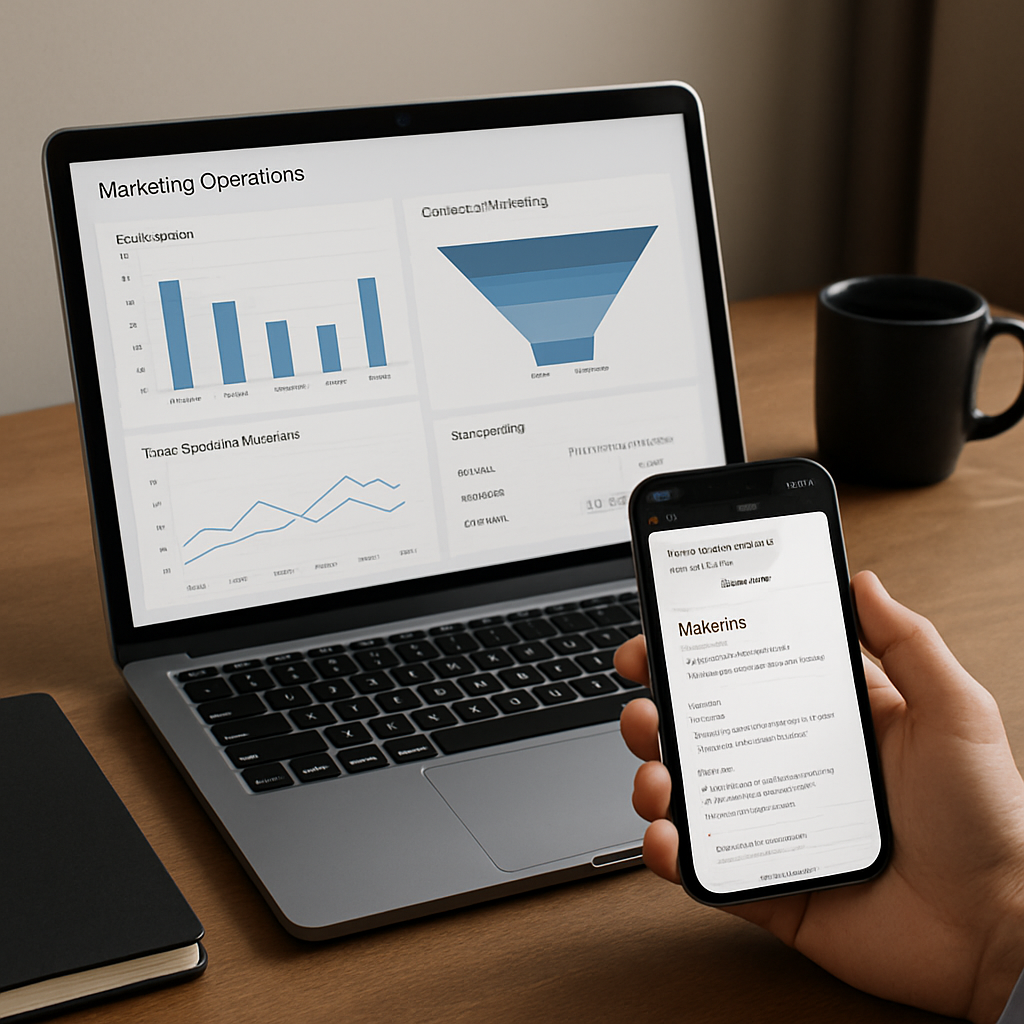
Next consideration: set simple targets for day 7 and day 30 tied to your activation event, then instrument cohort reporting to see whether your onboarding automation lifts the behavior that actually generates revenue.
2. Define measurable goals and activation metrics for days 0 to 30
Start with one north-star activation metric and three supporting KPIs. Pick the single behavior that proves your customer received core value in the first month, then use supporting metrics to diagnose where the flow breaks.
Minimum KPI set to operate on
| KPI | What to track | Measurement window | How to use it |
| North-star activation | The one event that signals value (example: completed first service, first venue check-in, or second purchase) | 0–30 days | Trigger automation eligibility and measure retention lift tied to revenue |
| Day 1 conversion to active | Percent of signups who complete activation within 24 hours | 0–1 day | Evaluates immediacy of your welcome flows and booking friction |
| Day 7 active rate | Percent who repeat the value action by day 7 or show equivalent engagement | 0–7 days | Early habit signal — good predictor of month 1 retention |
| 30-day retention (cohort) | Percent remaining engaged or retained at day 30 | 30 days | Primary outcome for experiments and ROI calculation |
| 30-day revenue per user | Gross revenue generated by the cohort in 30 days | 30 days | Converts behavior lift into monetary impact for payback analysis |
Practical trade-off: track fewer, high-quality events rather than many low-fidelity signals.** Too many KPIs produce noise—you will chase false positives from clicks and opens. If precise check-ins or transactions are available, prefer those over engagement proxies.
How to convert baseline data into numeric targets
Three step target setting: 1) measure current cohort performance for the chosen activation and 30-day retention, 2) set a realistic percent improvement based on channel lift benchmarks and budget, 3) translate that improvement into revenue to prioritize tests and spend.
- Measure a 90-day baseline cohort — capture a recent group of signups and their 0–30 outcomes.
- Choose intervention expectations — modest tests aim for 10 to 20 percent relative lift in activation; larger channel shifts should be justified by cost.
- Back into revenue — multiply incremental activations by average 30-day revenue to get a dollar ROI for the automation.
Concrete example: A neighborhood family entertainment center measures that 18 percent of new signups return within 30 days. They target a relative lift to 23 percent using a timed SMS + booking link series and estimate the added visits will drive $6,500 incremental revenue in the first three cohorts. They use that revenue projection to prioritize an SMS spend cap and a small booking voucher A/B test.
Real-world limitation: attribution will be messy when multiple channels and offers run simultaneously.** Use holdout cohorts or randomized A/B tests tied to the activation event rather than trying to attribute via last-touch heuristics. If you cannot run experiments, accept wider confidence intervals and lengthen evaluation windows.
Focus on one reliable activation event, instrument it well, and treat the rest of your metrics as diagnostic signals — not replacement goals.
Operational judgment: teams often over-index on vanity metrics like opens or coupon clicks. In practice, those move quickly but rarely correlate with durable retention. Prioritize signals that map to repeat economic behavior and make those signals the gate for automated sequences. If you need tooling, consider integrating with a CDP or an HR onboarding platform for employee-facing programs; for customer flows, a journey builder with event-based triggers cuts implementation time. See product for orchestration options.
Next consideration: once targets are set, lock in instrumentation and a control cohort before you change messaging or offers. Without that, you will not know which part of your onboarding automation actually moved behavior.
3. A practical day by day automation blueprint for the first 30 days
Start with minute-zero actions and end with decision points, not messages. Onboarding Automation should be a chain of conditional triggers that either progress a customer toward the activation event or escalate to a different treatment (reminder, human outreach, or offer) when they do not. Design each day as a single objective with a tight win condition and a clear next step.
Daily blueprint (condensed rules, then exact triggers)
- Day 0 — Minutes after signup: Send an instant SMS with {{booking_link}} and a short email with account essentials and one clear CTA. Capture UTM/referral and set the source attribute for downstream personalization.
- Day 1 — 24 hours: If no booking or check-in, send a brief value reminder SMS with a single, contextual next-step (book class, confirm appointment, browse curated products). Use {{firstname}} and {{nearestlocation}} tokens.
- Day 2–3 — Nudge window: Trigger a targeted push or WhatsApp message for users who showed intent (clicked booking link) but did not complete. Add social proof: recent attendees, a quick FAQ about first visit logistics.
- Day 4–7 — Conversion push: For users still inactive, escalate to a multi-channel touch: personalized email with recommended times based on local attendance patterns + SMS reminder. If they book, stop the escalation and trigger a confirmation flow.
- Day 8–14 — Habit seeds: For those who activated, deliver contextual onboarding content: short how-to videos, trainer introductions, or product care tips spaced across days to reduce cognitive load.
- Day 15–21 — Risk triage: Run a behavior scan. If no second visit/purchase, route high-value customers to human outreach or a one-time incentive; route low-value to automated re engagement with educational content.
- Day 22–30 — Retention play: For users who engaged, present a benefit-driven upgrade or membership reminder. For non-engagers, run a final reactivation sequence with a measured offer and add them to a longer-term drip rather than repeating the 0–30 flow.
Practical trade-off: SMS moves people fastest but inflates opt-outs if overused. Reserve SMS for time sensitive nudges and use email for richer content. If you only have one paid channel, prioritize timed SMS for the 0–3 day window and lean on email after day 4.
Real-world application: A neighborhood retail chain implemented this blueprint and used click-to-book links with stock-aware CTA tags. They removed customers from the escalation path immediately after a purchase event and routed high-spend shoppers to a concierge email — within two cohorts they reduced wasted incentive spend because fewer buyers received reactivation offers.
Implementation detail to enforce: treat the activation event as a hard cancel for upstream messages. Nothing confuses customers faster than receiving booking nudges after they already showed up or purchased. Map every trigger to the activation boolean activated = true to prevent that.
Customer Retention Automation: Keeping Customers Without Constant Promotions
Guardrails checklist: 1) one clear CTA per message, 2) activation cancels escalation, 3) channel escalation cadence (SMS -> WhatsApp -> email -> human), 4) holdout cohort for every major test, 5) per-message unsubscribe and opt-down handling.
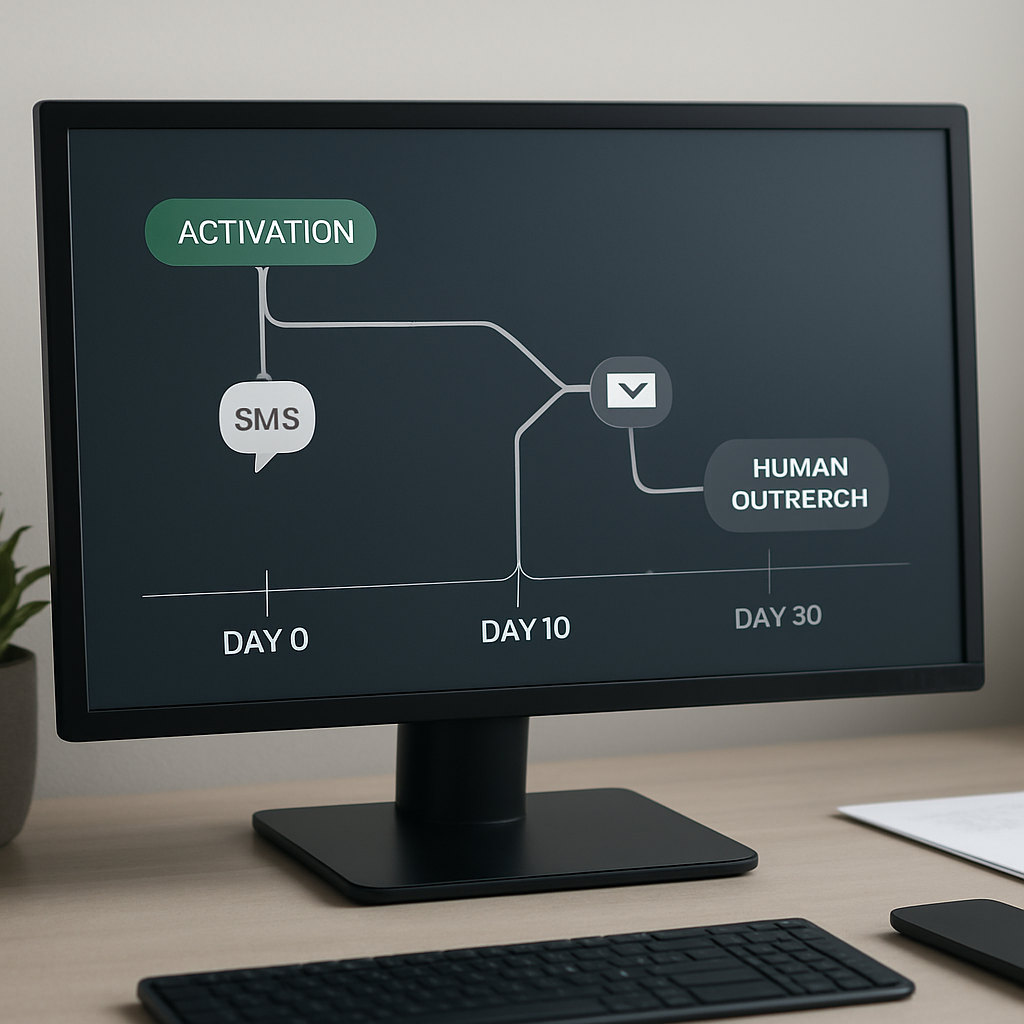
Judgment call that matters: prioritize behavior triggers over content creativity. Teams waste weeks polishing copy when the flow logic is the weak link. Get the triggers, cancel conditions, and segment routing right first — then optimize copy and microcopy in A/B tests tied to activation outcomes.
If you need a quick standard to measure success, run the blueprint on a pilot cohort with a randomized 10 percent holdout. Use that comparison to validate lift before scaling spend or adding discounts. For tooling, a cloud-based journey builder or CDP that supports event-based triggers will deliver this blueprint with minimal engineering.
4. Five automation workflows to build first
Start with the flows that move behavior, not the ones that look clever. Onboarding Automation succeeds when each workflow has a single measurable objective, a clear cancel condition tied to your activation event, and a short evaluation window. Build the highest ROI workflows first and instrument them to a holdout cohort before scaling.
Five high-value workflows (what to build, in order)
- Welcome + Activation Series — Trigger: signup or first purchase. Objective: drive the defined activation event within 7 days. Key signals: booking click, check-in, transaction; KPI: activation rate. Trade-off: aggressive timing accelerates activation but raises opt-outs on SMS.
- Behavioral Segmentation Router — Trigger: first 72 hours of behavior (clicks, no-shows, partial completions). Objective: route customers into tailored paths (no-show recovery, intent-to-book nurturing). Key signals: clicked booking_link, opened confirmation but didn’t complete; KPI: segment-to-activation conversion. Trade-off: richer segments require cleaner, faster data pipelines.
- Payment and Plan Onboarding — Trigger: first invoice, payment method added, or failed charge. Objective: eliminate billing friction and upsell appropriate plans. KPI: resolved payment rate, involuntary churn reduction. Trade-off: requires secure payment event capture and careful messaging to avoid complaint volume.
- Reengagement Ladder — Trigger: X days of inactivity (use short windows: 3, 7, 14). Objective: recover at-risk users with escalating interventions (SMS → email → one-time offer → human outreach). KPI: reengagement rate within 7 days of trigger. Trade-off: escalating offers reduce margin; prefer behavior-first remediation before discounts.
- Feedback → Referral Loop — Trigger: post-activation window (7–14 days after activation). Objective: capture NPS or quick feedback and convert promoters into referrals. KPI: survey response rate and referral conversion. Trade-off: ask too early and you get weak feedback; ask too late and you miss referral momentum.
Practical insight: prioritize the Welcome + Activation Series and Payment Onboarding when engineering bandwidth is limited. Those two workflows directly change whether a customer experiences value or leaves because of billing problems. Build the Behavioral Router next — personalization without fresh events is a waste of effort.
Concrete example: A 5-location wellness studio launched the Welcome + Activation Series first. They sent an instant SMS with a time-specific booking link, then a day-2 reminder only to people who clicked but didn’t book. After two pilot cohorts they reduced no-shows enough to stop one manual outreach shift, freeing staff time and improving appointment fill rates.
What teams misunderstand: many treat segmentation as a content problem instead of a data problem. You can write perfect conditional copy, but if your event stream is delayed by hours your router will send irrelevant messages. Real-time or near-real-time event capture is worth the early cost for these five workflows.
Customer Retention Automation focuses on keeping customers without relying on constant promotions; design workflows that restore value first, then use offers sparingly.
Quick build order and guardrails: 1) Welcome + Activation, 2) Payment/Plan, 3) Behavioral Router, 4) Reengagement Ladder, 5) Feedback/Referral. Enforce activation as a hard cancel, limit SMS touches in days 0–3, and use randomized holdouts for every major change.
Next consideration: ship these flows incrementally, measure activation and short-window revenue, then invest in richer personalization (predictive propensity, adaptive learning) only after the core logic reliably moves behavior. If you need orchestration tooling, see product for event-based routing and real-time triggers.
5. Personalization and predictive signals that reduce early churn
Direct point: using a small set of timely predictive signals to drive personalization reduces early churn more than broad personalization that waits for weeks of data. Quick, accurate routing beats broad creativity.
Which signals matter right away: prioritize signals that indicate intent, friction, or value capture. Examples: how long between signup and first booking, whether the new customer opened the confirmation but did not complete check-in, and initial channel preference (SMS, email, or WhatsApp). These are high-signal events you can capture without machine learning and use immediately for routing.
How to introduce predictive routing without heavy engineering
Follow a staged approach: start with simple rules, monitor outcomes, then graduate to a lightweight predictive model only if the rules miss meaningful segments. Rule-based thresholds are fast to implement in most journey builders and usually capture the majority of early churn cases.
- Collect immediate events: capture signup timestamp, booking attempts, payment success/failure, and first channel used.
- Define a short-lived risk flag: e.g., No booking within 72 hours OR clicked booking link but no check-in within 7 days = at-risk-new.
- Map treatments to risk tiers: automated nudge for low risk, prioritized SMS + human call for high-risk high-LTV, educational drip for intent-but-no-action cases.
- Measure and iterate: run a randomized holdout for the high-risk treatment to estimate lift before scaling human outreach.
- If moving to ML: keep models small (one or two features at first), retrain weekly during rollout, and threshold decisions conservatively to avoid over-intervention.
Practical trade-off: aggressive personalization and aggressive outreach both carry costs. A finely tuned predictive model can reduce wasted SMS and unneeded incentives, but building and maintaining that model requires clean event streams and ongoing validation. If your event latency is minutes to hours rather than real-time, prefer rules over models until you fix ingestion.
Concrete use case: a boutique fitness studio created a binary churn-propensity flag from three inputs: days-to-first-booking, booking-link click behavior, and membership tier. Members flagged high risk were routed to a trainer callback within 48 hours and received a single-session onboarding invite. The studio reduced manual follow-ups and increased the share of new members who attended a first session within two weeks.
Minimal-engineering personalization you can ship this week: dynamic subject lines based on booking intent, conditional CTAs that switch from Book Now to View Class Times, location-aware recommended timeslots, and time-zone adjusted send windows. These are available in most modern journey builders and deliver most of the practical benefit of personalization without custom models.
What people get wrong: teams often deploy predictive scores but fail to assign coherent actions. A score without mapped treatments is noise — the real ROI is the change in intervention mix (who gets a call, who gets an extra SMS, who gets a human). Start with actions, then tune the score to improve action efficiency.
Key takeaway: implement a short-lived risk flag and match it to narrowly defined interventions. Use rule-based routing first; graduate to small models only when you can capture events in near real-time and run holdouts to prove lift.
Customer Retention Automation: Keeping Customers Without Constant Promotions

Next consideration: treat predictive routing as an operational program: set SLA for human follow-up, monitor false positives, and lock a measurement cadence to validate whether the personalization reduces real behavioral churn. If you need orchestration, see product for examples of event-driven routing and holdout experiments.
6. Measurement plan, dashboards, and experiments to run in 90 days
Direct point: A short, disciplined measurement plan is the difference between sending messages that feel busy and running onboarding automation that actually changes behavior. Start by defining the cohorts and the single primary outcome you will optimize for, then build dashboards and experiments that test whether the flow moves that outcome.
Cohorts, controls, and cadence
Cohort rules: Use signup date as the anchoring field, split by acquisition channel and location, and create a randomized control group that does not receive the new onboarding sequence. Do not mix cohorts across multiple major creative or offer changes — isolate one variable per experiment series.
Practical consideration: Use a power calculator to estimate required sample size based on your baseline activation and expected relative lift. Small businesses should prioritize test simplicity — longer evaluation windows with clean randomization beat underpowered quick experiments.
Dashboard patterns that expose real impact
Dashboard design: Build compact widgets that answer specific decisions. Keep these live: a cohort retention curve (day 0 through 30), an activation funnel with cancel logic marked, a revenue-per-cohort view, and an experiment results panel with confidence intervals and sample sizes.
Avoid noise: Don’t clutter the main dashboard with open or click rates. Those are diagnostic; put them on a secondary tab. Your primary view must show behavior and dollars — visits, bookings, completed services, and 30-day revenue attributed to the cohort.
90-day experiment roadmap (prioritized)
- Test 1 — Welcome timing: Hypothesis: sending an immediate SMS within minutes increases day 1 activation versus a delayed (2–4 hour) SMS. Measure activation at 7 days; holdout 15% of new signups as control.
- Test 2 — Message framing: Hypothesis: a value-first message (what they get) outperforms a discount-first message. Evaluate 14-day activation and incremental revenue per converted user.
- Test 3 — Recommendation type: Hypothesis: personalized class recommendations based on local attendance outperform a generic class list. Run across two locations and track booking-to-attend conversion.
- Test 4 — Channel sequence: Hypothesis: SMS-first then email vs email-first then SMS changes opt-out and activation dynamics. Track unsubscribe rates alongside activation to measure cost of urgency.
- Test 5 — Reengagement ladder: Hypothesis: a tiered escalation (automated nudge → small incentive → human outreach) recovers more users per dollar than blanket discounts. Use cost-per-recovered-user as the KPI.
- Test 6 — High-LTV treatment: Hypothesis: routing top-tier customers to human outreach reduces churn more than automated messages. Randomize only high-value segment to validate ROI before scaling staff time.
Trade-off to accept: Faster wins come from single-variable A/Bs. Multi-arm and factorial tests are tempting but require much larger samples and complicate attribution. Run simple A/Bs first, then combine winning variants into a confirmatory multivariate test.
Concrete example: A 7-location fitness operator ran Test 1 with two-month rolling cohorts. They randomized new signups and measured booked-and-attended sessions at day 7. Immediate-SMS produced higher attendance in week one and allowed them to cut a manual call campaign, recovering staff hours for onboarding calls.
Measurement checklist: 1) Define primary outcome and cancel conditions; 2) Create randomized control groups; 3) Use cohort retention curves and revenue-per-cohort widgets; 4) Require minimum sample and pre-registered evaluation windows; 5) Escalate winners into production only after a confirmatory run. Customer Retention Automation: Keeping Customers Without Constant Promotions
Next operational step: Lock your instrumentation and control before you change message copy or cadence. If you need orchestration tooling that supports event-driven experiments and holdouts, consider a CDP or a journey builder like product to shorten the implementation loop.
7. Vertical specific sequences and sample messages
Vertical precision matters. The same 0–30 day cadence fails or succeeds depending on contextual triggers: booking confirmations for appointments, entry scans for venues, or shipment updates for retail. Build sequences around the event that best represents a first meaningful use for that vertical and keep the language and CTAs tightly relevant to that action.
Fitness clubs — booking-to-attend focused
Core treatment: short, actionable nudges that remove friction to the first visit and connect new members to staff. Use trainer introductions and class-specific CTAs rather than generic membership copy.
- SMS (minutes after signup): Hi {{firstname}}, welcome — tap to book your first class at {{nearestlocation}}: {{booking_link}}. Seats fill fast.
- Email (1 day): What to expect on your first visit — quick checklist, map, and a short trainer intro video. CTA: Confirm your spot.
- WhatsApp (day 3 if no-show): We noticed you haven’t attended. Reply 1 for help booking with a trainer or 2 to see class times this week.
Practical trade-off: aggressive SMS nudges lift attendance but increase opt-outs. Reserve two SMS nudges in days 0–3 and move richer content to email or WhatsApp.
Wellness studios and healthcare — consent and reassurance first
Operational constraint: privacy and consent change message design. Avoid clinical detail over open channels; use secure links for records or PHI and prefer appointment-confirmation flows that minimize back-and-forth for staff.
- Automated email (immediate): Appointment confirmed for {{appointmenttime}}. Please complete intake form here: {{secureform_link}}.
- SMS (48 hours before): Reminder: Your visit at {{location}} on {{appointment_time}}. Reply C to cancel or R to reschedule.
- Post-visit message (24 hours after): Thanks for coming. Here are aftercare tips and a prompt to book follow-up: {{bookfollowuplink}}.
Limitation to plan for: secure link expirations, multi-guardian bookings, and state-level privacy rules may force you to maintain parallel flows. Accept slightly slower automation in exchange for compliant, scar-free communication.
Retail and family entertainment — transaction-first nudges
Tactical insight: in retail, shipping and product care become activation signals; in family entertainment, group confirmations and arrival logistics reduce no-shows. Use transaction metadata to personalize recommended next actions.
- Email (after purchase): Thanks {{firstname}} — order #{{orderid}} is confirmed. Care tips and related picks below. CTA: Reorder essentials.
- SMS (3 days after event purchase): Bring the kids? Print-free entry at gate with code {{entrycode}}. Park map: {{maplink}}.
- Push or WhatsApp (day 7): Loved your visit? Book a party or get 10 percent off next booking with code WELCOME10 — valid 14 days.
Real-world example: A suburban family entertainment center automated a two-step confirmation that included a printable-free entry code and a map link. That single improvement cut arrival confusion and reduced same-day cancellations, increasing realized attendance for new bookings by measurable margins within two cohorts.
Customer Retention Automation: Keeping Customers Without Constant Promotions
What teams miss: templates without conditionals create noise. Include simple cancel logic (activated = true) and conditional blocks like if bookingclick and not checkedin then send reminder; otherwise stop. Personalization that shows the wrong location or expired code is worse than no personalization at all.
Execution checklist (quick): map the vertical activation event, author channel-specific short-copy templates with {{tokens}}, define cancel rules, set SMS caps for days 0–3, and pilot with a 10 percent holdout before scaling. Use product or a journey builder that supports event-based cancels and secure links.

Next consideration: pick one vertical and one sequence to pilot for 30 days, instrument activation cleanly, and treat misfires as data problems to fix (wrong token, stale inventory, or delayed events) rather than copy failures.
8. Implementation checklist and team responsibilities
Direct point: Implementation fails faster from fuzzy ownership than it does from a poor message. Assign names, deadlines, and cancel conditions before you touch copy or build journeys.
30-day launch checklist (10 items)
- Event schema locked: Define the exact event names and payloads (signup, bookingclick, checkin, purchase) and publish the schema to all teams.
- Data plumbing verified: End-to-end test that events arrive in your CDP/journey engine within the SLA you set (see info box).
- Template library completed: Short, channel-specific copy with tokens and fallback text for missing attributes.
- Journey build finished: Conditional paths, cancel logic (activated = true), and escalation branches implemented in the builder.
- Compliance and consent check: Ensure opt-ins, secure links, and any regional privacy rules are handled before sending.
- QA and preview runs: Live tests for 50 records across browsers, carriers, and locales; verify tokens and link resolution.
- Pilot cohort defined: Randomized cohort (10–20%) and a holdout control that receives baseline comms only.
- Analytics dashboard ready: Cohort retention curve, activation funnel, and experiment panel with pre-registered windows.
- Operational playbook distributed: SLAs for human follow-up, opt-down handling, and support scripts for front-line staff.
- Stakeholder sign-off and go/no-go date: Marketing operations, analytics, and a site representative sign approval and deployment time.
Practical trade-off: If you rush and skip schema locking, you will send irrelevant messages and inflate opt-outs. If you wait for perfect data, you delay learning. Ship with the minimal reliable events and tighten the schema in sprinted iterations.
Who owns what (clear handoffs)
Marketing operations owner: build journeys, author templates, set cadence, and own the deployment runbook. They are the day-to-day owner of the onboarding automation pipeline.
Analytics owner: owns cohort definition, control randomization, dashboarding, and experiment integrity. They gate any metric changes and validate lift before scale.
Front-line triggers owner: site managers or operations leads ensure on-the-ground events (check-ins, appointment completions) are reflected accurately and troubleshoot mismatches within 24 hours.
Escalation owner: designated person or small team responsible for human outreach when a high-value user hits the at-risk flag and for prioritizing callbacks within agreed SLA.
Engineering liaison and Legal: engineering supports event reliability and integration work; legal signs off on consent language and secure links. These are not optional approvals — they are deployment blockers if missing.
Operational SLAs to lock before launch: event latency under 15 minutes for core events; QA token resolution success > 99%; pilot sample size sufficient to detect your target lift (use a power calculator); human follow-up SLA = 48 hours for high-LTV at-risk users.
Concrete example: A three-location wellness studio assigned Marketing Ops to build and run the pilot, Analytics to own cohorts and dashboards, and one manager at each location to verify check-in events. They piloted 400 signups with a 15 percent holdout; analytics proved a 12 percent relative increase in week-1 activations and the studio reallocated one staff shift to coach follow-ups.
Judgment: Centralize decision rights but decentralize execution. Marketing Ops should control the orchestration, and Analytics should veto metric definitions. Front-line staff must be empowered to fix event mismatches rather than log tickets — that reduces time-to-correct and prevents noisy data from poisoning experiments.
Roadmap to scale: after a successful pilot, expand by location in weekly batches, add a predictive risk tier for routing high-LTV users to human outreach, and roll out multilingual templates where demand justifies cost. Keep a permanent holdout cohort to detect fade in lift as you scale.
Customer Retention Automation: Keeping Customers Without Constant Promotions
Next consideration: schedule a pilot retrospective 7 days after cohort close and freeze the control before any copy or incentive changes. That discipline protects your ability to learn what actually moves activation.
Frequently Asked Questions
Straight answer first: these FAQs focus on operational decisions that determine whether your onboarding automation creates repeat behavior or wastes budget. The emphasis is on decisions you can make this week: what to measure, how to route users, what not to automate, and where to insist on a holdout.
How do I choose a single activation metric that actually predicts value?
Pick the simplest transaction or physical action that ties to repeat behavior. For many membership businesses that means a completed visit, a redeemed appointment, or a second purchase within a set window. Avoid proxies like open rates or link clicks as your north-star — they correlate poorly with long-term revenue.
Which channels should I use in days 0–7 and how aggressive should the cadence be?
Use the fastest, highest-read channels for time-sensitive nudges and slower channels for context. SMS or WhatsApp work best for minute-to-day nudges (0–3 days), email is the place for procedural content and richer onboarding, and push/in-app is useful only if you have an engaged app audience. The trade-off: quicker nudges move behavior but increase opt-outs; prioritize immediacy for short windows and back off frequency after 72 hours.
What sample sizes do I need for reliable A/B tests on onboarding flows?
There is no magic number — it depends on baseline conversion and the lift you expect. Use a power calculator before you launch. As a rule of thumb, plan for several hundred users per arm to detect modest lifts; if your baseline activation is low, you will need larger samples or longer test windows. If you cannot reach those numbers, prefer holdout controls and longer evaluation periods rather than underpowered A/Bs.
When should I use incentives versus product-led nudges?
Default to behavior-first nudges and save incentives for situations where friction cannot be removed. Offers mask root problems and train customers to expect discounts. Use a targeted incentive only after you have validated that a non-monetary nudge (timed booking link, curated recommendation, human touch) fails for a measurable segment.
How do I personalize without a data science team?
Ship rule-based personalization first. Implement conditional tokens (nearest location, preferred time slot, membership tier) and simple routing rules (clicked booking link but no-checkin → reminder; paid but no-booking → concierge call). These deliver most of the performance lift you need and keep complexity manageable.
What are the common technical failure modes to watch for?
Event delays, token failures, and missing cancel logic are the usual culprits. If your event stream lags by hours, your router will send irrelevant nudges; if tokens fail you send inaccurate personalization; if activation is not a hard cancel you risk confusing customers with repeated CTAs. Set a short SLA for event delivery, build token fallbacks, and map cancel conditions explicitly in every journey.
How quickly should I expect measurable impact after launching an onboarding program?
You will see changes in day 1–7 activation within the first cohort; meaningful day 30 retention shifts need one to three cohorts. Short-term wins let you reallocate resources fast (for example, cutting manual outreach), but use holdouts to prove causality before scaling incentives or hiring staff to support a flow.
Concrete example: An urban coworking operator automated an instant-access SMS with a desk reservation link and a follow-up reminder 48 hours later for users who clicked but didn’t confirm. After two 30-day cohorts they measured a clear rise in first-week desk reservations and reduced the number of manual onboarding calls, which freed staff capacity for hot leads.
Quick FAQ checklist: 1) Lock one activation metric and make it the cancel signal for all flows; 2) Use SMS for 0–3 day nudges and email for richer content; 3) Run holdouts or powered A/Bs before rolling incentives; 4) Build token fallbacks and require event latency SLAs; 5) Route high-LTV at-risk users to human outreach only after testing.
Judgment call that matters: do not let creative A/Bs replace basic experimental discipline. High-quality holdouts and clean event instrumentation are cheaper and more informative than dozens of copy variants that never prove they moved real behavior.
Next actions you can take in 72 hours: 1) define and instrument one activation event and a simple cancel flag; 2) build a two-message 0–3 day flow (instant SMS + 48-hour reminder) with token fallbacks; 3) create a randomized 10–20 percent holdout and start a one-cohort pilot; 4) measure day 7 activation and plan a powered A/B for message timing if your sample allows. These are concrete, low-friction steps that expose whether your onboarding automation moves behavior.

Written by
Sarah Kim
Sarah is a CRM and customer data specialist who helps B2C brands turn raw data into personalised experiences. With a background in customer success, she writes about segmentation, customer journey mapping, and making the most of your CRM platform.
Recent blog posts
Back to blog

Ready to Run Successful Marketing Campaigns and Grow Your Business?
Gleantap helps you unify customer data, track behavior patterns, and automate personalized campaigns, so you can increase repeat purchases and grow your business.
Ready to Run Successful Marketing Campaigns and Grow Your Business?
Gleantap helps you unify customer data, track behavior patterns, and automate personalized campaigns, so you can increase repeat purchases and grow your business.