
 Divya Ghughatyal
Choosing the right franchise marketing software determines whether local promotions scale cleanly or become a compliance and attribution headache. This list compares the leading platforms by franchise-focused criteria, including centralized approvals and local customization limits, SMS and messaging, listings and reputation management, POS and CRM integrations, and rollout readiness. You will get concise vendor profiles, realistic pros and cons, and a practical 90-day pilot checklist to shortlist and test two platforms across your network.
1. Gleantap
Straight answer: Gleantap is a messaging-first franchise marketing software that delivers fast local lift for membership-driven and service franchises, but it is not a one-stop solution for paid local advertising or complex POS-driven attribution.
Core franchise features that matter
- SMS and automated messaging: location-level workflows, welcome sequences, appointment reminders, and segmentation for churn prevention
- Referral and rewards workflows: built-in referral funnels and incentives tuned for membership growth
- Centralized templates with local controls: corporate creates approved templates; franchisees can personalize within set limits
- Location-level reporting: campaign and message-level metrics broken down by location and by campaign
- Simple integrations: connectors and APIs aimed at CRMs used by fitness and service brands though not as extensive as enterprise middleware
Key judgment: For franchise systems that measure success in new-member signups, referral conversions, and immediate visit frequency, Gleantap usually produces faster measurable ROI than broad marketing suites. For networks that depend on layered local paid media, complex co-op reconciliation, or deep POS attribution, expect to run Gleantap alongside other tools rather than replace them.
Practical tradeoffs
Tradeoff: You gain speed to value and higher open rates with messaging, but you trade off broad media orchestration and some enterprise integrations. If your rollout requires centralized paid ad orchestration, local SEO at scale, or complex co-op management, plan to integrate Gleantap with a listings or co-op platform such as Yext or BrandMuscle.
Concrete example: Run a 90-day pilot across 10 representative locations where the goal is to increase new-member conversion and referral volume. Deploy a 3-message welcome series, a referral push with a tracked offer code, and a weekly retention check-in. Measure new-member lift, referral conversion rate, and cost per new member by location; expect meaningful lift in the first 30 days if lists and opt-ins are healthy.
If your priority is fast membership growth and referral economics, start with Gleantap. If you need enterprise-level local ad orchestration or co-op fund management, treat Gleantap as the engagement layer rather than the whole stack.
Quick test to validate fit: pick 10 diverse locations, map current opt-in rates, launch a referral + SMS welcome funnel, and use location-level reporting to compare incremental new members to a matched control group over 90 days.
Integration note: prioritize connectors to your CRM and POS so you can attribute conversions. Use Gleantap alongside a listings or reputation product if discoverability is weak – see Think With Google on multi-location search behavior and Twilio for SMS best practices.
Next consideration: if opt-in hygiene or message volume costs are a concern, run a small pilot to establish unit economics before committing to network-wide rollout.

2. SOCi
Straight to the point: SOCi is worth evaluating when fractured local presence and reputation management are the primary barriers to discoverability and footfall across dozens or hundreds of locations. It centralizes listings, reviews, social, and local paid media so headquarters can enforce brand consistency while local teams still publish market-relevant content.
What SOCi actually does for franchises
- Listings and knowledge management: keep NAP, hours, and attributes consistent across directories and maps to reduce customer confusion and lost visits.
- Review moderation at scale: flag, respond, and route reviews to local teams with audit trails and centralized response templates.
- Localized social content and paid media: roll out a national creative with per-location overrides and manage local ad budgets from one pane.
- Enterprise reporting and governance: multi-location dashboards, approval workflows, and permissioning that map to franchise hierarchies.
Practical tradeoff: SOCi buys you control and visibility at scale but introduces cost and operational overhead. Expect a non-trivial onboarding effort to clean existing location data, train local operators, and lock down approval workflows. For teams that need rapid, message-driven conversion (SMS referrals, welcome flows), SOCi is complementary rather than a standalone growth engine.
Integration reality: SOCi integrates with major ad channels and local listing sources, which simplifies paid local media and discovery tracking, but accurate revenue attribution still requires POS or CRM links. If you do not connect transactions back to locations, you will measure impressions and clicks, not true lift in sales or memberships.
Concrete use case
Concrete Example: A 75-location regional restaurant chain used SOCi to standardize listing data and centralize review replies. Within the first 8 weeks they reduced conflicting directory records dramatically and had a single workflow for review escalation, which cut average response time and increased local map clicks from targeted locations. The chain then layered a messaging program with a platform focused on SMS-driven offers to convert that increased discovery into incremental visits.
| SOCi capability | What it fixes for franchises |
| Listings and local pages | Removes inconsistent business data that suppresses search visibility and causes missed visits |
| Review management | Improves local reputation and provides a single source of truth for customer issues |
| Local paid media orchestration | Reduces agency friction and enforces brand-compliant ad creatives across markets |
Judgment call: Choose SOCi when local discovery and reputation are growth gatekeepers. If your funnel problem is conversion after discovery, pair SOCi with a messaging-first solution.
Key takeaway: SOCi is best as the foundational layer for multi-location discoverability and reputation. Plan for a 60- to 90-day cleaning and onboarding phase, then phase in local paid media. Combine SOCi with a dedicated messaging or loyalty platform to convert improved visibility into measurable revenue.
Pilot recommendation: Start with a 50-location cluster focused on listings and reviews for 90 days. Track NAP accuracy, review velocity and sentiment, map-driven clicks, and downstream conversions if POS/CRM is connected. If you see sustained lift in discovery metrics, expand to local paid media orchestration.
Further reading: For context on multi-location behavior and why consistent local presence matters, read the industry findings at Think with Google.
3. BrandMuscle
Plain fact: BrandMuscle is built around co-op advertising, creative distribution, and strict brand compliance, not around messaging-first local engagement. Visit BrandMuscle to see their positioning. For franchise leaders who need financial controls and versioned creative rolled out to hundreds of locations, BrandMuscle is often the default choice.
Where BrandMuscle actually helps
- Co-op and fund management: Tracks spend, claims, and reimbursements so franchisors can enforce co-op rules and automate reconciliation.
- Creative distribution at scale: Central teams publish approved templates and localized variations while preserving mandatory brand elements.
- Digital asset management: Single source of truth for logos, legal copy, and campaign assets that reduces rogue creative use.
- Compliance and approval workflows: Built-in gates prevent unapproved local edits and provide audit trails for regulated industries.
- Reporting on creative uptake: Measures which local assets are used and ties that to campaign-level spend and claims.
Trade-offs you must accept
Key trade-off: Brand control at this level comes at the cost of local speed and experimental flexibility. The platform enforces templates and approval steps that reduce creative errors, but they also slow down hyperlocal A/B testing and fast-turn promotions.
Integration reality: BrandMuscle handles creative distribution and co-op accounting well, but it is not a full-stack local marketing platform. You will almost certainly need a separate messaging or local listings tool for SMS, reputation, and POS-driven attribution. Pairing BrandMuscle with an SMS-first vendor or a listings specialist is common and recommended.
Cost and rollout: Expect enterprise-level contracts and a heavyweight onboarding cycle. Smaller franchise systems often overpay for capabilities they do not use; evaluate whether co-op reconciliation is a current need or a future one before committing.
Concrete example: A regional quick-serve restaurant with 200 locations used BrandMuscle to run a seasonal promotion distributed as approved creative templates. The brand eliminated frequent local compliance failures and automated co-op claims, but store managers reported longer time-to-launch for localized offers. The outcome was improved auditability and cleaner fund reconciliation, with a trade-off in activation speed.
How to test BrandMuscle without overcommitting
- Pick a single campaign type: Use BrandMuscle for one repeatable campaign (seasonal offer or co-op-funded radio/digital buy) rather than all campaigns.
- Scope a 20-location pilot: Include corporate-run, franchisee-run, and underperforming units to surface operational issues.
- Define measurement: Track time-to-launch, percent asset adoption, claim reconciliation accuracy, and local sales lift attributable to the campaign.
- Prepare integrations: Map co-op account codes to your finance system and plan a light integration with your CRM or POS for attribution.
- Pair with engagement tools: Run creative through BrandMuscle while using a messaging tool for customer-facing outreach.
Practical takeaway: Choose BrandMuscle when co-op fund governance and brand-compliant creative distribution are business-critical. If your priority is fast local activation, SMS-driven growth, or listings/reputation management, treat BrandMuscle as part of a toolchain, not a single-vendor solution.

4. FranConnect
Core claim: FranConnect is a franchise operations and development platform that brings marketing into the same data model as sales, operations, and finance rather than standing alone as a point marketing tool. That architectural choice is its strength and its constraint.
What FranConnect actually gives you
- Unified franchise data model: centralized lead management, territory assignments, and franchise development pipelines that connect marketing activity to signed units and royalties.
- Marketing resource management: campaign templates, approval workflows, and asset distribution so local teams get brand compliant creative without manual approvals.
- Reporting and analytics software: franchise-level performance dashboards tying campaigns to development and operational KPIs for cross-functional visibility.
- Franchisee support tools: onboarding workflows, training trackers, and co-op reconciliation features that reduce administrative friction for approved campaigns.
Practical insight: Because FranConnect ties marketing into development and operations it becomes the single source of truth for attribution across multiple stakeholders. That makes it far easier to report which national or regional campaigns actually delivered signed franchises or incremental revenue.
Where FranConnect is a tradeoff, not a silver bullet
- Breadth over depth: the platform covers many franchise workflows but it is not purpose-built as an SMS-first or paid local ad orchestration tool. Expect to pair it with messaging platforms, local ad managers, or local SEO tools for growth campaigns.
- Implementation effort: meaningful value requires clean location and CRM data, which often reveals months of data hygiene work and process redefinition during rollout.
- Speed vs governance: centralized approvals and compliance reduce brand risk but slow local campaign launch cadence; local teams will push back unless you provide templated quick-start content.
Concrete example: A national recruitment campaign run through FranConnect can route incoming franchise leads to assigned territory reps automatically, record marketing source attribution, and follow each lead through qualification to a signed franchise. In practice one franchisor reduced lead leakage between regions and shortened the sales cycle by tracking lead age and campaign source in the same dashboard.
Another use case: Use the marketing resource management module to push a brand compliant promotion to 200 locations with locked fields for pricing and editable fields for imagery and local contact. That prevents local deviation while still allowing necessary region-specific details.
If your priority is operational control and end-to-end franchise reporting choose FranConnect; if your priority is fast local customer engagement via SMS or hyperlocal paid ads, pair FranConnect with a messaging or local marketing specialist.
Key takeaway: FranConnect wins when you need a single platform to connect marketing spend to franchise development and operations. Do not expect it to replace dedicated local messaging, review management, or paid ad orchestration tools.
Implementation recommendation: Run a 90-day pilot that focuses on lead generation and campaign approval workflows across 10 pilot territories. Measure lead conversion to qualified meeting, time-to-assign, campaign adoption rate by franchisee, and whether reporting reduces manual reconciliation. Use the pilot to define which specialist marketing tools must remain integrated – for example tie in a messaging platform for customer-facing offers and a local listings product for discoverability.
When assessing FranConnect, ask for concrete examples of connectors to your POS and CRM, request sample reports that marry marketing source to signed unit metrics, and insist on a data cleanliness plan up front. If you skip that, the integrated model becomes a liability rather than an advantage.
Takeaway: Use FranConnect when you want marketing to report into franchise development and operations rather than operate as a silo. Expect to pair it with best-of-breed local marketing and messaging tools for execution speed and customer engagement.
5. Yext
Straight talk: Yext is the best tool you can buy to stop incorrect location data from sabotaging local discovery, but it is not a marketing automation platform. Expect real gains in search visibility and fewer lost calls – not turnkey increases in same-store sales without additional engagement channels and measurement work.
What Yext actually delivers for franchises
Core strengths: Yext centralizes your location knowledge – names, addresses, hours, menus, services, and structured attributes – and pushes that to search engines, maps, and directories. That reduces listing friction at scale and cleans up duplicate or outdated records that fragment local SEO and call routing.
- Synchronized data at scale: bulk updates, scheduled changes for holidays, and attribute-level control for thousands of locations.
- Local page management: templated local landing pages that inherit brand content while allowing limited local edits.
- Review monitoring and response workflows: centralized queues with role-based access for regional marketing or local managers.
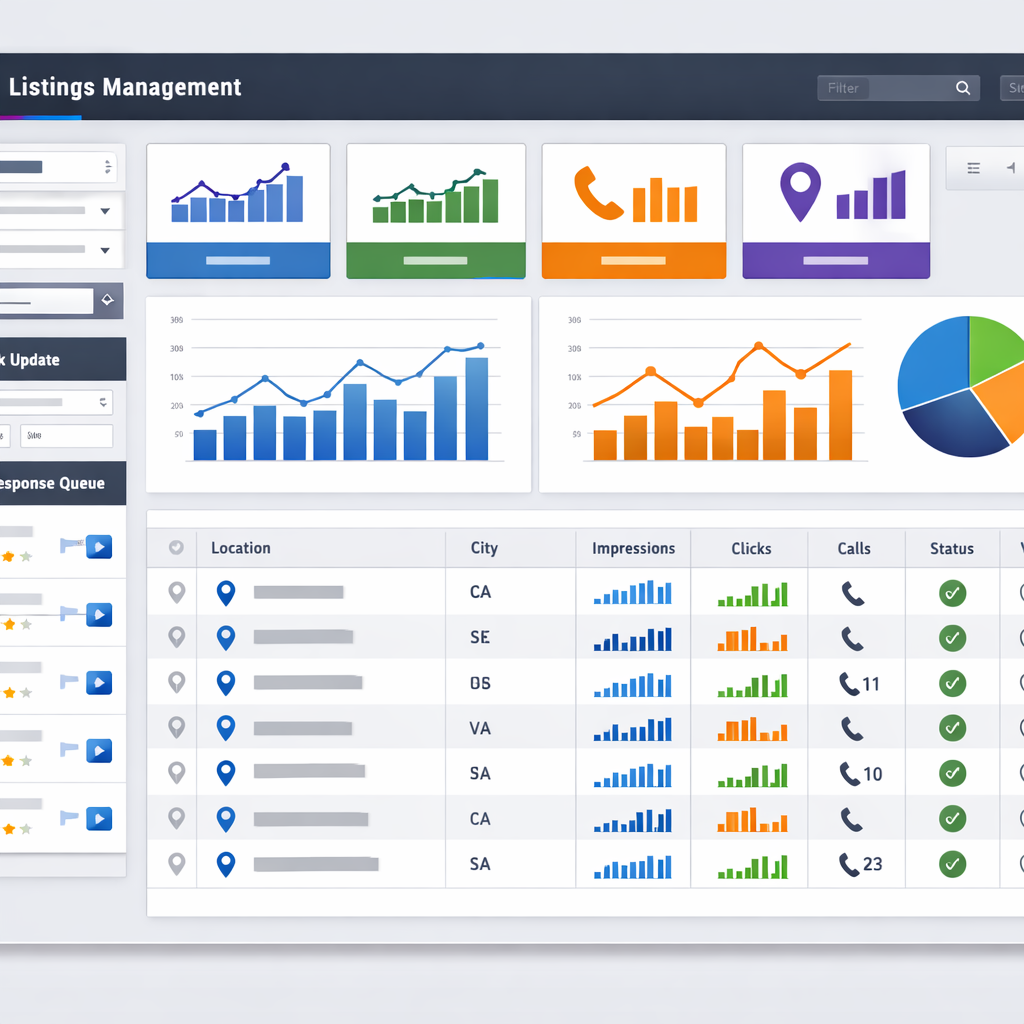
- Analytics on discovery and engagement: impressions, clicks, calls, direction requests, and page-level performance to prioritize markets.
Important tradeoff: centralizing listings improves consistency but creates governance work. Franchise agreements often give local owners control over their Google Business Profile. Using Yext to claim and control listings can require negotiated access changes and training – expect legal and operational coordination, not just a tech rollout.
Measurement limitation: Yext shows discovery signals and engagement events, but those signals are a proxy. To convert improved discoverability into reliably attributed revenue you will need unique tracking – local landing pages with UTMs, call-tracking numbers per market, or POS integration. Without that you will see better search metrics but unclear ROI.
Concrete example: A 150-location quick service restaurant standardized hours, menu items, and holiday hours through Yext and removed 320 duplicate listings. Within 60 days the brand saw a 22 percent increase in direction requests on aggregated listings and a 14 percent rise in calls. To prove revenue impact they added unique call-tracking numbers per region and matched spikes in call volume to POS transactions during the same period.
Practical integration note: treat Yext as the canonical source of truth for location metadata and feed that into local landing pages, paid local ads, and CRM syncs. If you are running SMS or email campaigns from a separate platform, ensure those local pages accept query parameters so you can join Yext engagement with downstream conversion events.
Key takeaway – Use Yext to fix the discovery layer first. Then invest in tracking and engagement tools so better visibility converts into measurable sales. Yext alone improves findability; it does not automate foot traffic or lifetime value.
6. Podium
Straightforward verdict: Podium is a conversational and reputation platform built for local customer interactions, not a full-suite franchise marketing automation system. It wins where speed and simplicity matter – webchat, two-way messaging, and review generation – but becomes a patchwork when you want centralized campaign orchestration, co-op management, or heavy SMS automation across hundreds of locations.
Core strengths that matter to franchises
- Conversational inboxes: unified, location-based inboxes that let local teams handle texts, webchat, and messenger in one place.
- Review generation and response: automated review requests tied to customer interactions increase local review velocity without heavy manual follow-up.
- Webchat conversions: lightweight site widgets that turn discovery traffic into appointments or leads quickly.
- Local visibility of conversations: franchise managers can audit and coach local reps from the same inbox, which improves service consistency.
Practical limitation: Podium centralizes messaging but not attribution. Without tight POS or CRM integrations you will not reliably tie conversations to revenue or measure per-location ROI. Expect an integration project or manual reconciliation step if measuring lifetime value or campaign return is a requirement.
Tradeoffs to accept before buying
- Feature focus vs breadth: Podium focuses on conversational experience and reputation. If you need multi-location ad orchestration, co-op fund tracking, or advanced email/SMS marketing automation, you will add another vendor.
- Pricing by feature and location: modular pricing means costs scale with enabled channels. For networks with many low-volume locations, unit economics can go sideways if every location needs full feature access.
- Inbox overload risk: opening two-way messaging to every location increases noise. You need routing rules and training to keep response SLAs consistent.
Concrete example: A multi-location dental group deployed Podium webchat and automated review requests at 12 high-volume practices. Local teams handled appointment requests via webchat instead of a separate booking line, and the brand saw faster acknowledgment times and a measurable increase in review submissions over 60 days. They still needed a connector to the practice management system to report confirmed appointments back into the corporate dashboard for attribution.
What teams commonly misunderstand: buyers expect Podium to replace a local marketing stack. In practice it replaces phone follow-up and manual review tasks, but does not replace tools for local paid media, creative distribution, or franchise development workflows. Treat Podium as the conversational and reputation layer, not the campaign brain.
Key takeaway: Use Podium when your immediate priority is local responsiveness, booking conversion from website traffic, and accelerating review growth. If franchise growth depends on centralized campaign orchestration or co-op reconciliation, plan to pair Podium with a campaign or co-op platform.
Pilot idea: run a 60-day pilot across 8 to 12 representative locations focused on webchat to appointment flow and automated review solicitation. Track conversation-to-appointment conversion, response time, and change in review velocity. Parallel-track a connector to your CRM or POS to validate attribution before a network-wide rollout.
Next consideration: decide whether you need a conversation-first tool now and campaign orchestration later, or a single-vendor approach. If the former, pair Podium with a messaging-first engagement platform like Gleantap and use a listings tool such as Yext to cover discovery gaps; see Gleantap resources on referrals and local engagement for complementary tactics.
7. Broadly
Direct point: Broadly is a reputation-and-customer-experience tool built to deliver fast, measurable improvements in local review volume and sentiment, not a full marketing automation suite. For franchise leaders who need to fix discoverability and social proof quickly at the location level, Broadly buys time and lift while you assemble broader marketing plumbing.
Strengths that matter for franchises
- Automated review solicitation: templates and scheduled follow ups that nudge customers to leave public reviews via SMS or email.
- Simple contact capture and CRM-style follow up: captures customer details at point of service and routes leads or unhappy customers to local managers for remediation.
- Customer surveys tied to review workflow: route detractors to private remediation and promoters to public review channels to protect ratings.
- Low operational friction: fast onboarding for local teams with minimal training, making it realistic to roll out across dozens of locations quickly.
Practical limitation: Broadly will not replace a listings manager or a marketing automation platform. You will still need a solution like Yext for consistent location data and a messaging tool like Gleantap or Podium for high-volume SMS campaigns and lifecycle automations. Broadly solves reputation and basic CX workflows; it is not optimized for paid local media, co-op creative distribution, or deep attribution to POS.
Operational tradeoff: aggressive review solicitation increases volume but creates inbound work. Local teams must be prepared to respond to negative feedback or incoming contact workflows. If you do not define a remediation playbook and SLA, review outreach will surface problems without producing conversion gains.
Concrete use case
Concrete Example: A regional dental franchise used Broadly to automate post-appointment review requests via SMS and a short survey. Within 60 days they increased review velocity at underperforming clinics, which improved average star ratings on Google My Business and correlated with a measurable uptick in search-driven appointment calls at those locations. The team routed survey detractors into a two-business-day remediation workflow to prevent one-star reviews from going public.
- Integration point to prioritize: sync customer contact data from your POS or booking system so review asks fire only after a confirmed visit.
- Measurement to track: review count, average rating, review response time, and conversion of search views to calls or bookings at the location level.
- Implementation tip: start with the ten lowest-rated locations to prove ROI before expanding network-wide.
Broadly gives fast reputation wins with low training overhead, but you must pair it with listings and messaging tools for full local marketing coverage.
Key takeaway: Use Broadly when your immediate goal is to increase local review volume and capture customer feedback quickly. Expect to pair it with a listings tool like Yext and a messaging or automation platform such as Gleantap for lifecycle campaigns and attribution.

Selection checklist and 90-day pilot roadmap
Immediate point: pick a vendor with the right tradeoffs for what you need now, not everything you might need later. If your priority is local revenue this quarter, prioritize messaging and location-level attribution. If your problem is poor discovery, prioritize listings and reputation tools first.
Practical selection checklist with scoring guidance
How to score: assign a weight 0-5 for each criterion based on your business priorities, then score each vendor 0-5 and multiply. Focus on the highest weighted gaps, not the total score alone.
| Criterion | Weight (0-5) | Why it matters |
| Centralized approvals and version control | 5 | Protects brand and reduces compliance risk as campaigns scale |
| Local customization limits and templates | 4 | Lets local teams adapt offers without breaking brand |
| SMS and email marketing capabilities | 5 | Primary revenue driver for immediate local conversions |
| Listings and review management | 4 | Impacts discovery and conversion from search and maps |
| POS / CRM integration options | 5 | Essential for accurate local attribution and lifecycle automations |
| Reporting by location and campaign | 5 | You cannot scale what you cannot measure at the unit level |
| Vendor rollout support and training | 3 | Determines speed of adoption across franchisees |
| Cost scalability and pricing model | 3 | Per-location vs per-message affects long term TCO |
| Security, compliance, and data ownership | 4 | Nonnegotiable for franchise networks handling payments and PII |
- Scoring tip: run this table for three shortlisted vendors and compare where each has a decisive advantage. Weighting reveals tradeoffs quickly.
- Common misjudgment: teams overweight feature parity and ignore integration effort. A connector that exists is not the same as a connector that works for your POS or CRM instance.
- Vendor red flag: no clear plan for local onboarding or lack of sample SLAs for support during rollout.
90-day pilot roadmap you can execute now
- Week 0-2 Setup and alignment: configure core account, ingest location data, establish centralized approval workflow, and run two training sessions for pilot franchisees. Deliverable: working templates and an adoption playbook.
- Week 3-6 Local launch: activate platform at 8-12 representative locations across three market types – high volume, mid, and low. Run one messaging sequence (welcome + offer) and one listings correction task. Deliverable: live campaigns and baseline metrics.
- Week 7-10 Optimization: refine messaging cadence, A/B test offer creative, adjust local limits, and validate POS attribution. Deliverable: optimized campaign and weekly location-level reports.
- Week 11-12 Analysis and decision: evaluate KPIs, operational friction, and training adoption. Produce a go/no-go brief with rollout timeline and cost projection.
Concrete example: run a 90-day pilot with 12 locations: deploy an SMS welcome series plus a one-time local offer, correct listings for those locations using the vendor tool, and instrument POS attribution. Expect to see early signals in message open and redemption rates within two weeks, and reliable revenue attribution by week 6 once POS mapping is validated.
Practical tradeoff to accept: move fast with minimal integrations for the first 6 weeks to validate product-market fit, but plan a second integration phase. Early wins without POS will overstate uplift if offline redemptions are not reconciled.
Key metric targets for a pilot: aim for +10 to 20 percent new customer lift per location, 15 20 percent message conversion on targeted offers, and a measurable increase in review velocity for corrected listings. If you do not hit directional lifts by week 10, renegotiate scope or test a different local tactic.
Next consideration: after the pilot, prioritize building an adoption playbook and a small internal rollout team that owns integrations, training, and SLA enforcement before signing a multi-year enterprise contract.
Frequently Asked Questions
Direct point: The questions buyers ask most are not about feature lists – they are about integration, rollout, measurement, and who on the franchise side will actually use the software. Answers below give short, practical guidance you can use in vendor conversations and a few concrete vendor-agnostic checks to avoid costly mistakes.
Short, action-focused answers
- Which franchise marketing features drive the fastest local revenue lift?: SMS welcome and time-limited offer campaigns, automated referral flows, and fixing local listings usually move the needle fastest. See Twilio on SMS marketing for why SMS outperforms email for immediate responses.
- Do franchise platforms include centralized control and local customization?: Yes – but the degree of local freedom varies. Ask for a demo of the local edit experience and the approval workflow so franchisees can show what they would actually be able to change.
- How important are POS and CRM integrations?: Critical. Without them you cannot accurately attribute transactions to messages or offers. If the vendor has no direct connector, treat the integration risk as a major time and budget line item.
- Can smaller franchises use enterprise platforms affordably?: Often not immediately. For smaller systems, begin with messaging-first or reputation tools and add enterprise modules only after process and data hygiene scale. Gleantap has practical resources on referral programs that show how to start small with measurable outcomes.
- Realistic timeframe to roll out to 100 locations?: Plan 3 to 6 months with a tight playbook, dedicated rollout staff, and prioritized integrations. Expect the lower bound only if locations are homogeneous and the vendor provides templates and onboarding resources.
- How to measure success during a pilot?: Track new customers per location, message open and conversion rates, referral-to-member conversion, review counts and sentiment, and incremental revenue against a baseline period.
- Are co-op advertising and fund tracking necessary for all franchises?: No. They are essential if you reimburse local spending. If you do not operate a co-op fund, prioritize messaging, listings, and review management first.
Practical tradeoff to acknowledge: Buying a single all-in-one enterprise suite looks tidy but often slows time to value. Messaging-first platforms deliver measurable revenue quickly but will require additional tools for listings, co-op accounting, or complex creative distribution. Make a decision based on what you need to move in the next 90 days, not on theoretical completeness.
Concrete Example: A regional fast-casual franchise with 45 locations cleaned up inconsistent hours and menu entries using a listings platform and then launched a targeted SMS offer to lapsed customers. Within eight weeks same-store transactions from the campaign rose 9 percent at pilot sites and review response rates improved, which further increased organic discovery for nearby locations.
- Common buyer mistake: Prioritizing bells and whistles over data ownership and export capability – you must be able to extract contact, campaign, and performance data on request.
- Question to ask every vendor: How do you handle bad or missing location data, what connectors exist for our POS/CRM, and who owns the message send reputation?
- Negotiation lever: Get trial volumes and onboarding milestones written into the contract with clear success metrics and exit windows if the pilot does not meet them.
Pilot metrics to require in your SLA: New customers per location, message delivery and conversion rates, referral conversions, incremental revenue, and review velocity. Require weekly location-level reporting during the pilot.
Key limitation: vendor lock-in is real. If a platform makes it hard to export engagement or audience lists, you will pay to escape later. Insist on standard export formats up front.
Next actions you can take this week: Shortlist three vendors and score them on integration readiness, local UX, and reporting. Run a 10-location pilot that pairs a listings correction task with a single SMS offer or referral campaign and measures the metrics in the info box. Use the pilot to validate both technical connectors and local adoption, not just campaign creative.

Ready to Run Successful Marketing Campaigns and Grow Your Business?
Gleantap helps you unify customer data, track behavior patterns, and automate personalized campaigns, so you can increase repeat purchases and grow your business.
Ready to Run Successful Marketing Campaigns and Grow Your Business?
Gleantap helps you unify customer data, track behavior patterns, and automate personalized campaigns, so you can increase repeat purchases and grow your business.