
 Divya Ghughatyal
Milestone and anniversary automations turn routine dates into relationship moments that drive visits, referrals, and membership renewals. In this customer celebration campaigns, use case guide you will get a step-by-step plan for the data and triggers to capture, the channels and content that work best, and the measurement tests that prove lift. Practical templates, channel rules, and compliance checklists you can implement in weeks, not months.
1. Business cases and value of celebration automations
Straight point: Celebration automations work when they have a narrow business objective and a measurable KPI attached. Sending a warm anniversary message is nice; tying that message to a retention or revenue goal is what creates value.
Objectives and the metrics that matter
Map objective to a KPI: If your objective is to reduce voluntary churn, measure 90 day retention for recipients versus a control. If your objective is to increase visits, measure short term lift in visits or bookings in the 14 day window after a milestone message.
| Business objective | Representative milestone | Primary KPI |
| Increase monthly retention | Membership anniversary | 90 day retention delta vs control |
| Reactivate dormant customers | Return after 60 days of inactivity | Return rate within 14 days |
| Drive referrals and word of mouth | Milestone reward for 1 year members | Referral count or referral conversion rate |
| Boost spend or upgrades | Nth visit milestone (10th, 25th) | Average order value or upsell redemption |
Practical tradeoff: Recognition without relevance wastes attention. Small experiential rewards or bespoke asks outperform blanket discounts in most service businesses because they preserve margin and feel more personal. The tradeoff is operational complexity – experiential rewards need inventory or booking logic and tighter redemption rules.
Concrete use case
Concrete example: A boutique gym triggers a 1 year membership anniversary workflow. Day 0: send SMS that recognizes the milestone and includes a one time guest pass code. Day 3: send an email highlighting progress stats and a referral invitation with a tracked link. The campaign uses a randomized control group to measure 90 day retention lift and referral conversions.
- Why this works: Recognition taps emotion, the guest pass is low cost and experiential, and the email provides a follow up channel for referrals and social proof.
- When it fails: If contact data or consent is unreliable the campaign will underperform and risk regulatory issues. Clean opt in flags and suppression rules before you scale.
- Channel judgment: Use SMS for immediate, time bound rewards; email for richer storytelling and attachments; in app or push for achievement badges that encourage social sharing.
Key takeaway: Start with one objective and one milestone. Run a controlled test that measures the KPI you care about. If the test moves the needle, scale the workflow and add segmentation.
Further reading: For anniversary email best practices see HubSpot anniversary email guide. Next consideration: Before you build, inventory which milestones you can reliably trigger from existing data and which will require backfill work or policy changes to consent and data capture.
2. Define milestones, events, and required data fields
Key point: Treat milestones as events plus trusted attributes, not just dates. The automation you build will be only as reliable as the event model and the handful of fields you depend on.
Milestones and the event type to use
- Membership anniversary (calendar): uses a persistent membership_start_date and yearly calendar logic.
- Birthday (calendar): uses birth_date and should respect local timezone and opt‑in rules.
- Nth visit milestone (event): requires an incremental visit_count event stream that triggers when count hits 10, 25, 100, etc.
- First purchase or first visit (single event): first_transaction_date or first_visit_at with immediate follow-up.
- Subscription renewal anniversary (calendar + event): subscription_renewed_at plus plan metadata to confirm active status.
Exact fields to capture (minimum viable set)
- Primary identifier: customer_id or email as a unique key.
- Contact handles: email, phone_mobile.
- Consent flags: sms_consent (TCPA), email_consent (GDPR/opt‑in).
- Milestone anchors: membership_start_date, birth_date, first_transaction_date.
- Behavioral counters/timestamps: visit_count (incremental), last_visit_at, last_purchase_at.
- Segment attributes: plan_tier, location_id, preferred_channel.
- Commercial metadata: lifetime_spend, referral_source.
- Audit fields: source_of_truth, imported_at, backfill_flag.
Practical insight: Use both snapshot attributes (dates) and event streams (visit increment, purchase event). Event streams give you real‑time triggers and accurate attribution, but they require reliable ingestion and idempotency controls. Snapshots are simpler but can miss the moment.
Data hygiene checklist and operational rules
- Normalize timezones: store all timestamps in UTC and calculate local send windows at execution time.
- Backfill with a flag: if you derive membership_start_date from first transaction, set backfill_flag = true so copy avoids claiming perfect accuracy.
- Null and future checks: reject birth_date values that would make a customer improbably old or in the future; surface these to a data queue.
- Consent-first gating: suppress any SMS sends unless sms_consent = true and you have a recent consent timestamp.
- Idempotency for events: ensure duplicate visit events do not increment visit_count twice—add an event_id dedupe rule.
- Quality threshold: set a maximum acceptable null rate (for example 5%) for critical fields; pause the campaign if threshold exceeded.
Trade-off to accept: If you want immediate, contextual celebration messages (for example a 10th-visit SMS the moment it happens), you must invest in event ingestion and dedupe. If you prioritize speed of launch, start with calendar anchors and snapshots, then add event-driven triggers in phase two.
Operational rule: Map every milestone to a primary field and a fallback. Example: primary = visit_count event, fallback = days_since_first_visit snapshot. Fallbacks prevent complete failure when streams lag.
Concrete example: A boutique gym implemented a 10th-visit reward. They initially used a nightly job to update visit_count so members didn’t get the reward immediately after their class. Switching to an event increment on check-in increased redemption within 48 hours by making the message timely and relevant. They kept the nightly job for reconciliation and set a backfill_flag for older members.
If a field can be wrong, mark it. Systems that hide data quality problems cause bad customer messages faster than systems that show issues.
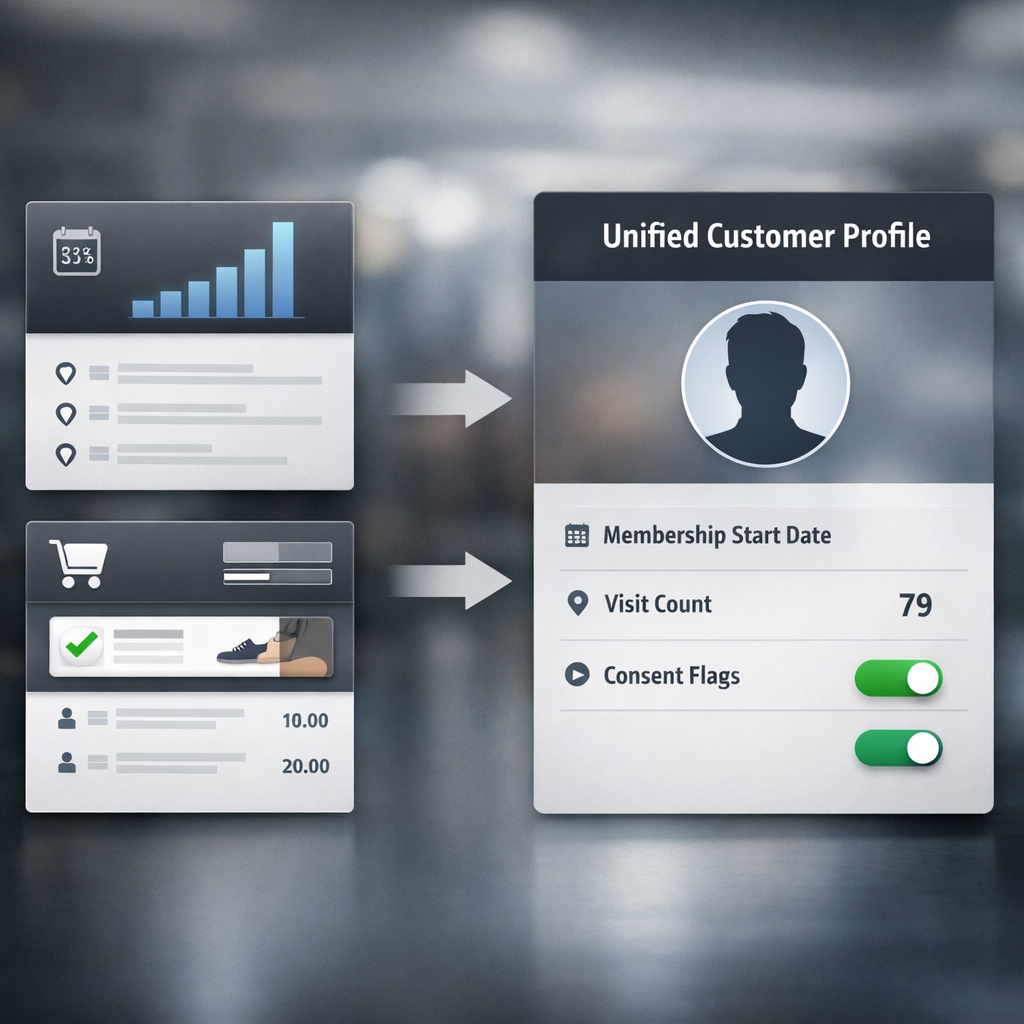
Next consideration: decide which milestones you will backfill for historical customers and which you will enforce going forward only, then map those decisions to the fields and flags above.
3. Build event driven workflows and triggers
Key point: Event driven triggers beat calendar blasts for timing and relevance, but they require operational guards. Build workflows that respond to changes in customer state – visit count increments, membership anniversaries, or a returned consent flag – then add layers that prevent duplicates, respect consent, and scale.
Trigger types and practical rules
Trigger types: Use three clean categories so logic does not become messy: event based (state change like visitcount => 10), calendar anchored (annual anniversary computed from stored startdate), and behavioral (inactivity then milestone). Each serves different business goals and requires different reliability levels from your data source.
- Event based – real time: for immediate recognition such as hitting your 10th class; requires incrementing counters and idempotent events
- Calendar anchored – scheduled: for yearly anniversaries; can be computed daily in a job but schedule sends to customer local time
- Behavioral – conditional: for combos like lapsed members hitting a milestone after returning; add reentry rules so customers do not reenter erroneously
Practical rule: Always attach a unique event id or flag to the customer profile so workflows can mark an event as handled. That prevents duplicate messages when data syncs twice or when backfills run.
Example workflow – membership anniversary (operational details)
Concrete example: When a membership anniversary event fires, mark the event handled immediately. Send an SMS recognition message within the first hour, then queue an email with a small experiential offer three days later. Suppress sends for customers with an active cancellation flag, and exclude anyone who redeemed an anniversary offer in the last 90 days.
Why this matters: The two-step sequence balances immediacy and richness. SMS gets attention; the follow up email carries richer content and tracking for redemption. In practice this improves engagement without blasting the same customer twice in a short window.
Execution considerations, tradeoffs, and pitfalls
Data quality tradeoff: Real-time event triggers are only as good as the stream feeding them. If your POS or checkin system has sporadic latency, you will either send late messages or risk duplicates when backfills run. The pragmatic tradeoff is to accept slight timing slippage and implement robust dedupe and processed flags.
Scaling limitation: High volume businesses must batch compute calendar triggers daily instead of scheduling thousands of individual cron jobs. Batch jobs are easier to audit but give up minute-level precision. Choose the lower friction option that matches your customer expectation for immediacy.
- Suppression windows: enforce per-customer cooldowns – for example one celebration message per 90 days – to avoid fatigue
- Reentry criteria: define exactly when a customer can reenter the workflow to avoid repeated rewards after a status flip
- Testing: run randomized control groups at the workflow level to measure lift; do not rely on aggregate before/after comparisons
Operational checklist: add idempotency flags, local time scheduling, suppression lists, redemption/exclusion filters, and a backfill plan before enabling live triggers.
Next consideration: Once your triggers are stable, link customer profile attributes to personalize messages at scale.
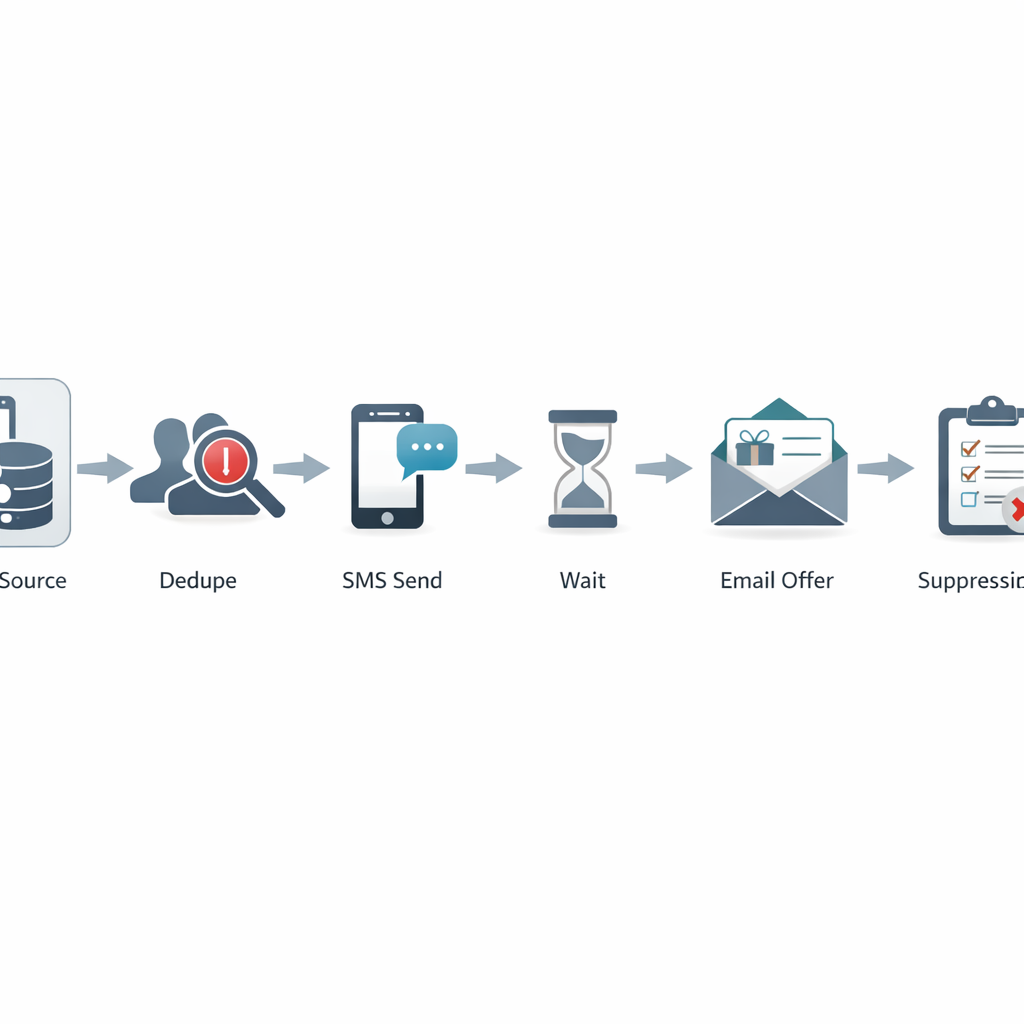
Start small: implement two reliable triggers, validate dedupe and suppression, then expand. Reliability beats fancy personalization every time when the trigger fails.
4. Channel strategy with sample copy and offer ideas
Channel choice matters more than creative alone. Pick the channel that matches the milestone intent – immediate, short reward; deep, badgeable recognition; or social sharing – then tailor copy and offer size to that channel. The wrong channel wastes a good message faster than a bad offer.
Channel decision framework
Use this simple decision rule: match Milestone Intent to Channel Strength. Intent examples: immediate action, relationship building, public recognition, or reactivation. Channel strengths are immediacy for SMS, richness for email, persistence for in app, and amplification for social.
| Milestone | Primary channel | Secondary channel | Timing / cadence | Recommended offer type |
| 1 year membership anniversary | SMS follow up | Send on anniversary date, SMS reminder after 3 days | Certificate + one small experiential reward – free PT consult or class upgrade | |
| 10th visit milestone | SMS | In app badge | Send immediately after visit count increments | Free guest pass or class credit |
| Birthday | SMS if time sensitive | Send morning of birthday local time | Discounted add on or priority booking window | |
| 100 workouts completed | In app push + share prompt | Email with printable badge | Send upon milestone, include share option | Social badge + exclusive content or behind the scenes |
| Lapsed 90+ days reengage | SMS | Email sequence | Staggered: SMS then email if no response | Low cost experiential credit or limited time class pass |
Sample copy snippets and rules
- SMS (keep it under 160 characters): Thanks, FirstName! Happy 1 year with us. Reply STOP to opt out.
- Email subject / preheader blueprint: Subject: Happy 1 Year, FirstName – Your Membership Milestone; Preheader: Claim a free PT consult or download your certificate.
- Email body blueprint: Lead with recognition, show milestone stat, present a single clear call to action, include a small experiential offer, and end with share ask and easy unsubscribe.
- Push / In app: Congrats FirstName! 100 workouts done – tap to claim your badge and share it on Instagram.
- WhatsApp / Rich SMS: Use only where consent exists. Send a short greeting, then a single image or voucher and a CTA to reserve.
Practical tradeoff: SMS gets attention but compresses nuance and increases opt out risk when overused. Email holds storytelling and attachments but suffers from lower open rates. Push works only if customers use your app. Use a fallback plan: if primary channel lacks consent, fall back to the secondary channel and suppress duplicate sends.
Concrete example: A boutique gym sends an email on a member 1 year anniversary with a printable certificate and details for a free PT consult. Members who do not open the email receive an SMS reminder after 3 days with a shorter CTA and booking link. The two-step approach increases visibility without heavy discounting and respects channel strengths.
Key takeaway: Prioritize channel by the action you want the customer to take, not by what is cheapest. Immediate actions via SMS, meaningful recognition via email or in app, and public amplification via shareable badges or social prompts.
Testing and measurement note: Test offer type across channels using small randomized samples – recognition only versus recognition plus experiential reward – and measure short term redemption plus 90 day retention. For tactical guidance on anniversary email best practices see HubSpot anniversary emails and for automation timing ideas see Mailchimp anniversary automation.

5. Content templates and personalization tokens
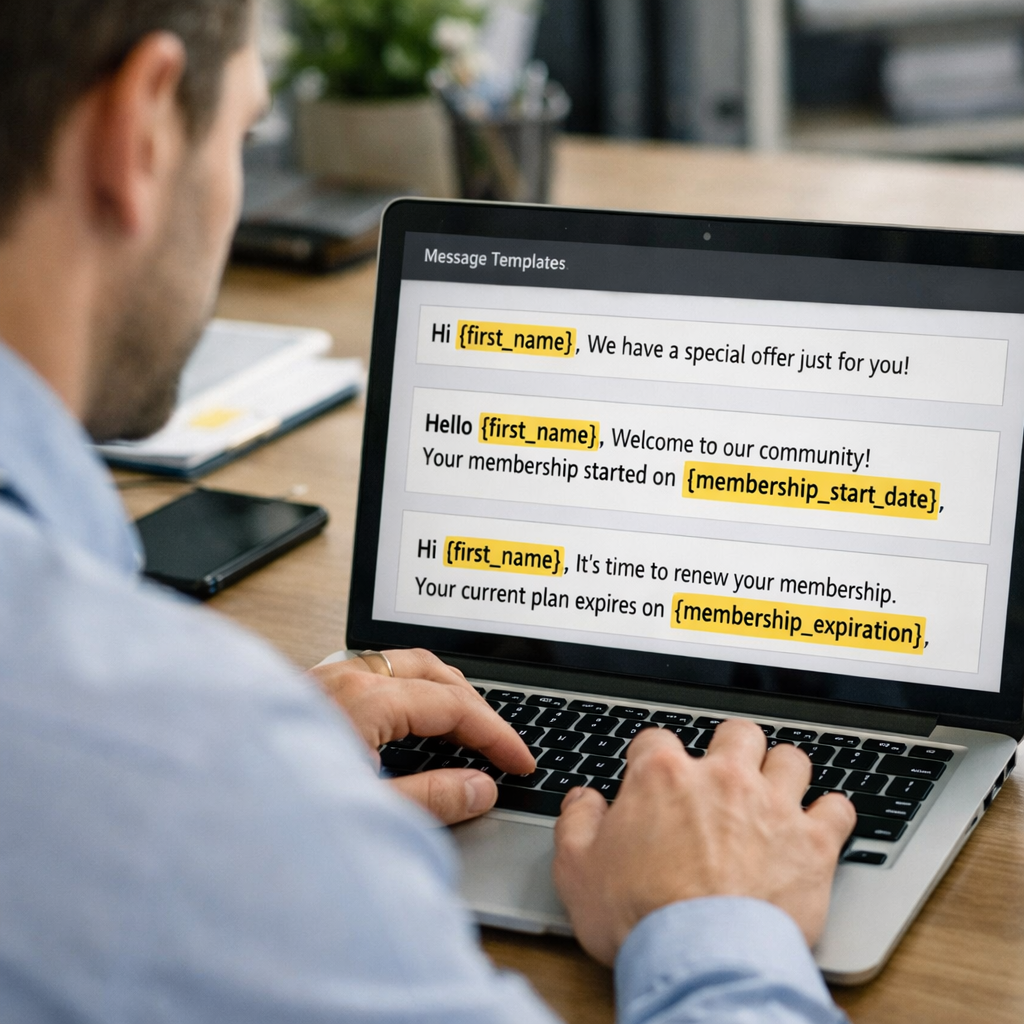
Start with token safety. Treat personalization tokens as a data contract, not decoration — every token you put in a template must have a tested fallback, a validation rule, and a plan for missing or stale values. Templates that assume perfect data fail in production and harm user experience more than generic copy.
Which tokens to standardize and why
| Token | Purpose | Fallback / Validation |
| first_name | Personal salutation to increase open and reply rates | Use there or friend if null; strip emojis and long strings |
| membershipstartdate | Calculate anniversary and personalize message timing | Validate date format; backfill from first transaction if missing |
| visit_count | Display milestone numbers (10th visit, 100th class) | Default to a recent visit and avoid numeric claim when null |
| membership_tier | Tailor offers or recognition to plan level | Fallback to member and suppress tier-specific offers if unknown |
| location_name | Localize offers and coach references; increases relevance | Use brand name when location unknown; avoid promises linked to a specific site |
| consent_sms | Respect TCPA and suppress SMS sends where false | Always check before queuing an SMS; don’t fallback to SMS-to-email conversion without opt in |
Practical trade-off: rich micro personalization (favorite class, coach name, typical visit time) raises relevance but increases data maintenance and error surface. If you have inconsistent data, prioritize stable tokens (firstname, startdate, visit_count) and add richer tokens only for high-value segments.
Five ready-to-adapt templates (use tokens)
- Membership anniversary SMS — Channel: SMS. Text: Hi {firstname}, happy 1-year with us! To celebrate, enjoy a free guest pass at {locationname}. Show this message at check-in. Consent required.
- Birthday email with voucher — Channel: Email. Subject: Happy Birthday, {firstname}! Body: Celebrate with $10 credit toward your next booking. Voucher code: BDAY{memberid_suffix}. Expires in 30 days.
- 10th visit push — Channel: Push/In-app. Text: Congrats {first_name} — your 10th class! Tap to claim a free PT consult. Badge: 10th Visit • Share to Instagram.
- Subscription renewal anniversary email — Channel: Email. Subject: Thanks for another great year, {firstname}. Body: As a loyalty thank-you, enjoy priority booking for one week. Offer is valid at {locationname} only.
- 90-day lapsed re-engagement — Channel: SMS + Email. SMS: We miss you, {first_name}. Book any class this week and bring a friend free. Email: Include testimonial or success story to rebuild trust.
Concrete example: A boutique gym tested a modular anniversary flow where an SMS recognition (using {firstname}, {membershiptier}, {membershipstartdate}) is sent on the exact anniversary, followed by an email with a downloadable certificate and a small experiential reward. They limited tokens to three stable fields and avoided coach-level personalization to reduce QA overhead, which kept error rates below 0.5% while increasing redemption of the experiential reward.
Token testing and rollout: preview templates against a representative sample, not just one record. Run a small randomized pilot with token-enabled vs token-minimal variants to catch edge cases. Automate validation that flags records where critical tokens are null or inconsistent before a send window opens.
If a token could expose sensitive or legally protected data, do not include it. Personalization should not require additional risky data collection.
Key action: Build templates with explicit fallbacks, sample outputs, and a small test corpus.
Final consideration: personalization amplifies impact only if it is reliable. Invest the same effort in token hygiene and preview tooling as you do in copywriting. For practical template inspiration and best practices, see HubSpot anniversary email guidance.
6. Measurement framework and A B test playbook
If you cannot show incremental impact, the celebration campaign is guesswork. Map each milestone use case to one primary business metric first, then design tests to prove causality rather than chasing opens or vanity metrics.
Primary and secondary metrics — choose what matters
Primary KPI mapping: Pick a single primary KPI that ties directly to business value — for example redemption rate within 14 days for an experiential reward or 90-day retention delta for yearly anniversaries. Secondary metrics should include delivery, open/click, short-term visits, and net revenue per customer so you can diagnose why a test moved (or did not move) the primary KPI.
- Example mapping: For a membership anniversary campaign the primary KPI is 90-day retention change; secondary KPIs are redemption rate of the offered reward, visits in 30 days, and referral signups.
- Avoid optimizing opens: Higher open rates do not equal retained customers. Design tests that measure behavior, not just engagement signals.
- Attribution window: Choose windows that match the action. Use 7–14 days for timebound offers and 60–90 days for retention outcomes.
Control and randomization: Always include a randomized holdout or control group to measure incremental lift. For small membership bases (under a few thousand), prefer larger relative holdouts (5–15%) or run multi-month pooled tests — small samples produce noisy results and misleading encouragement to scale ineffective offers.
Trade-off judgment: Short tests give quick answers about redemption but miss downstream lifetime effects. If you must prioritize, run a two-stage approach: fast test for immediate behavioral response, then a longer follow-up on retention for winning variants. Don’t conflate a quick coupon redemption spike with durable customer loyalty.
Concrete test example
Concrete Example: A boutique gym tests two anniversary approaches: recognition-only SMS versus SMS plus a complimentary 30-minute personal training session. Hypothesis: the experiential add-on will increase redemption and drive higher 90-day retention. Randomize active members into three groups: control (no message), recognition-only, and recognition+PT. Measure redemption in 14 days and retention at 90 days; if redemption lifts but retention does not, scale the recognition message and iterate on the offer.
| Test element | Recommendation | Why it matters |
| Primary KPI | Pick a single, behavior-based metric (redemption, visits, retention) | Prevents optimizing meaningless engagement metrics |
| Control group size | 5–15% holdout depending on list size; larger for smaller populations | Ensures measurable incremental lift without overly reducing reach |
| Minimum duration | 7–14 days for offers; 60–90 days for retention measures | Balances speed with the need to observe downstream behavior |
| Significance threshold | Use 90–95% confidence and report MDE (minimum detectable effect) | Avoid false positives from small sample noise |
| Segmenting | Test on meaningful segments (new vs long-term members) not random slices | Different segments respond differently; pooled tests can hide this |
Common mistake most teams make: running multiple overlapping experiments on the same cohort. That confounds results and costs money. Sequence tests or use mutually exclusive audience slices, and keep a test registry so campaigns do not collide.
Quick A B test playbook: 1) Define primary KPI and attribution window. 2) Create randomized control (5–15%). 3) Calculate realistic sample needs or extend duration for small audiences. 4) Run short behavioral test first, then measure retention. 5) Inspect secondary metrics to diagnose why winners worked. 6) Lock guardrails to prevent message fatigue and overlapping tests.
Practical limitation and suggestion: if your customer base is too small to run clean randomized tests, use staggered rollouts by location or period and treat early cohorts as quasi-experiments. Accept more uncertainty, but track cohorts consistently and use pooled analysis over time to build a case before scaling.
Use your customer profile to power the experiment: consistent event timestamps, consent flags, and location data make randomization and attribution reliable. For measurement frameworks and personalization best practices, consult resources like HubSpot anniversary email guidance and run tests focused on behavioral lift rather than opens.
Next consideration: pick the first test that answers the riskiest assumption in your campaign (usually offer relevance or timing), design the control properly, and commit to both short-term behavior and longer retention measurement before you scale.
7. Compliance, frequency limits, and scale considerations
Compliance is non negotiable. Treat legal and consent checks as gating criteria, not optional extras. If you launch celebration campaigns without a clean consent baseline you will see higher opt outs, complaints, and possible regulatory exposure that destroys any short term engagement wins.
Compliance essentials
Audit consent flags now. Confirm separate flags for SMS and email, and capture the date, method, and text of consent. For SMS, ensure prior express written consent exists for promotional messages and log how consent was collected to comply with TCPA requirements.
- GDPR and data subject rights: Use consent as the marketing lawful basis when in doubt, and implement easy mechanisms to access, correct, or erase customer data.
- Transactional versus promotional: Label messages in your system so transactional recognition messages that contain no promotional offer can be treated differently from messages that include offers.
- Recordkeeping: Keep an immutable audit trail of sends, opt outs, and consent changes for at least the period required by applicable law.
Practical judgment: Many teams assume a single consent flag is enough. In practice you need channel level consent, timestamped records, and an ingestion pipeline that preserves consent metadata during imports or backfills.
Frequency limits and customer fatigue
Set explicit cadence guardrails. Limit celebratory recognition to core milestones and cap major celebration messages to one per 90 days per customer. That rule reduces fatigue while leaving room for one timely, high-value recognition plus one transactional notification if needed.
- Cross-channel suppression: If a customer receives an SMS recognition, suppress an email version for the same milestone window unless the email contains materially different content.
- Soft limits versus hard limits: Implement soft limits for suggestions and hard limits for sends. For example, soft limit warns marketers at 60 days, hard limit blocks sends within 30 days of a prior celebration.
- Complaint thresholds: Pause campaigns automatically if complaint rate exceeds 0.3 percent or unsubscribe rate spikes above historical averages.
Tradeoff to accept: Tighter frequency caps protect deliverability and brand reputation but reduce reach. The right balance depends on lifetime value and how unique the milestone is. Prioritize strict limits for SMS and looser limits for email.
Scale considerations and operational controls
Do not backfill blindly. Backfilling a large base for anniversary sends can create provider throttles, spikes in complaints, and sudden cost increases. Stagger backfill by cohort and honor local time windows to avoid waking or irritating customers.
Concrete example: A 10,000 member boutique gym rolled out a one year membership anniversary SMS to the full database. They attempted a single day send, hit the SMS provider rate limit, and saw a complaint spike because many members received messages at midnight local time. The fix was to pause the campaign, segment the base into dayparted cohorts, and rerun with phased throttling and a fallback to email for lower priority cohorts.
- Throttling and queueing: Implement send queues and provider throttling to respect rate limits and avoid blacklisting.
- Template versioning and localization: Create modular templates so localization or regional compliance variations scale without bespoke builds.
- Monitoring and rollback: Track delivery, bounce, complaint, and opt out metrics in real time and build an automated rollback if thresholds are reached.
Action checklist: Audit channel consent and timestamps; create cross-channel suppression lists; enforce a 90 day major celebration cap; stagger backfills by cohort and local time; monitor complaint rate and pause at 0.3 percent.
Next consideration: After controls are in place, run a small randomized pilot to validate engagement and complaint signals before scaling to the full base. If you need a quick refresher on anniversary automation best practices see HubSpot and for email automation hygiene see Mailchimp.
Frequently Asked Questions
Straight answer first: the point of an FAQ for celebration campaigns is to remove hesitation so teams can launch with reasonable risk controls. Focus questions on data readiness, channel tradeoffs, measurement approach, and compliance — those are the decisions that slow projects down.
- What is the minimum data set required to run an anniversary automation? At minimum you need membership start date, a reliable contact handle (email or mobile), and explicit consent flags for the channels you plan to use. Without consent for SMS you must exclude numbers to avoid TCPA risk.
- How do I prove a celebration campaign improved retention? Use a randomized control group. Define the test window up front – 60 to 90 days for visit frequency, 90 days for retention signals – and measure both redemption and downstream behavior. If you cannot run randomization, compare matched cohorts by tenure and activity but treat results as directional only.
- Which channel should I prioritize for small experiential rewards? Prioritize SMS for immediacy and time bound rewards, and email for richer creative or attachments like certificates. Tradeoff: SMS drives fast responses but higher opt outs and stricter compliance; email is lower risk but slower to convert.
- How often should I run anniversary and milestone messages to avoid fatigue? Enforce a cadence guardrail such as one major recognition per 90 days and restrict repeat offers for the same milestone. The tradeoff is frequency versus salience: too many recognitions dilute meaning; too few lose engagement opportunities.
- Can I personalize milestone messaging without a large content team? Yes. Build a small set of modular templates and rely on tokens for name, milestone value, membership tier, and location. The practical limit is data quality – poor or missing attributes create jarring messages, so invest in a simple data validation step before sending.
- What low cost rewards actually increase goodwill? Prefer experiential credits such as a free guest pass, priority booking for a class, a one time class upgrade, or a short coaching session. These cost less than blanket discounts and preserve long term price integrity while improving customer satisfaction.
- How do I handle missing or incorrect milestone dates in my database? Backfill with first transaction or first visit when available, surface nulls in a dashboard, and create a small manual correction workflow with audit fields. Consider excluding records with unresolved dates from time sensitive sends until they are fixed.
- When should I use an anniversary message versus a visit-count milestone? Use anniversaries for high-emotion recognition tied to loyalty milestones such as 1 year or 5 years; use visit-count milestones to nudge behavior in the short term, for example encouraging a lapsed member to reach their next milestone.
Quick test plan: pick one milestone, create a 10 percent randomized control, choose either SMS or email not both, measure redemption and 90 day retention, then iterate on copy or offer.
Concrete example: A boutique fitness studio launched a 1 year anniversary automation that sent an SMS recognition message followed by an email with a complimentary guest pass if the member redeemed in 7 days. The team ran a small control group and learned the two step approach increased redemptions compared with a single email, and that adding the member location name in the SMS improved redemption relevance.
Common misunderstanding: Teams often treat celebration campaigns as vanity messaging. In practice they are tactical retention plays – small, timely rewards or recognition that change short term behavior and, when measured with controls, compound into improved lifetime value. Design the campaign with measurement first, then creative.
- Define the single milestone you will test in the next 30 days and capture the required data attributes.
- Launch with a small control group and one clear KPI such as redemption rate or 90 day retention lift.
- Apply a cadence rule and compliance checklist before scaling across segments.
Ready to Run Successful Marketing Campaigns and Grow Your Business?
Gleantap helps you unify customer data, track behavior patterns, and automate personalized campaigns, so you can increase repeat purchases and grow your business.
Ready to Run Successful Marketing Campaigns and Grow Your Business?
Gleantap helps you unify customer data, track behavior patterns, and automate personalized campaigns, so you can increase repeat purchases and grow your business.