
 Divya Ghughatyal

Scattered profiles and weak identity resolution make personalization guesswork, not strategy. This guide shows how to build a reliable 360-degree customer view using a customer insights platform and customer data platform to activate unified profiles across SMS, email, ads, and in-app channels while measuring retention, LTV, and conversion lift. You will get a practical roadmap, vendor evaluation criteria, governance checklist, and two playbooks with segment definitions and measurement plans so you can run a focused pilot and prove incremental value within 8 to 12 weeks.
Why a 360-Degree Customer View Drives Better Business Outcomes
Direct business impact: a reliable 360-degree view converts messy signals into measurable lifts in retention, average revenue per user, and conversion rates because it fixes two practical problems marketers face every day – noisy segments and delayed activation. A customer insights platform or customer data platform becomes valuable only when unified profiles are used to make decisions in near real time and to feed those decisions into channels that change customer behavior.
Which KPIs the 360-degree view actually moves
- Retention rate: unify attendance, transaction, and engagement events so your CDP can trigger interventions when a member misses two sessions in a row rather than waiting for a monthly churn signal.
- Average revenue per user (ARPU): enable micro offers and cross-sell by identifying recent high-intent behaviors and pushing targeted campaigns instead of blasting the entire list.
- Acquisition efficiency: reduce paid spend by using higher-confidence lookalike audiences built from resolved, first party profiles rather than raw analytics exports.
Practical trade-off: start with precision not breadth. Deterministic identity matching using email or authenticated ids gives immediate, high-confidence segments but covers fewer anonymous visitors. Probabilistic matching increases coverage but injects noise into campaigns and attribution. In practice the right approach pairs deterministic anchors for critical workflows and selective probabilistic enrichment only where the expected lift justifies the risk.
Concrete example: a midmarket fitness chain used a CDP to stitch POS attendance, membership status, and mobile app events into a single profile. When a member recorded two missed check-ins and a decline in app engagement, the CDP placed them in a 14 to 30 day lapsed segment and pushed a targeted reactivation sequence via SMS using Gleantap. The result was a measurable 10 to 15 percent incremental retention lift at 30 days for the pilot cohort.
What teams get wrong: many teams treat the CDP as a data warehouse substitute and delay activation while they perfectionize data models. That wastes time. Real value comes from running a narrow pilot tied to one KPI and exposing imperfect profiles to marketing destinations quickly. Use Segment resources or the CDP Institute overview to confirm vendor activation capabilities before you build long integration lists.
Start with one KPI, one deterministic identifier, and one activation channel. Measurement follows.
Pilot guidance: aim for an 8 to 12 week pilot focused on reactivation or onboarding, require deterministic identifiers for the target cohort, and pick at least two destinations for activation and measurement. See a short pilot checklist in the Forrester and Gartner guidance linked in this guide.
Activation over storage: choose a CDP with the connectors you will actually use. Integration breadth matters more than fancy identity graphs if your segments cannot reach SMS, email, or ad platforms. Use your vendor shortlist to validate destination latency, suppression controls, and consent propagation before signing a contract.

Next consideration: pick the single KPI and pilot segment you will prove first and document the one sentence hypothesis that links the unified profile to the business outcome.
How a CDP Fits into Your MarTech Stack and How it Differs from CRM, DMP, and Data Warehouse
Direct point: a Customer Data Platform is the operational glue that builds unified, actionable customer profiles and pushes those profiles into activation channels in near real time, it is not a CRM replacement, an ad-buying system, or a raw analytics store.
- CDP (customer data platform / customer insights platform): centralizes event and identity data, resolves identities, exposes real-time segments and user profiles to destinations (email, SMS, ad platforms, webhook destinations). Use it when your priority is marketer-led activation and consistent audience definitions across channels.
- CRM: stores lifecycle, deal, and support records with a sales-first model. It is authoritative for customer contracts, pipeline, and service interactions but is poor at ingesting high-volume event streams or powering low-latency cross-channel segmentation.
- DMP: focused on anonymous audience targeting and lookalike modeling for ad buys. It has short retention windows and is designed for third-party cookie-style environments, not for long-lived first-party profiles or personalisation tied to identity.
- Data warehouse: optimized for analytics and historical queries. It is the source of truth for deep analysis and model training but lacks native real-time activation and marketer-friendly UI without middleware.
Key trade-offs and limitations
Practical insight: choose a CDP when activation speed and centralized identity matter more than raw analytical depth. If your primary need is complex cohort analysis or model training, the warehouse should be the center of gravity; if you need to execute campaigns from those insights, the CDP is the execution layer. Expect to run both.
Limitations to plan for: identity resolution is the frequent bottleneck, deterministic matching (email, authenticated id) gives high confidence but limited coverage; probabilistic linkage expands reach at the cost of accuracy. Also budget for duplicate reconciliation and a governance process so marketing segments do not diverge from analytics definitions.
Questions to ask vendors during evaluation
- What is the end-to-end latency from event ingestion to segment availability? (sub-second, seconds, minutes?)
- How does your platform perform identity resolution and what data sources does it prioritize for deterministic matches?
- Which prebuilt destinations exist for our channels (SMS/WhatsApp via Gleantap, Facebook, Google, email providers) and what control do marketers have over delivery?
Concrete example: A midmarket fitness chain used Twilio Segment to stitch web events, app check-ins, POS purchases, and membership status into unified profiles, then exported reactivation segments to Gleantap for automated SMS sequences and to Google Ads for lookalike campaigns. The CRM remained the system of record for memberships and billing, while the warehouse (BigQuery) received the same cleaned events for longitudinal LTV analysis.
Key takeaway: treat the CDP as the activation and identity layer that complements, not replaces, your CRM and warehouse. Expect to maintain data parity and sync rules across systems, and prioritize deterministic identity before expanding to probabilistic methods.
Vendor note: consider Twilio Segment or mParticle for marketer-friendly CDPs with broad destinations; use CDP Institute and Segment docs to validate capabilities against your real-time and identity requirements.

Collecting and Stitching Customer Data: Identity Resolution and Data Models
Key point: Identity resolution is the gatekeeper for any reliable 360-degree view. If profiles are duplicated, mis-merged, or missing deterministic anchors like email or authenticated user id, your segments will be noisy and campaign performance will suffer. Build the match logic first, not last.
Identity stitching strategy
Deterministic first, probabilistic second. Deterministic matching using email, phone, or a login id gives high confidence and should be your primary anchor. Probabilistic methods – device graphs, IP-based joins, cookie stitching – increase coverage but introduce false positives and extra privacy risk. Vendors that operate identity graphs include LiveRamp and Tealium; CDP vendors such as Twilio Segment and mParticle provide built-in identity resolution tools and configurable match hierarchies.
- Common sources to ingest: web events (page and conversion events), mobile SDK events, CRM records, POS transactions, class attendance and door check-ins, email interactions, customer support logs, offline lead forms, and third party enrichments.
- Match hierarchy example: authenticated user id > email > phone > device id > third party graph id. Apply match thresholds and require at least one deterministic anchor before auto-merging.
- Audit and suppression: log every merge with provenance metadata and maintain a suppression source of truth for legal opt-outs and unsubscribe signals.
Minimal unified profile schema and event set
Design for activation, not for completeness. Start with a small canonical schema that supports your top pilot use case and expand once the match logic is stable. Separate static traits from event streams so marketers can build segments without deep queries.
| Attribute | Type | Example | Recommended retention |
| primary_id | string | authenticateduser123 | persist |
| string | [email protected] | persist | |
| phone | string | +919876543210 | persist |
| lifetime_value | numeric | 540.75 | rolling 24 months |
| last_checkin | timestamp | 2026-10-01T09:12:00Z | rolling 24 months |
| events | event stream | classattended, purchase, appopen | raw 30-90 days, aggregated 24 months |
Concrete example: A fitness club stitches POS purchases, class attendance logs, and app events to an email anchor. When a member has not checked in for 28 days and last purchase was more than 90 days ago, the CDP places them in a lapsed-member segment and pushes the profile to Gleantap to run a timed SMS reengagement flow. This flow depends on accurate phone matching and a reliable last_checkin timestamp.
Tradeoffs that matter in practice: real-time identity stitching improves personalization but costs more and amplifies bad data. Batch joins are cheaper and safer for backfill and analytics, but will not support sub-minute activations. Expect to run a hybrid architecture – real-time merges for authenticated sessions and campaign triggers, daily batch reconciliations for warehouse-level reporting.
Operational requirement: maintain an identity audit log with merge reasons, confidence score, and source. This single practice prevents silent segmentation breakages and makes compliance checks practical.
Practical judgment: prioritize getting 80 percent of profiles right for your pilot use case rather than chasing full coverage. Mis-merged profiles harm revenue and trust more than missing matches that you can later recover with probabilistic methods.
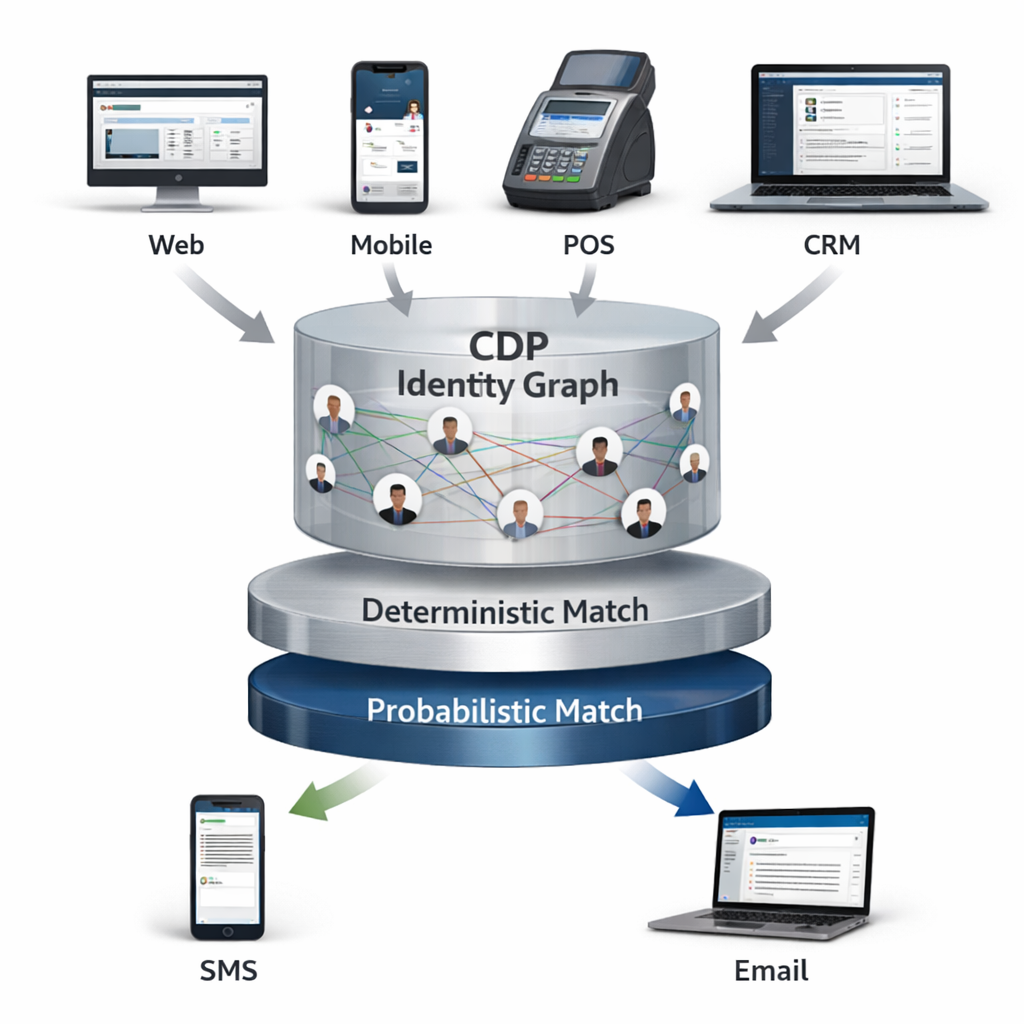
Next consideration: run a simple identity audit now – export ten merged profiles, review the provenance for each attribute, and confirm match thresholds. Use resources like the CDP Institute and Segment guidance for reference during the audit.
Segmentation, Real-Time Activation, and Common Activation Patterns
Key point: Treat segmentation as executable rules, not static lists. In practice the value of a customer data platform or customer insights platform comes from segments that update in real time and directly drive channel behavior.
Segment recipes that actually move metrics
- Lapsed members 14 to 60 days: recent attendance = 0, membership active, last payment within 90 days; activation = 3-step reactivation SMS + offer. Good KPI: 30 day retention lift.
- High intent prospects: visited pricing page >= 3 times in 7 days or viewed checkout and dropped; activation = timely chat outreach or abandoned-cart email. Good KPI: conversion rate within 7 days.
- High LTV customers: top 10 percent of lifetime spend and frequent class attendance; activation = early access offers and VIP loyalty campaigns. Good KPI: incremental revenue per user.
- At-risk subscribers: decrease in session frequency > 40 percent over 30 days combined with negative sentiment in feedback; activation = personalized outreach and concierge calls. Good KPI: churn reduction.
Practical tradeoff: Broader segments increase reach but reduce message relevance. If a segment adds noisy users, activation costs rise and measured lift falls. Prioritize high-precision segments for paid channels and broader ones for low-cost channels like automated email.
Real-time activation patterns and where they fit
- Event-triggered single message: convert an on-site signal to an outgoing message within seconds (example: abandoned checkout -> email). Works best when latency must be under one minute.
- Profile-enriched drip: create a segment on an event then enrich profile with behavioral analytics and schedule a sequence (example: new joiner onboarding over 30 days). Requires reliable identity resolution and attribute enrichment.
- Audience export to ads: batch or near-real-time audience sync for paid channels. Useful for prospecting lookalikes but expect a 24 to 48 hour tail for refresh in ad platforms.
- Hybrid orchestration: immediate message for high urgency and a follow up via a different channel after profile scoring. This pattern balances speed and contextual relevance.
Latency versus coverage: Real-time activation needs low latency and high confidence identifiers. Deterministic IDs give lower latency and higher conversion but leave gaps. Probabilistic stitching increases coverage but can add false positives and downstream friction in paid ad spends.
Concrete example: Use a customer data platform like Twilio Segment to capture a churn signal when a member misses three scheduled classes and closes the app. The event enriches the profile with recent purchase and attendance history, places the member into a reengagement segment, and triggers a Gleantap SMS sequence for members who consented to messaging. Measure incremental 30 day retention versus a holdout.
| Activation pattern | Best channels | Primary KPI |
| Event-triggered single message | SMS, Email, Push | Immediate conversion or recovery rate |
| Profile-enriched drip | Email, SMS sequences, In-app | Engagement over 30 to 90 days |
| Audience export to ads | Facebook, Google Ads, DSPs | Acquisition cost and conversion lift |
Operational tip: Build suppression and consent checks into the activation layer, not ad hoc in each destination. A single suppression source prevents costly privacy errors and preserves deliverability.
Misunderstood point: Marketers often treat real-time segments as a creativity play. In reality the hard work is maintaining signal quality and mapping each segment to a single measurable KPI. If you cannot test for incremental impact, the segment is a vanity artifact.
Further reading: For practical connector advice and real-time capabilities see CDP Institute and Twilio Segment documentation at Segment Resources.
Next consideration: Pick two segments for a pilot, one high precision, low reach; one medium precision, higher reach, and run parallel tests to learn which activation patterns scale without eroding ROI.
Measurement Frameworks and Dashboards to Prove Value
Start with the question you must answer for the business: did the CDP-driven activation move a dollar or a behaviour that matters. Measurement is not a nice-to-have afterthought; it is the core governance that converts a pilot into funding for scale. Build a plan that ties a single primary KPI to a clear intervention, a defined cohort, and a measurement window.
Designing the measurement plan
Define baseline and primary KPI. Choose one primary KPI such as 30-day retention rate, incremental revenue per customer, or checkout conversion rate. Capture at least 6 to 12 weeks of baseline data before launching to understand natural variance.
- Cohort and control design: Use randomized assignment when possible. If randomization is impossible, construct matched cohorts using recent activity, tenure, and value bands.
- Treatment window and attribution: Pick a sensible attribution window for the behaviour you expect to change – 7 to 30 days for onboarding emails, 30 to 90 days for retention or winback.
- Secondary KPIs: Track engagement metrics such as message open rate, click-through, and subsequent channel conversions to diagnose whether failures are creative, channel, or segment related.
Tradeoff to accept early. Short windows show quicker signal but overstate transient effects; long windows give business-relevant ROI but delay decisions. For membership businesses, I prefer a fast signal at 30 days and a confirmation at 90 days before scaling spend.
What dashboards should show
Dashboards must make causality visible, not just trends. Present treatment vs control side-by-side with cohort size, confidence intervals, and cumulative lift. Include upstream diagnostic panels for data freshness, identity match rate, and destination delivery success to rule out operational failure.
| Metric | What to track | Why it matters |
| Primary KPI (eg 30-day retention) | Cohort retention curve with control comparison | Shows incremental behavioural change tied to CDP activation |
| Incremental Revenue | Cumulative revenue per user, treatment vs control | Translates behaviour into monetary value for ROI |
| Activation health | Identity match rate, segment membership latency, delivery success | Helps distinguish measurement noise from execution failure |
| Message performance | Send, deliver, open, click, reply by channel and creative | Diagnoses why a segment did or did not respond |
Practical limitation. Most teams over-attribute gains to segments without checking identity coverage. If your deterministic match rate is below 60 percent, reported lifts often reflect a biased sample of engaged, logged-in users. Always surface sample coverage on the dashboard.
Concrete example: A midmarket fitness chain ran a 30-day winback campaign using CDP segments exported to Gleantap for SMS sequences. They randomized 6,000 lapsed members into treatment and control, tracked reactivation rate at 30 and revenue at 90 days, and surfaced identity match rate and delivery failures on the dashboard. The result: a 12 percent incremental reactivation at 30 days and clear carrier-level delivery issues that required segment suppression before scaling.
- Minimum dashboard components: Build panels for cohort comparison, delivery and identity health, per-channel ROI, and sample-size/statistical significance.
- Tooling choices: Use Looker, Tableau, or BigQuery driven visualizations for repeatable SQL-backed dashboards, or a marketer-friendly BI if engineering bandwidth is limited.
- Operationalize: Automate daily refreshes and set alerts on sample size drops, identity match rate regressions, and unexpected lift that exceeds plausible ranges (these often indicate data bugs).
Key consideration: Do not judge a CDP pilot only by creative performance. The most common failure mode is poor identity coverage or delivery suppression silently biasing results. Make identity match rate and delivery success first-class metrics on every measurement dashboard.
Next consideration: After you validate a pilot with clean cohorts and clear lift, the next step is to translate the dashboard into an operational SLA: refresh cadence, who owns decisions to scale, and the budget thresholds that trigger rollout. That governance is what makes measurement actionable.
Governance, Privacy, and Operational Controls
Governance is the gatekeeper. If you treat consent, access, and suppression as optional, your CDP will produce insights you cannot legally or safely act on. Put operational controls in place before you connect marketing channels or you will have to pause campaigns, rollback audiences, and rebuild trust.
Core controls to implement immediately
- Consent source of truth: Capture consent metadata at the point of collection and sync that SOT to the CDP. Include timestamp, channel, consent scope, and legal basis.
- Suppression at activation: Apply suppression lists and consent checks at the last-mile destination, not just in the CDP UI, so downstream tools never receive disallowed data.
- Data minimization and schema policy: Only ingest fields needed for the use case. Every nonessential PII field should be flagged for masking or excluded.
- Retention and deletion flows: Implement automatic retention windows and verified deletion pipelines that honor right to be forgotten requests across warehouse and destinations.
- RBAC and attribute-level masking: Use role based access and mask sensitive attributes for noncompliant roles. Log access to masked attributes.
- Audit trails and lineage: Maintain immutable logs of data ingestion, identity merges, and outbound deliveries to support investigations and regulatory requests.
Practical tradeoff: Stronger privacy controls reduce the surface for missteps but also shrink the data available for modeling. Expect lower coverage for behavioral models when you enforce strict minimization or deny probabilistic enrichment. Accept that tradeoff; noisy or illegal activations cost more than reduced model accuracy.
Concrete example: A midmarket gym chain launched a reengagement SMS drive and pulled audiences directly from a CDP without syncing an updated opt out list. Several customers complained and carriers throttled messages. The immediate fix was to implement suppression at the Gleantap destination and to bind consent metadata from the CRM as the SOT; the longer term fix was daily consent syncs and a preflight delivery check.
Operational cadence and runbook items
- Daily: Run data quality checks for required identifiers, consent flags, and failed deliveries; surface anomalies to a data steward.
- Weekly: Identity resolution audit, sample merged profiles, verify merge logic, and check for cross account collisions.
- Monthly: Compliance review, retention rule audits, pending deletion requests, and third party enrichments inventory.
- Per campaign: Preflight checklist that validates consent, suppression lists, destination masks, and fallback message paths.
Minimum controls to enforce day one: consent SOT with timestamps, suppression at destination, retention and deletion workflows, RBAC with attribute masking, and immutable audit logs. Start there and expand controls as you scale.
Hard stop rule: do not activate a segment across channels until suppression and consent checks pass for every destination.
Tools and references: Use the CDP community guidance on consent and activation patterns at CDP Institute and the vendor docs on enforcement and streaming destinations such as Segment documentation to understand how consent metadata flows to downstream tools.
Next consideration: Schedule a governance sprint before your pilot production run, map consent sources, set enforcement points, and author the campaign preflight checklist. Without that work you will delay value and increase operational risk.
Implementation Roadmap and Common Pitfalls to Avoid
Hard truth: most CDP projects stall because teams treat the work as an engineering integration instead of a short, measurable business pilot. Build the roadmap around a single KPI and a channel you can control, then expand. This keeps scope tight and makes it possible to show value in weeks, not quarters.
90–180 Day Phased Roadmap
- Weeks 1–2, Audit and KPI definition: Inventory sources, map ownership, and list the deterministic identifiers you have (email, authenticated id, phone). Define one primary KPI for the pilot (for example, 30-day reactivation rate) and two success gates: a minimum data coverage threshold and a target incremental lift measurement method. Deliverable: KPI brief, data inventory spreadsheet, stakeholder RACI.
- Weeks 3–8, Pilot selection and data plumbing: Pick one business use case with clear ROI (reactivation, onboarding, or VIP cross-sell). Implement ingestion for the minimal event set and two destinations (one messaging channel + one analytics sink). Prioritize deterministic joins in this phase; add probabilistic layers later. Deliverable: working pipeline sending events to the CDP and one activation destination such as Gleantap for SMS automation.
- Weeks 9–12, Identity stitching and segment testing: Build the unified profile schema, validate identity merges against a gold sample, and create the pilot segments. Run dry-run activations to test suppression, throttling, and consent enforcement. Deliverable: validated unified profiles, initial segments, and suppression rules.
- Weeks 13–24, Measure pilot and scale: Launch the activation with control and treatment groups, collect conversion data, and iterate on segment logic. Only expand connectors and use cases once gating criteria are met – otherwise you amplify messy data. Deliverable: measurement report, rollout plan, and prioritized backlog for next use cases.
Trade-off to accept: moving faster means accepting less coverage early on – you will miss some customers if you rely solely on deterministic keys. That is OK for a pilot. The real choice is speed for validated impact versus slow perfection that never ships.
Concrete example: A regional fitness chain ran a 12-week pilot to re-engage lapsed members. They ingested class-attendance CSVs, web visits to the pricing page, and CRM membership statuses into the CDP, stitched profiles using email and member id, created a 14–45 day lapsed segment, and routed activations to Gleantap SMS. The pilot used a randomized control to prove incremental reactivation before turning the flow into an ongoing program.
- Pitfall, Over-ambitious scope: Trying to fix every data source at once. Mitigation: pick one use case and limit required sources to the minimum that materially affect the KPI.
- Pitfall, Insufficient deterministic identifiers: Relying too soon on probabilistic matches. Mitigation: instrument a short authentication step or capture email/phone at key moments to increase deterministic coverage.
- Pitfall, Ignoring operational controls: Failing to build suppression, consent, and rollback paths before activation. Mitigation: run dry-runs and maintain a suppression playbook; require legal sign-off for messaging templates.
- Pitfall, No cross-functional owner: Data projects become ghosts without a single accountable product or marketing owner. Mitigation: assign a CDP product owner with budget authority and a weekly steering cadence.
| Criterion | What to check | Example vendor placement |
| Real-time latency | Can the CDP evaluate segments and forward events within your required window (sub-second to minutes)? | Twilio Segment, mParticle |
| Identity resolution | Does it prioritize deterministic joins and allow inspection/audit of merges? | RudderStack, Treasure Data |
| Connector ecosystem | Are there prebuilt destinations for your channels and analytics tools to avoid custom engineering? | Twilio Segment, RudderStack |
| Marketer usability | Can non-technical marketers create segments and review audience size without engineering? | mParticle, Segment |
| Pricing predictability | Does the pricing model align with your growth – avoid per-event cost traps early? | RudderStack (self-hosted option), Segment (tiered) |
Most teams chase coverage before confidence – validate with a small, deterministic pilot and a control group. Expand only after you can measure incremental lift and confirm identity stitching quality.
Scale gate checklist: consistent event schema; identity merge accuracy verified against a gold sample; successful A/B showing positive incremental lift; suppression and consent flows enforced; clear owner and budget for expansion.
Next consideration: if you lack deterministic identifiers, budget for a short authentication or capture flow in the first two weeks – it is the single fastest lever to turn a pilot into measurable customer insights and reliable activations.
Frequently Asked Questions
Practical answers matter more than theoretical ones. Below are the questions you will actually need to decide during vendor selection, pilot design, and activation, with concise, actionable answers, tradeoffs, and what to watch for in the real world.
- How long to get measurable value from a CDP pilot: With a tight scope, one clear use case, deterministic IDs for the majority of your target audience, and two destinations (for example email and SMS), expect measurable results in 8 to 12 weeks. Tradeoff: shorter pilots limit learning about edge cases; longer pilots delay scaling and stakeholder buy-in.
- Which identity resolution approach to prioritize: Prioritize deterministic matching (email, login, phone) as the primary anchor because it yields reliable segments and simple suppression rules. Layer probabilistic methods only after you can measure accuracy versus deterministic baselines. Consideration: probabilistic increases coverage but raises compliance and false-match risks.
- Can a CDP replace my CRM: No. A CDP builds unified profiles and real-time segments for activation and analytics; CRM remains the source of truth for sales pipeline, opportunity lifecycle, and account management. Use the CDP to feed cleaned segments into your CRM, not to manage sales workflows.
- Minimum governance controls from day one: Capture consent metadata on every record, implement per-field retention and purpose metadata, maintain an access control matrix, and log all outbound deliveries. Skipping this makes the CDP unusable for campaigns once legal or ops teams push back.
- Vendors for midmarket teams with limited engineering resources: Twilio Segment, RudderStack, and mParticle provide the best balance of marketer-friendly UIs and prebuilt connectors. Reality check: these reduce engineering lift but do not eliminate the need for a data steward and some initial wiring.
- How to measure ROI from a 360-degree view: Use controlled experiments or matched cohorts to attribute incremental lifts in retention, ARPU, or conversion. Avoid single-campaign before/after comparisons, they overstate impact. Practical insight: tie measurement windows to your business cadence (30/90 days for memberships, 7/30 days for ecommerce funnel changes).
- How does Gleantap fit into a CDP activation stack: Gleantap is a destination for time-based and behavioral SMS/WhatsApp sequences. Use the CDP to populate reengagement or retention segments and send personalized flows via Gleantap.
- Which integrations are non-negotiable during evaluation: Real-time web and mobile SDKs, email and SMS destinations, an analytics warehouse connector (Snowflake/BigQuery), and at least one ad-platform audience export. If a vendor lacks these as managed connectors, expect months of custom work.
Day-one checklist: capture consent metadata; ensure deterministic id coverage >50% for your pilot segment; configure at least two activation destinations (email + SMS/WhatsApp); define one primary KPI and a measurement plan with a control cohort.
Concrete example: A midmarket gym ran a reactivation pilot using a CDP to detect 14-to-60-day lapsed members, exported the segment to Gleantap, and sent a three-step SMS sequence. They used a randomized control group and saw a 9% incremental retention lift at 30 days. The pilot took ten weeks from kickoff to initial readout because deterministic login coverage was 70% and the team prioritized measurement over speed.
Common misunderstanding: People treat the CDP as a single-project purchase. In practice a CDP is an operational layer, it requires ongoing stewardship, a playbook for segment hygiene, and a measurement cadence. Buying a CDP without committing budget to 6 months of activation and analytics is a recipe for shelfware.
If you must pick one metric to lock on for your first pilot, pick retention or revenue per active user, these are the clearest levers for membership and subscription businesses.
Next actions you can do this week:
1) Run a quick coverage audit: calculate what percentage of your target pilot audience has deterministic identifiers (email/login/phone).
2) Draft a one-page measurement plan naming primary KPI, cohort logic, sample size, and a 30/90-day readout date.
3) Identify two activation destinations (example: email provider + Gleantap for SMS/WhatsApp) and confirm they exist as native connectors in your shortlisted CDP vendors.
4) Book a 60-minute cross-functional review with legal, CRM, and growth to commit to consent and suppression rules.



Ready to Run Successful Marketing Campaigns and Grow Your Business?
Gleantap helps you unify customer data, track behavior patterns, and automate personalized campaigns, so you can increase repeat purchases and grow your business.
Ready to Run Successful Marketing Campaigns and Grow Your Business?
Gleantap helps you unify customer data, track behavior patterns, and automate personalized campaigns, so you can increase repeat purchases and grow your business.