
 Sagar Babber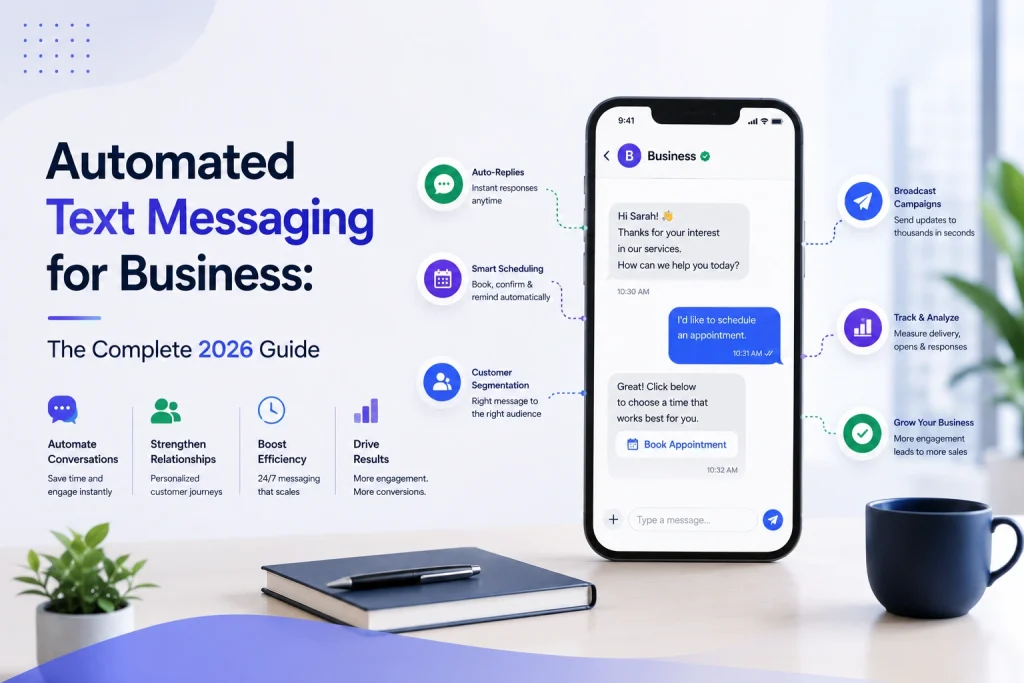
Automated text messaging for business is software that sends and replies to SMS messages automatically — appointment reminders, lead follow-ups, review requests, win-back offers — triggered by customer behavior instead of typed by staff. Texts get read: SMS open rates hover near 98%, and most messages are read within minutes. That combination of reach and automation is why texting has become the highest-leverage channel for local and multi-location businesses.
This guide covers how automated texting services work, what you can (and should) automate, what it costs, how to stay TCPA-compliant, and how to choose a platform. It draws on what we’ve learned at Gleantap processing over 1 billion messages for fitness, wellness, and entertainment brands engaging 60M+ consumers.
How an Automated Text Messaging Service Works
At its core, an automated texting platform connects three things: your customer data, a set of triggers, and a compliant sending infrastructure.
Triggers start a message. A trigger can be time-based (a class starts in 24 hours), behavior-based (a lead filled out a form, a member hasn’t visited in 14 days), keyword-based (someone texts JOIN to your number), or event-based (a missed call, a failed payment, a completed purchase).
Workflows decide what happens next. Instead of a single blast, modern platforms run multi-step sequences: text a new lead within 60 seconds, wait a day, follow up if there’s no reply, notify a salesperson if the lead responds. The best systems branch based on what the customer does.
Two-way conversation is what separates current platforms from the mass-texting tools of five years ago. When a customer replies, the message routes to a shared team inbox — or an AI agent answers it directly, handling questions, booking appointments, and knowing when to hand off to a human. Gleantap’s AI agent and omnichannel inbox were built around exactly this pattern.
What Businesses Automate with Texting
Automated text reminders
The workhorse. Appointment, class, reservation, and payment reminders sent 24 hours and 1–2 hours before the event, with a reply-to-confirm or reply-to-reschedule option. Reminder automation routinely cuts no-shows by 30–50% for appointment-based businesses, and the reschedule flow recovers revenue that a plain reminder would lose.
Speed-to-lead follow-up
Leads go cold fast — responding within five minutes instead of an hour can multiply your contact rate several times over. Automated lead follow-up texts every new inquiry within seconds, then runs a persistence sequence until the lead books or opts out. For membership businesses this single automation usually pays for the platform by itself.
Missed-call text-back
When your front desk can’t pick up, an automatic text goes out: “Sorry we missed you — how can we help?” The conversation continues over SMS instead of ending at voicemail. Businesses that add missed-call text-back typically discover how many customers were silently lost to unanswered phones.
Business group texting and announcements
One-to-many messages to a segment — a closure notice, a schedule change, a flash promotion — sent as individual texts so replies stay private, unlike consumer group chats. Good platforms let you segment by behavior (members vs. leads vs. lapsed) rather than blasting everyone, which protects both response rates and compliance standing.
Reviews, referrals, and win-backs
Post-visit review requests, referral asks to your happiest customers, and win-back offers triggered when a customer’s activity drops. These lifecycle automations run quietly in the background and compound: a steady stream of reviews lifts local search rankings, and win-backs recover customers no one had time to call.
Automated Texting vs. Group Texting Apps vs. SMS Marketing Tools
These terms get used interchangeably, but they’re different categories — and choosing the wrong one is the most common buying mistake.
| Group texting apps | SMS marketing tools | Automated texting platforms | |
|---|---|---|---|
| Built for | Small-group coordination | Promotional broadcasts | Full customer lifecycle |
| Triggers | Manual only | Scheduled campaigns | Behavior, time, keywords, events |
| Two-way replies | Group chat (everyone sees) | Limited or none | Private, inbox or AI-answered |
| CRM & segmentation | None | Basic lists | Built-in customer profiles & behavior data |
| Compliance tooling | None | Opt-out handling | Consent capture, 10DLC, DNC scrubbing, quiet hours |
| Best for | Teams & clubs | Retail promos | Appointment & membership businesses |
If you only need to blast a coupon monthly, an SMS marketing tool is enough. If revenue depends on appointments, memberships, or repeat visits, you need the automation and two-way layer. (Deciding between message formats? See our breakdown of SMS vs. MMS for marketing.)
What Automated Texting Costs
Pricing follows two models, often combined:
Per-message pricing — roughly $0.01–$0.05 per SMS depending on volume, plus carrier fees. Simple, but costs scale directly with usage and these tools usually lack automation depth.
Platform pricing — a monthly fee tied to contacts or locations, typically $50–$300+/month for small businesses, with messages included or discounted. Platforms in this tier bundle the CRM, workflows, inbox, and compliance tooling that per-message tools charge extra for or don’t offer.
The real math isn’t the sticker price — it’s consolidation. If automated texting replaces a mass-texting tool, a reminder system, a review tool, and part of a receptionist’s day, the platform fee is usually the cheapest line item in the stack. See Gleantap’s pricing for how we structure it.
Staying TCPA-Compliant (Non-Negotiable)
Automated texting is regulated, and enforcement is real — TCPA violations run $500–$1,500 per message. The rules are manageable if your platform enforces them:
Consent first. You need prior express written consent before sending automated marketing texts — a checkbox on your form, a keyword opt-in, or written agreement. Follow opt-in best practices and keep records of when and how each contact consented.
Identify yourself and honor opt-outs. Every campaign should identify your business, and STOP must always work — instantly and automatically.
Register your numbers. US carriers require 10DLC registration for business texting. Unregistered traffic gets filtered or blocked outright.
Scrub against DNC lists and respect quiet hours. Reputable platforms handle Do-Not-Call scrubbing and time-window enforcement automatically.
Compliance also protects deliverability — carriers filter senders who generate spam complaints, and consumers are more scam-aware than ever (we catalog the patterns in our guide to common scam text messages). Clean consent practices keep your messages in the inbox.
How to Choose an Automated Text Messaging Service
Six questions that separate the platforms:
1. Is it truly two-way? Can customers reply, and does the platform route or answer those replies? One-way tools leak revenue.
2. Can it trigger on behavior? Scheduled blasts are table stakes. Triggers on visits, purchases, inactivity, missed calls, and form fills are where ROI lives.
3. Does it include the customer data layer? Automation is only as smart as the profile behind it. A built-in CRM beats syncing a spreadsheet.
4. Is compliance built in? Consent capture, 10DLC registration support, DNC scrubbing, quiet hours — automated, not left to you.
5. Does AI answer, or just autocomplete? An AI agent that can hold a conversation, book an appointment, and escalate properly is a different product from canned auto-replies.
6. Does it know your industry? Reminder logic for a gym differs from a salon or a family entertainment center. Vertical depth shows up in the templates, integrations, and playbooks.
Why Membership & Appointment Businesses Choose Gleantap
Gleantap is an automated text messaging platform with the customer engagement layer built in: behavior-triggered SMS and email/text campaigns, an AI agent that answers replies and books appointments 24/7, a unified inbox for your team, and compliance tooling (consent, 10DLC, DNC, quiet hours) handled by default. It’s built for fitness, wellness, and entertainment operators — and it’s been battle-tested across more than a billion messages. If you’re comparing options, our comparison hub shows how we stack up head-to-head.
See automated texting in action — book a 20-minute demo →
Frequently Asked Questions
An automated text messaging service is software that sends SMS messages to customers automatically based on triggers, schedules, or keywords — without a person typing each message. Common automations include appointment reminders, lead follow-up, missed-call text-back, review requests, and win-back campaigns. Modern platforms also handle two-way conversations using AI.
Yes, when done correctly. In the US, the TCPA requires prior express written consent before sending automated marketing texts, a clear opt-out method in your messages, and respect for opt-out requests. Businesses must also register their sending numbers through 10DLC. A compliant platform automates consent capture, opt-out handling, and DNC scrubbing for you.
Most services charge either per message (roughly 1 to 5 cents per SMS) or a monthly platform fee based on contacts, typically from around $50 to several hundred dollars per month for small businesses. Platforms with built-in automation, CRM, and AI replies cost more than bare-bones mass-texting tools but replace several point solutions.
They can on a two-way texting platform. Replies either route to a shared team inbox or are answered automatically by an AI agent that can respond to questions, book appointments, and escalate to a human when needed. One-way blast tools that can’t receive replies frustrate customers and hurt deliverability.
SMS marketing usually refers to one-to-many promotional broadcasts you send manually or on a schedule. Automated texting is broader: it includes behavior-triggered messages such as reminders, lead follow-up, and win-backs that fire one-to-one at the right moment. The highest-performing programs combine both on a single platform.
The best choice depends on whether you need simple blasts or full engagement automation. For appointment-based and membership businesses — gyms, studios, salons, clinics, family entertainment centers — a platform like Gleantap combines automated texting with a built-in CRM, AI-powered two-way replies, and compliance tooling, so you don’t have to stitch together separate tools.
Recent blog posts
Back to blog
Ready to Run Successful Marketing Campaigns and Grow Your Business?
Gleantap helps you unify customer data, track behavior patterns, and automate personalized campaigns, so you can increase repeat purchases and grow your business.
Ready to Run Successful Marketing Campaigns and Grow Your Business?
Gleantap helps you unify customer data, track behavior patterns, and automate personalized campaigns, so you can increase repeat purchases and grow your business.