
 Divya Ghughatyal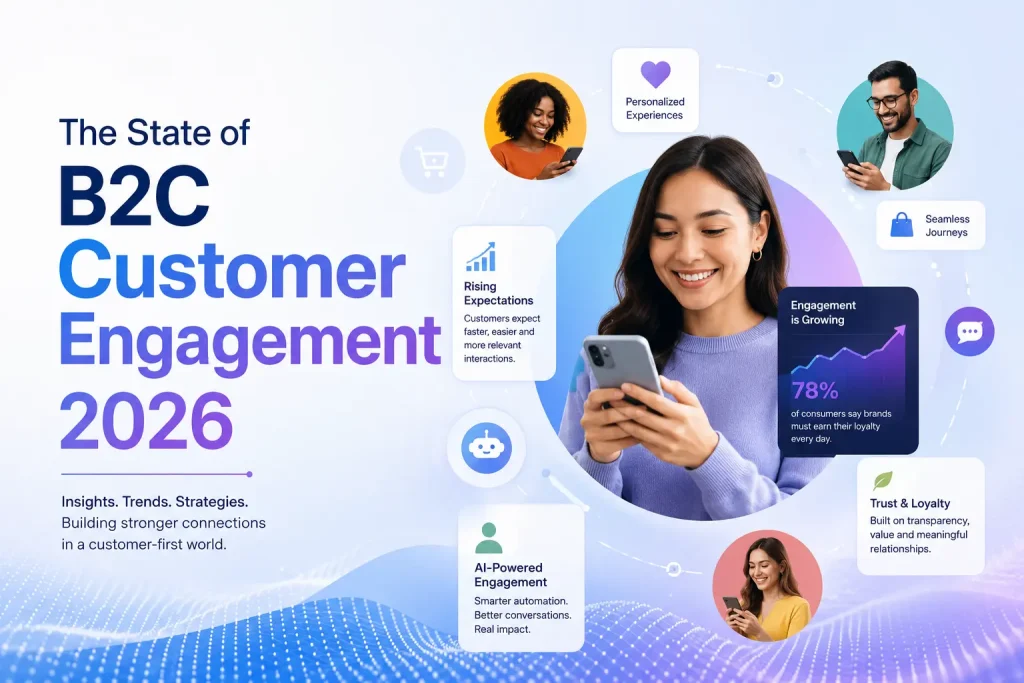
Why the next era of growth belongs to brands that turn customer data into real-time action
Executive Summary
B2C customer engagement is entering a new era.
For the last decade, most brands tried to win customers with better campaigns: more emails, more SMS messages, more automations, more loyalty programs, more dashboards, and more channels.
But the market has changed.
Customers now expect every interaction to feel timely, relevant, and connected. They expect brands to remember context, respond instantly, respect privacy, and make their experience easier—not noisier. At the same time, businesses are under pressure to grow with leaner teams, fragmented systems, rising acquisition costs, and customers who are quicker to leave after poor experiences.
The result is a major shift:
B2C engagement is moving from campaign management to autonomous revenue systems.
The winning brands will not simply send more messages. They will build systems that can identify customer intent, understand behavior, predict the next best action, and automatically engage customers across the right channel at the right moment.
This report explores six major shifts shaping B2C customer engagement in 2026:
- Customer loyalty is more fragile than companies think.
- Personalization is moving from “nice to have” to revenue infrastructure.
- AI is shifting from content generation to customer action.
- First-party data is becoming the foundation of customer engagement.
- Omnichannel is no longer about channel count—it is about continuity.
- Local and multi-location businesses need enterprise-grade engagement without enterprise complexity.
1. The customer loyalty gap is widening
Many companies believe they are doing a good job with loyalty. Customers disagree.
PwC’s 2025 Customer Experience Survey found that 70% of executives say customer expectations are evolving faster than their company can adapt, while 29% of consumers say they stopped using or buying from a brand due to poor customer experience, either online or in person. PwC also found that more than half of consumers stopped using or buying from a brand because of a bad experience with its products or services.
This is the first major warning sign for B2C brands: customer experience is no longer a soft metric. It is a revenue protection system.
Forrester’s 2025 Global Customer Experience Index tells a similar story. In the U.S., 25% of brands’ customer experience rankings declined in 2025, compared with only 7% that improved. Forrester also noted that CX quality declined across effectiveness, ease, and emotion in most U.S. industries.
That matters because most B2C businesses are fighting margin pressure from all sides:
- Paid acquisition is expensive.
- Labor is expensive.
- Retention is harder.
- Customers have more choices.
- Switching costs are low.
- Expectations are shaped by the best digital experiences, not just direct competitors.
For a gym, wellness studio, clinic, spa, amusement park, restaurant, or local service business, a poor experience may not look dramatic. It may simply look like:
- A lead inquiry that sits unanswered overnight.
- A missed follow-up after a trial class.
- A member who stops attending and never gets re-engaged.
- A failed payment that becomes a cancellation.
- A customer complaint that goes unresolved.
- A prospect who visits the pricing page but never gets contacted.
- A review that receives no response.
- A staff member who forgets to call a high-value lead.
These are small moments. But they compound into revenue leakage.
The new engagement reality
The old assumption was:
“If customers like us, they’ll stay.”
The new reality is:
“Customers stay when the experience keeps proving value.”
Loyalty is not a program. It is the cumulative result of every touchpoint.
That means B2C companies need to stop thinking of engagement as a marketing function alone. Engagement now spans sales, service, retention, operations, reviews, payments, loyalty, and customer support.
2. Personalization is now a growth engine, not a marketing tactic
Personalization used to mean adding a first name to an email.
That version of personalization is dead.
Today, customers expect brands to understand context:
- What did I look at?
- What did I ask about?
- What location do I visit?
- What have I purchased?
- What class did I attend?
- When was my last visit?
- Am I at risk of churning?
- Did I already speak with someone?
- Am I a new lead, active customer, past customer, or VIP?
Twilio’s 2025 State of Customer Engagement Report says AI is creating a new era where customer experiences can become more personal, relevant, and connected—but it also notes that many consumers still feel like “just another number.” Twilio frames the opportunity as closing the gap between customer insight and customer action.
Salesforce’s State of Marketing report makes the same point from the marketer side. Salesforce surveyed nearly 4,500 marketers worldwide and reported that 83% of marketers recognize the shift toward personalized, two-way messaging, but only one in four are satisfied with how they use data to power those moments.
That is the personalization gap.
Most brands have more data than ever, but they still struggle to use it in real time.
Why personalization fails
Personalization fails when data is trapped in disconnected systems:
- POS data lives in one place.
- CRM data lives somewhere else.
- Website behavior is separate.
- Email and SMS engagement are separate.
- Reviews are separate.
- Staff notes are separate.
- Membership data is separate.
- Support conversations are separate.
The result is “personalized” communication that does not feel personal.
A customer cancels and still gets a renewal campaign.
A lead already booked a tour and still gets “book a tour” texts.
A high-value customer complains and still receives a generic promo.
A member at risk of churn receives a birthday coupon but no retention outreach.
That is not personalization. That is automation without intelligence.
The next stage: behavior-aware engagement
The next era of B2C personalization will be based on behavioral signals, not static segments.
Examples:
- A pricing-page visitor receives a helpful follow-up within minutes.
- A prospect who viewed class schedules gets a message about the best intro class.
- A member who has not visited in 14 days gets a personalized check-in.
- A customer with a failed payment gets a recovery message before collections.
- A lead who asked about family plans gets routed into the right offer.
- A customer who leaves a positive review gets a referral prompt.
- A customer who leaves a negative review gets escalated to a manager.
This is where engagement becomes a revenue system.
3. AI is shifting from content generation to customer action
The first wave of AI in marketing was mostly about productivity: write this email, summarize this conversation, generate this ad, create this campaign.
That was useful, but limited.
The next wave is about action.
Gartner predicts that by 2029, agentic AI will autonomously resolve 80% of common customer service issues without human intervention, leading to a 30% reduction in operational costs. Gartner describes agentic AI as a shift from tools that merely generate text to systems that can take autonomous action to complete tasks.
McKinsey’s 2025 State of AI survey also shows that AI adoption is broadening, but most organizations are still early in scaling impact. McKinsey found that 88% of respondents report regular AI use in at least one business function, while roughly one-third say their companies have begun scaling AI programs. McKinsey also found that 23% of respondents report scaling agentic AI somewhere in the enterprise, while another 39% are experimenting with AI agents.
The message is clear: AI is no longer experimental, but value capture is still uneven.
Why most AI engagement efforts underperform
AI does not create business value simply because it exists.
It creates value when it is connected to:
- Customer data
- Business rules
- Real-time triggers
- Approved actions
- Human escalation paths
- Channel orchestration
- Measurement loops
McKinsey’s research highlights that high-performing AI organizations are more likely to redesign workflows, define human validation processes, build technology and data infrastructure, and embed AI into business processes.
For B2C businesses, that means the question is not:
“Can AI write our campaigns?”
The better question is:
“Can AI help us identify who needs attention, decide what should happen next, and take action before revenue is lost?”
The rise of AI revenue agents
B2C companies will increasingly use AI agents for specific growth and retention jobs.
Examples:
Lead Response Agent
Responds instantly to new leads, answers questions, qualifies interest, and books appointments.
Website Visitor Agent
Identifies high-intent website visitors, tracks behavior, and triggers personalized outreach.
Failed Payment Recovery Agent
Detects failed payments, sends recovery messages, creates staff tasks, and escalates unresolved accounts.
At-Risk Customer Agent
Monitors behavior such as declining visits, inactivity, sentiment, or missed appointments and triggers retention outreach.
Review Response Agent
Responds to reviews, escalates negative feedback, and prompts happy customers for referrals.
Class or Event Fill Agent
Identifies underfilled classes, events, or appointment slots and engages the right audience.
Referral Generation Agent
Finds happy, engaged customers and prompts them to invite friends at the right moment.
This is the move from automation to autonomy.
Automation follows rules.
Autonomy uses context to decide the next best action.
4. First-party data is becoming the foundation of engagement
Privacy changes, platform restrictions, and consumer expectations are pushing brands away from rented data and toward direct customer relationships.
Deloitte lists first-party data as one of the major marketing trends shaping the immediate future, recommending that brands transform privacy into opportunity by using privacy-friendly data strategies to build trust and customer loyalty. Deloitte also highlights omnichannel experiences, automation, generative AI, and hyper-personalized experiences at scale as major trends.
Qualtrics XM Institute’s 2025 research on privacy and personalization, based on more than 23,000 consumers globally, found that consumers want personalization but remain highly concerned about data privacy. The report also notes that purchase history and site visits are among the top candidates for personalization, and that trust in data practices corresponds to comfort with data usage.
This creates a clear mandate:
Customers will share data when they believe it improves the experience. They will punish brands that misuse it.
PwC reinforces this point: 53% of consumers say it is worth sharing personal information if it makes interacting with a brand smoother, but 93% say a brand would lose their trust if it mishandled that data.
The first-party data advantage
For B2C brands, first-party data includes:
- Contact information
- Membership status
- Purchase history
- Visit frequency
- Website activity
- Appointment history
- Class attendance
- Email/SMS engagement
- Reviews and feedback
- Support conversations
- Lead source
- Location preferences
- Payment status
- Customer lifecycle stage
The brands that win will not necessarily have the most data. They will have the most usable data.
The new data question
The old question was:
“Do we have the data?”
The new question is:
“Can we act on the data in time?”
A churn signal is useless if no one acts on it.
A pricing-page visit is useless if sales never follows up.
A failed payment signal is useless if it becomes a cancellation.
A customer complaint is useless if it never reaches the right person.
First-party data becomes valuable when it powers action.
5. Omnichannel is no longer about being everywhere
For years, “omnichannel” meant having multiple channels: email, SMS, chat, phone, social, web, app, and maybe push notifications.
But customers do not care how many channels a brand has.
They care whether the experience feels connected.
Deloitte defines the opportunity as creating unified experiences and one-to-one relationships by stitching together journeys across digital and physical interactions.
That phrase—digital and physical—is especially important for local and multi-location B2C businesses.
A fitness club, clinic, spa, or amusement park does not operate purely online. The customer journey moves between:
- Website
- Search
- Ads
- Reviews
- Forms
- Phone calls
- Texts
- Emails
- Front desk
- Sales team
- In-person visit
- Membership or purchase
- Support
- Retention
- Referral
If those moments are disconnected, the customer feels the friction.
The broken omnichannel experience
A prospect fills out a form.
Then they call the business.
Then they visit the location.
Then they get a generic email.
Then a staff member texts them without knowing they already called.
Then they receive another promo that ignores their actual interest.
This is not omnichannel. It is multi-channel chaos.
The connected omnichannel experience
A prospect visits the pricing page.
The business identifies the visit as high intent.
The CRM checks whether they are a known lead.
The AI agent sees they previously asked about family membership.
The prospect gets a helpful SMS offering the right membership option.
If they reply, the AI answers questions or books a tour.
If they do not reply, a sales task is created.
If they book, the system suppresses redundant promotions.
If they show up, the staff has context.
That is omnichannel engagement.
The difference is not the number of tools.
The difference is continuity.
6. Small and mid-sized B2C businesses are ready for AI—but need simplicity
AI is no longer just an enterprise trend.
PayPal and Reimagine Main Street’s 2025 small business survey found that 25% of small businesses have already integrated AI into daily operations, while over 50% are exploring AI implementation. The same survey found that 66% of small business owners believe adopting AI is essential for staying competitive.
The U.S. Chamber of Commerce’s 2025 small business technology report found that 58% of small businesses self-identified as using generative AI, up from 40% in 2024 and 23% in 2023. It also found that 84% plan to increase their use of technology platforms.
JPMorganChase Institute’s 2026 research notes that small firms have historically adopted new technologies more slowly than larger counterparts because of barriers such as capital constraints, limited technical expertise, and integration costs. The report also notes that AI tools promise productivity gains, better decision-making, and competitive advantages through improved customer engagement.
This is the key tension for B2C companies:
They want AI.
They need AI.
But they cannot afford complex enterprise implementations.
What B2C businesses actually need
Most local and multi-location operators do not need another complicated dashboard.
They need systems that help them answer:
- Who needs attention today?
- Which leads are most likely to convert?
- Which customers are at risk?
- Which failed payments need follow-up?
- Which reviews need a response?
- Which campaigns are actually driving revenue?
- Which locations are underperforming?
- Which staff tasks need to happen now?
- Which customers should receive which message?
The future of B2C engagement will belong to platforms that hide complexity behind intelligent action.
7. Industry spotlight: Fitness and wellness
Fitness is a strong example of how B2C engagement is changing.
The Health & Fitness Association’s 2025 Fitness Industry Benchmarking Report found that in 2024, the sector had median revenue growth of 9.9%, net membership growth of 5.5%, and a member retention rate of 66.4%.
That means the industry is growing—but retention still leaves significant room for improvement.
For fitness and wellness operators, customer engagement directly affects:
- Lead conversion
- Trial-to-member conversion
- Visit frequency
- Class attendance
- Failed payment recovery
- Upgrade opportunities
- Referral generation
- Review volume
- Member retention
- Lifetime value
The challenge is that the member journey is full of signals that often go unused.
A member attends three times in week one, then disappears.
A prospect asks about pricing, then never books.
A member visits the cancellation page.
A parent asks about kids’ classes.
A customer leaves a five-star review.
A member’s payment fails twice.
A former member clicks a reactivation offer.
Each of these moments should trigger action.
Most businesses still rely on staff to notice.
The next generation of businesses will rely on systems that never miss the signal.
8. The B2C engagement maturity model
To understand where the market is heading, it helps to break B2C engagement into five maturity stages.
Stage 1: Manual Engagement
The business relies on staff memory, spreadsheets, inboxes, and one-off campaigns.
Common symptoms:
- Leads fall through the cracks.
- Follow-up is inconsistent.
- Customer data is scattered.
- Staff manually tracks tasks.
- Campaigns are generic.
- Reporting is limited.
Business risk: Revenue leakage is high because action depends on human consistency.
Stage 2: Basic Automation
The business uses scheduled campaigns and simple triggers.
Common symptoms:
- Welcome emails
- Birthday messages
- Basic nurture sequences
- Simple SMS reminders
- Generic win-back campaigns
Business risk: Automation improves consistency but lacks context. Customers may still receive irrelevant messages.
Stage 3: Segmented Engagement
The business uses customer segments based on lifecycle, behavior, or attributes.
Common symptoms:
- New leads vs active customers
- High-value customers
- Inactive members
- Past-due accounts
- Former customers
- Location-level targeting
Business risk: Segmentation improves relevance, but most action is still pre-planned rather than real time.
Stage 4: Predictive Engagement
The business uses data to anticipate customer needs and risks.
Common symptoms:
- Churn risk scoring
- Lead conversion scoring
- Visit frequency alerts
- Revenue opportunity detection
- High-intent website visitor alerts
- Location health analytics
Business risk: Insights are valuable, but only if teams act quickly.
Stage 5: Autonomous Engagement
The business uses AI agents and workflows to identify, decide, act, and learn.
Common symptoms:
- AI responds to leads instantly.
- AI identifies high-intent prospects.
- AI routes conversations.
- AI creates staff tasks.
- AI recovers failed payments.
- AI detects churn risk.
- AI personalizes outreach.
- AI escalates sensitive issues.
- AI measures outcomes.
Business advantage: Engagement becomes always-on, context-aware, and revenue-focused.
9. The new operating model: System of Record + System of Action
Most B2C businesses already have systems of record.
Examples:
- POS system
- Billing system
- CRM
- Booking platform
- Membership database
- EHR/EMR for clinics
- Ticketing or support system
- Website analytics
- Review platforms
These systems store what happened.
But storing data is not enough.
B2C brands now need a System of Action—a layer that turns data into engagement.
System of Record
The system of record answers:
- Who is the customer?
- What did they buy?
- What is their status?
- What location do they belong to?
- What is their payment history?
- What appointments or visits happened?
System of Action
The system of action answers:
- What should happen next?
- Who should we engage?
- What should we say?
- Which channel should we use?
- Should AI handle it or should staff step in?
- Did the action drive revenue?
- What should we do differently next time?
This is the strategic gap in most B2C businesses.
They have the data.
They have the channels.
They have the staff.
But they lack the intelligence layer that connects everything.
That is where the category is moving.
10. The highest-impact engagement plays for 2026
Below are the plays B2C brands should prioritize in 2026.
Play 1: Instant lead response
Speed still matters.
When a prospect submits a form, asks a question, visits a high-intent page, or replies to an ad, the business should respond immediately.
The goal is not to “automate everything.” The goal is to prevent high-intent demand from going cold.
Recommended workflow:
- Capture the lead source and intent.
- Match the lead to existing CRM data.
- Trigger an immediate SMS or chat response.
- Let AI answer basic questions.
- Offer the next best conversion step.
- Create a staff task if the lead is high value or unresponsive.
- Suppress redundant campaigns once the lead books or converts.
Play 2: Website visitor identification and intent-based outreach
Website traffic is often treated as anonymous until a form is submitted.
That leaves revenue on the table.
For B2C businesses with high-intent pages—pricing, schedules, membership options, services, locations, booking, demo, or contact pages—visitor behavior can reveal buying intent.
Recommended workflow:
- Install a website tracking pixel.
- Identify known or matched visitors where permitted.
- Track page-level behavior.
- Score intent based on pages viewed and repeat visits.
- Trigger personalized outreach.
- Route high-intent prospects to sales or AI.
- Measure conversion from visit to conversation to purchase.
This is especially powerful for businesses where customers research before visiting in person.
Play 3: Failed payment recovery
Failed payments are not just billing issues. They are retention risks.
A failed payment can quickly become:
- Lost revenue
- Staff follow-up burden
- Customer frustration
- Membership cancellation
- Collections activity
Recommended workflow:
- Detect failed payment immediately.
- Send a friendly recovery message.
- Include a direct payment update link.
- Follow up across SMS/email if unresolved.
- Create a staff task after a defined threshold.
- Pause outreach once payment is resolved.
- Track recovery rate and revenue saved.
Play 4: At-risk customer re-engagement
Most churn does not happen suddenly. It shows up as behavior change first.
Signals may include:
- Declining visit frequency
- Missed appointments
- No class attendance
- No recent purchases
- Negative sentiment
- Support complaints
- Failed payments
- Reduced email/SMS engagement
- Cancellation page visits
Recommended workflow:
- Define risk signals by business type.
- Score customers based on recency, frequency, monetary value, and sentiment.
- Trigger personalized check-ins.
- Offer helpful next steps, not just discounts.
- Escalate high-value customers to staff.
- Track save rate, return visits, and retained revenue.
Play 5: Review response and reputation growth
Reviews are no longer just social proof. They are part of the customer engagement loop.
A review can signal:
- A happy customer ready for referral
- An unhappy customer who needs intervention
- A location-level service issue
- A staff performance opportunity
- A product or experience gap
Recommended workflow:
- Monitor reviews across major platforms.
- Use AI to draft or publish brand-safe responses.
- Escalate negative reviews.
- Tag themes such as staff, cleanliness, pricing, billing, or experience.
- Trigger referral asks for happy customers.
- Feed insights into location performance dashboards.
Play 6: Location-level engagement intelligence
For multi-location businesses, the future is not just “how are campaigns performing?”
The better question is:
“Which locations are healthy, which are leaking revenue, and why?”
Location-level engagement should track:
- Lead response time
- Lead-to-visit conversion
- Visit-to-purchase conversion
- Member/customer retention
- Review volume and sentiment
- Failed payment recovery
- Campaign engagement
- Staff task completion
- Revenue per customer
- Customer lifecycle health
This lets leadership identify whether a location has a demand problem, conversion problem, retention problem, staffing problem, or experience problem.
11. Metrics that matter in the new era
B2C brands need to move beyond vanity metrics.
Open rates and click rates still matter, but they are not enough.
Revenue metrics
- Revenue influenced by engagement
- Revenue recovered from failed payments
- Revenue from reactivated customers
- Revenue from referrals
- Revenue per customer
- Customer lifetime value
- Net revenue retention by location
Conversion metrics
- Lead response time
- Lead-to-conversation rate
- Conversation-to-appointment rate
- Appointment-to-purchase rate
- Trial-to-member conversion
- Website visitor-to-lead conversion
- High-intent visitor conversion
Retention metrics
- Churn rate
- Save rate
- Visit frequency
- Inactive customer recovery
- At-risk customer engagement
- Retention by location
- Retention by lifecycle stage
Experience metrics
- Review rating
- Review response time
- Sentiment trend
- Support response time
- Complaint resolution rate
- NPS or satisfaction score
Operational metrics
- Staff task completion
- AI resolution rate
- Escalation rate
- Campaign setup time
- Automation coverage
- Channel response time
- Cost per retained customer
The best engagement teams will measure not just activity, but action and outcomes.
12. What this means for B2C leaders
For CEOs, CFOs, CMOs, and operators, the takeaway is simple:
Customer engagement is becoming a core revenue function.
It is no longer enough to buy a CRM, send newsletters, run ads, and hope staff follows up.
The new mandate is to build an engagement system that can:
- Capture demand
- Identify intent
- Personalize communication
- Respond instantly
- Recover lost revenue
- Prevent churn
- Improve experience
- Support staff
- Measure business impact
This is especially important for local and multi-location businesses because execution inconsistency is one of the biggest growth killers.
A great campaign does not matter if one location follows up and another does not.
A great lead source does not matter if response time is slow.
A great customer experience does not matter if churn signals are ignored.
A great AI tool does not matter if it is disconnected from the business workflow.
The future belongs to brands that can turn every customer signal into the right action.
13. The Gleantap perspective: From campaigns to autonomous engagement
At Gleantap, we believe the next generation of B2C growth platforms will not be defined by who sends the most messages.
They will be defined by who helps businesses take the smartest actions.
That means moving beyond traditional marketing automation and toward an intelligent engagement layer that connects data, AI, communication, and operations.
For B2C businesses, the goal is not more software.
The goal is:
- More leads converted
- More customers retained
- More payments recovered
- More reviews generated
- More conversations handled
- More staff time saved
- More revenue captured
The future of customer engagement is not another campaign calendar.
It is an always-on system that knows who needs attention, what should happen next, and how to take action before the opportunity is lost.
Conclusion: The new rule of B2C engagement
The old rule was:
Send the right message to the right person at the right time.
The new rule is:
Take the right action for the right customer at the right moment.
That distinction matters.
A message is only one possible action. Sometimes the right action is a text. Sometimes it is an email. Sometimes it is a phone call task. Sometimes it is a payment recovery workflow. Sometimes it is an AI conversation. Sometimes it is a manager escalation. Sometimes it is doing nothing because the customer already converted.
The future of B2C customer engagement will be won by brands that understand this difference.
Campaigns will not disappear.
Automation will not disappear.
Human teams will not disappear.
But the center of gravity is shifting.
The next era belongs to businesses that build intelligent, connected, AI-assisted engagement systems that turn customer data into revenue-producing action.
That is the state of B2C customer engagement in 2026.
Suggested SEO Title
The State of B2C Customer Engagement 2026: AI, Personalization, and the Shift from Campaigns to Autonomous Revenue Systems
Suggested Meta Description
Explore the major customer engagement trends shaping B2C businesses in 2026, including AI agents, personalization, first-party data, omnichannel engagement, and revenue automation.
Suggested Featured Image Concept
A premium illustration showing customer signals flowing from website, SMS, email, reviews, POS, and CRM into an AI-powered “System of Action” that triggers personalized outreach, staff tasks, and revenue recovery workflows.
Suggested Charts to Add
- The B2C Engagement Maturity Model
Manual → Basic Automation → Segmented → Predictive → Autonomous - System of Record vs System of Action
POS/CRM/Billing stores data; Gleantap activates it. - Revenue Leakage Map
Missed leads, failed payments, inactive customers, poor reviews, slow follow-up. - AI Agent Use Cases for B2C Businesses
Lead Response, Website Visitor, Payment Recovery, Review Response, Retention, Referral. - Metrics That Matter
Activity metrics vs revenue metrics vs retention metrics.
The future of B2C growth will not be driven by brands that simply send more campaigns. It will belong to businesses that can turn customer signals into real-time action. Every missed lead, failed payment, ignored review, or inactive customer represents lost revenue hiding in plain sight. The opportunity in 2026 is not just to automate communication, but to build intelligent engagement systems that proactively convert, retain, and re-engage customers at scale. Brands that unify their data, activate AI-driven workflows, and create connected omnichannel experiences will outperform competitors still relying on disconnected tools and manual follow-up. The question is no longer whether customer engagement matters—it is whether your business can act fast enough to keep customers from leaving and revenue from slipping away.
Ready to Run Successful Marketing Campaigns and Grow Your Business?
Gleantap helps you unify customer data, track behavior patterns, and automate personalized campaigns, so you can increase repeat purchases and grow your business.
Ready to Run Successful Marketing Campaigns and Grow Your Business?
Gleantap helps you unify customer data, track behavior patterns, and automate personalized campaigns, so you can increase repeat purchases and grow your business.