

On this page
- The Evolution of Gym CRM From Contact Management to Member Intelligence
- Data Foundations: The exact sources and schema needed for personalization
- Segmentation and Predictive Modeling for Member Journeys
- Orchestrating Automated Member Journeys with Triggers and Actions
- Omnichannel Personalization at Scale and Message Personalization Techniques
- Measuring Impact and Calculating ROI for Personalization
- Implementation Roadmap and Quick Wins for the First 90 Days
- Frequently Asked Questions
If your club still treats members as a single mailing list, you are leaving revenue and retention on the table. This practical guide shows how gym CRM personalization and modern Gym CRM platforms turn attendance, booking, transaction, and wearable signals into real-time member intelligence and automated journeys that increase visits, reduce churn, and lift lifetime value. We trace The Evolution of Gym CRM: From Contact Management to Member Intelligence, then give the exact data model, integration patterns, journey templates, KPIs, and a 90-day roadmap to deliver measurable quick wins.
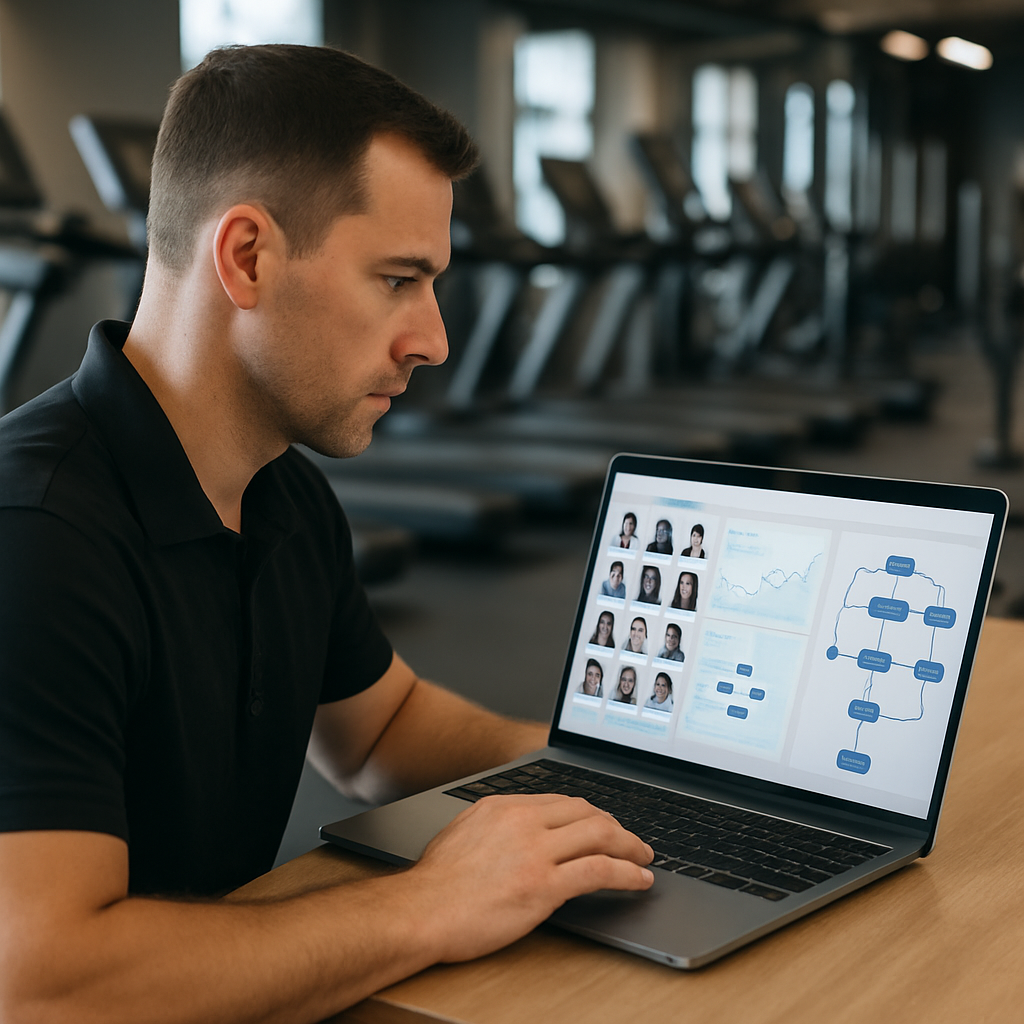
The Evolution of Gym CRM From Contact Management to Member Intelligence
Direct assertion: Gym CRMs have moved beyond address books and blast email tools into systems that build real-time, actionable member intelligence for automated decisioning and orchestration.
What changed: The shift labeled The Evolution of Gym CRM: From Contact Management to Member Intelligence is not a product buzzword. It is the addition of three capabilities to the old CRM stack – persistent unified profiles, event-level behavioral data, and a rules-or-ML decision layer that triggers channels in real time. When those three layers are present you can stop guessing who to message and start scoring who to act on.
Practical trade-off: Unifying every possible data source – POS, access control, MINDBODY or Zen Planner bookings, Myzone wearables, ClassPass referrals, web behavior – is ideal but costly. Most clubs get 70 to 90 percent of the value by prioritizing attendance logs, membership status, and transaction history first. Add wearables and marketplace data later when you can reliably match identities and handle consent.
Concrete example: A mid-size wellness club replaced weekly manual email blasts with two automated journeys – a 7-day trial conversion flow and an attendance recovery flow that triggered after two missed weeks. The club integrated booking data and access logs, used propensity thresholds to route high-value members to a phone follow-up, and reported measurable uplift in conversion and retention after the 90-day pilot; see a real implementation example in the Gleantap case studies.
A useful judgment: People assume personalization equals more messages. In practice, successful personalization reduces message volume while increasing relevance – better targeting means fewer wasted sends and less member fatigue. The real work is in decisioning – deciding who gets a low-cost SMS nudge versus a high-touch call – not in writing one more email template.
Implementation note: Identity resolution and consent are the two engineering choke points. If you cannot reliably match a phone number to a membership ID, your SMS efforts will fragment. Likewise, aggressive personalization without documented consent creates compliance and trust risk. Start with deterministic matches (email + membership ID) and explicit opt-in signals before deploying cross-device personalization.
Focus first on signals that predict behavior – last visit, booking cadence, payment issues – and instrument them well. They unlock the highest ROI on personalization work.
Key takeaway – Treat your CRM as a member intelligence engine: unify a few high-value signals, add a scoring layer to prioritize actions, and orchestrate fewer, smarter touches across SMS, email, and calls.
Data Foundations: The exact sources and schema needed for personalization
Direct point: Reliable gym CRM personalization starts with a small set of clean signals and a single canonical profile per member. Without that, your decisioning layer will route the wrong offers to the wrong people and produce noise, not lift.
Priority data sources and why they matter
- Membership master record (source of truth): membershipid, status, tier, joindate — drives eligibility and long-term LTV calculations.
- Access control / door swipes: timestamped visits — the highest-signal behavioral indicator for attendance and churn prediction.
- Class bookings and attendance (MINDBODY / Zen Planner / ClassPass): bookedclassid, booking_status, instructor — informs preference and conversion triggers.
- POS / transaction data: orderid, sku/category, paymentstatus — required for upsell propensity and LTV.
- Engagement channels: email opens/clicks, SMS replies, push interactions — necessary to measure message effectiveness and suppress fatigued members.
- Third-party telemetry (Myzone, wearable integrations): workout intensity, duration — useful for personalized programming and high-value upsells, but lower priority than attendance.
- Web and landing behavior: page views, trial form completions — helps refine lead source and conversion touchpoints.
Integration trade-off: Real-time attendance and booking events are worth the engineering effort; batch-ingest historical transactions is acceptable as a second step. Prioritize low-latency flows that materially change member state (trial ending, no-show, payment failure).
Minimal member profile schema (developer-ready)
| Field | Type | Description | Refresh cadence |
| member_id | string | Primary canonical identifier (internal). | Never changes |
| emails | array[string] | All verified emails with source tag (POS, lead form). | Event-driven |
| phones | array[string] | Phone numbers with verification and consent flag. | Event-driven |
| status | enum(active, lapsed, trial, cancelled) | Current membership lifecycle state. | Real-time |
| lastvisitat | timestamp | Most recent access control or class attendance timestamp. | Real-time |
| weeklyvisitavg | float | Rolling 4-week average visits per week. | Hourly |
| favoriteclasstype | string | Top class category by bookings in last 90 days. | Daily |
| lifetime_value | decimal | Cumulative revenue minus refunds; used for prioritization. | Daily |
| consent_flags | object | Channels opted into (email/sms/push) and GDPR/CCPA status. | Event-driven |
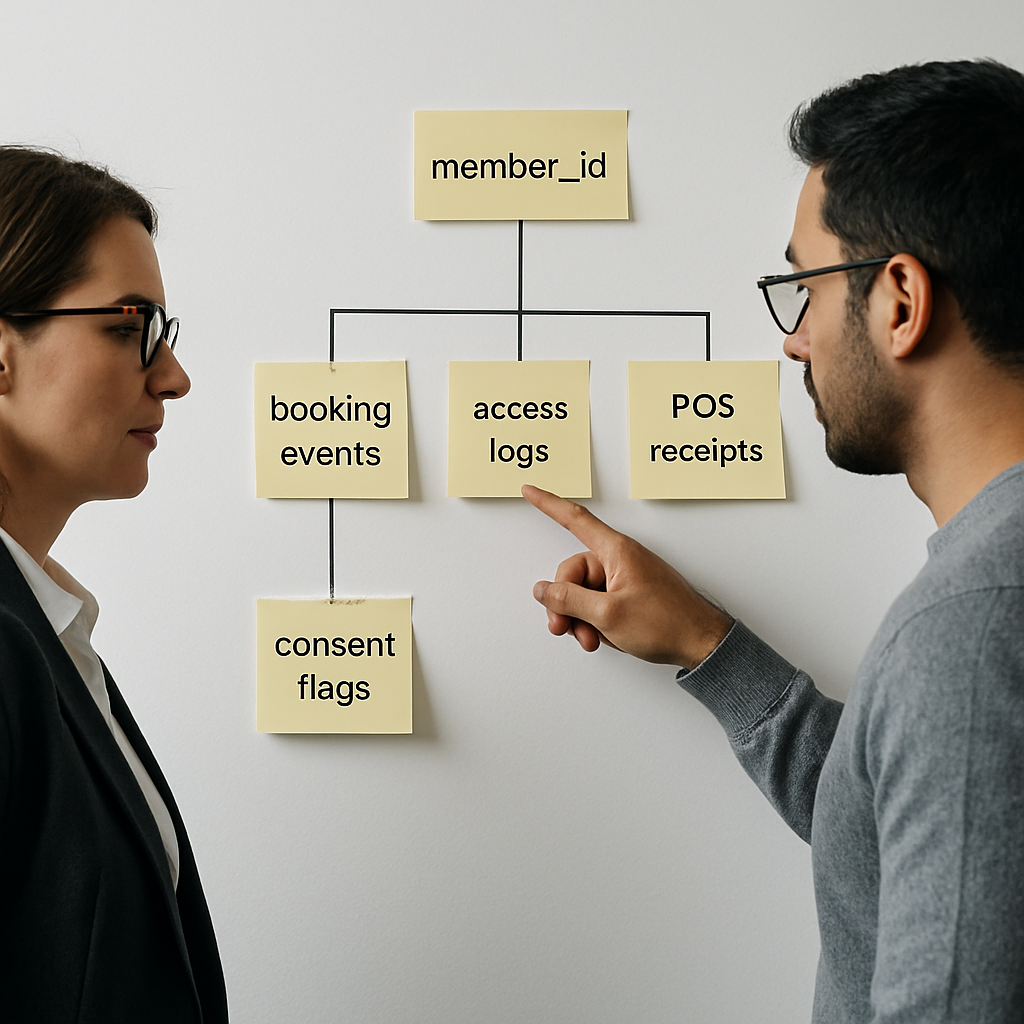
Identity resolution note: Use deterministic joins first — memberid + email + phone + accesscard_id. Only add probabilistic merges after you document error rates and member consent. Mis-matches are expensive: an incorrect merge can trigger a high-touch retention offer to a low-value lead.
Concrete example: A boutique studio integrated accesscontrol logs, MINDBODY bookings, and POS receipts. They created a weeklyvisitavg metric and a favoriteclass_type token. Using those fields, they sent an SMS with a 3-class pack offer targeted at members whose visits dropped by 40 percent and who had a high spend history; the offer was routed to email only if the member lacked SMS consent.
Practical limitation and judgment: Collector mentality fails here. Capturing every possible field without stable identifiers or consent creates a maintenance burden and privacy risk. Focus on a compact schema you can keep accurate: membership state, last visit, booking behavior, transactions, and consent. Add niche signals like wearables when identity and consent are rock solid.
Start with clean event contracts for visit, booking, and transaction — these three unlock most personalization use cases without a full data lake build.
Tools and quick paths: For rapid progress use direct webhooks from MINDBODY or Zen Planner to your CRM, layer in POS via daily exports or API, and use middleware like integrations or Segment for identity stitching if you lack engineering bandwidth.
Segmentation and Predictive Modeling for Member Journeys
Core point: segmentation without predictive scores is just labeling. To create member journeys that change behavior, you need segments that are both actionable and time-sensitive — and models that translate behavior into a probability you can operationalize.
From segments to decisions
Start by mapping each segment to a decision an operator can execute. A segment called high-churn-risk is only useful if it maps to one of three actions: automated retention messaging, a human outreach queue, or a suppressed marketing state. That mapping forces you to set thresholds based on capacity, not optimism.
- Churn risk score – probability a member cancels in the next 30/60/90 days; route top X percent to member success calls.
- Upgrade propensity – likelihood to buy a higher tier or personal training; use for targeted offers with limited inventory.
- Reactivation likelihood – chance a lapsed member will return with a small incentive; control spend by predicted ROI.
- Class conversion score – how likely a trial-booker converts to recurring class attendee; allocate follow-up coaching resources accordingly.
Practical trade-off: higher model granularity improves precision but reduces the number of members per bucket, which hurts statistical power and increases operational complexity. In practice, clubs are better off with three operational tiers per model (low/medium/high) rather than ten fine-grained buckets.
Modeling approach that works in the real world: begin with interpretable methods (logistic regression, decision trees) using features you already have: recent visit trend, payment status, booking cadence, campaign engagement, and spend categories. Push complex ensembles later — they help when you have large, clean datasets and an SRE process for retraining and monitoring.
Evaluation and guardrails: aim for models with useful separation (AUC > 0.65 is a pragmatic target for small clubs) and test calibration so predicted probabilities align with real outcomes. Equally important: align thresholds to match how many people staff can call or how many offers you can fund.
Concrete use case: a regional club assigned a churn score weekly and routed the top 6 percent to a concierge team for a phone outreach offering a free PT session. The club only sent automated SMS nudges to the next 20 percent. This two-tier routing preserved staff time and let automation handle lower-touch cases while focusing human effort where it mattered. Results: measurable improvement in retention where human follow-up was applied; see a similar implementation in the Gleantap case studies.
Design segments around the action you will take and the capacity to execute it; misaligned thresholds create backlog, not results.
Common misconception: teams often expect predictive models to eliminate manual prioritization. They do not. Models should reduce guesswork, not replace operational limits. Set conservative thresholds until you validate throughput and uplift.

Orchestrating Automated Member Journeys with Triggers and Actions
Direct point: Effective orchestration is decisioning, not just sequencing—your gym CRM must translate real-time signals into prioritized actions that respect member preferences, staff capacity, and message cadence.
Orchestration primitives every Gym CRM needs
- Trigger: an event or state change (trialend, failedpayment, visit_gap>14d) that starts a flow.
- Condition: branching logic using profile fields or scores (e.g., churn_score > 0.6 and LTV > 300).
- Action: a deliverable—send SMS, queue a call, create a task in a CRM, or fire a webhook to POS.
- Delay / Wait: scheduled pauses with cancellation checks (wait 3 days unless visited=true).
- Escalation: human handoff rules that open tasks only when automation fails to re-engage.
- Suppression & Merge: global suppression lists, per-member rate limits, and conflict resolution so flows don’t overlap.
Trade-off to accept: Real-time triggers increase relevance but amplify false positives if identity matching is imperfect or consent flags lag. If your access logs or phone verification are unreliable, prefer hourly batching for high-value triggers and real-time only for low-risk notifications like SMS class reminders.
Practical routing and priority rules
Priority judgment: Route members using a combination of propensity and resource cost. Use churn_score for human-touch routing, but cap weekly human outreaches per staff member. Automation should handle the long tail; reserve hands-on for the top 5-10 percent by predicted LTV impact.
| Trigger (example) | Primary Action | Channel | SLA / Backoff |
| trialend -7d and trialengagement < 2 | Send limited-time upgrade offer; if upgrade_propensity > 0.5 create a call task | SMS -> Email -> Phone | SMS immediate; email next day; call within 48 hours if no response |
| Payment failure (first attempt) | Retry invoice; notify member; open billing task if unpaid | Email + SMS; internal task | Retry payment at 24h, escalate at 72h |
| Visits drop >50% over 2 weeks and LTV > 200 | Tiered reactivation: automated class suggestions -> offer PT session -> concierge call | Push / SMS -> Email -> Phone | 2 automated sends over 5 days, then human queue |
Real-world flow example: A regional studio used trialend triggers plus a simple upgradepropensity score. Members with high propensity received an SMS with a limited offer and a one-click booking link; mid propensity got an email sequence; the top 4 percent were flagged for a concierge call. This routing reduced wasted calls and increased trial-to-paid conversions where the concierge intervened.
Operational consideration: Build idempotency into actions. If a webhook retries or a member flips state, ensure the CRM detects duplicates and avoids double-sending. Also, enforce per-member throttles (for example, no more than three outbound marketing sends per week) to prevent fatigue and complaints.
Design rules around operational capacity: tie thresholds to how many calls staff can actually make and how many offers you can honor.
Next consideration: Before scaling, implement holdout cohorts and track both short-term conversions and longer-term retention. Orchestration that boosts immediate conversion but harms retention through over-messaging is a false win; measure both outcomes concurrently.
Omnichannel Personalization at Scale and Message Personalization Techniques
Core assertion: Omnichannel personalization only delivers when channel choice, message intent, and data freshness align with a member’s immediate state — not when you simply spray the same creative across more endpoints. Gym CRM personalization and modern Gym CRM platforms enable that alignment by making a single decision engine aware of channel constraints and consent.
Channel roles and practical constraints
- SMS — action driver, short window: use for time-sensitive nudges (class starts, trial-ending prompts); keep messages under two lines and include a single CTA.
- Email — depth and receipts: use for billing, longer explanations, program content, and confirmations where tracking and receipts matter.
- Push / in-app — experiential nudges: micro-personalization tied to app state; avoid for billing or sensitive topics.
- Calls / human outreach — conversion saver: reserved for high-LTV or high-risk cases where automation failed or the member is in the top support tier.
- Webhook / integrations — system actions: use to create bookings, apply credits, or open staff tasks; these are not consumer channels but part of the omnichannel loop.
Practical trade-off: High-frequency real-time personalization raises two operational costs: content management complexity and testing overhead. Implementing per-member creative variations across three channels multiplies QA work. The smarter trade is to personalize the decision (who, when, which channel) while keeping creative variants limited and reusable.
Message personalization techniques that scale: Use three composable layers — 1) decision tokens (for routing: churnscore, preferredchannel), 2) shallow personalization tokens (name, favoriteclass, lastvisit), and 3) contextual recommendations (next-available class using a simple rules engine or collaborative filter). Prefer server-side rendering for emails and SMS to avoid exposing logic in the client; push minimal tokens to the app for quick renders.
Concrete example: A mid-size studio leveraged their Gym CRM to send a single, personalized SMS 45 minutes before an evening HIIT slot to members tagged with favoriteclass=HIIT and preferredtime=evening. The message included a one-tap waitlist link rendered server-side and fell back to an email if the SMS was undeliverable. The studio routed members with churn_score > 0.7 into a concierge call queue instead of sending promotional offers, preserving staff time while increasing attendance for that segment. See how capabilities map to product features in Gleantap features.
Testing advice that avoids false positives: Start with sequential A/B runs on single elements (subject line, CTA, send-time) before combining into multivariate tests. Use a persistent holdout cohort for retention outcomes — short-term conversion lifts can be misleading if long-term churn increases because of over-messaging.
Operational rule of thumb: Limit active personalization dimensions per message to two (for example, favoriteclass + lastvisit_gap) to keep template counts manageable and reduce error modes like missing tokens or incorrect merges. This reduces engineering churn and keeps fallbacks predictable.
Personalization scaled well is a routing problem first and a creative problem second — focus on who gets what and why, then on what the message says.
Start with deterministic signals (last visit, membership tier, consent flags) to power channel routing and personalized tokens. Add recommendations and collaborative filtering only after identity resolution and consent are reliable.
Measuring Impact and Calculating ROI for Personalization
If you cannot tie personalization to incremental revenue or retained members, you cannot scale it. Measurement is the governance that separates experiments from investments; treat personalization budgets like any other revenue-generating program.
What to measure and why it matters
Track a small set of outcome metrics and their upstream signals. Primary outcomes: retention rate, trial-to-paid conversion, net new revenue attributable to campaigns, and average visits per member. Upstream signals to validate execution: open/click rates by channel, offer redemption, booking lifts, and payment recovery success. Measure both immediate action (conversion, booking) and downstream behavior (returns over 90–180 days) so you do not confuse short-term lifts with long-term value.
Practical trade-off: short attribution windows make campaigns look better but hide negative long-term effects like message fatigue. If a promotion increases immediate bookings but lowers repeat visits months later, the apparent win is a loss. Use layered attribution: short windows for conversion, longer windows for retention.
Basic experiment design and quick formulas
Always run randomized holdouts. Split targetable members into test and control before any filtering or prioritization. Use a persistent control cohort for retention analysis and rotating test cohorts for creative/offer iterations. To estimate incremental revenue: Incremental Revenue = (ConversionRatetest – ConversionRatecontrol) × N_test × Average LTV per member. Net ROI = (Incremental Revenue – Campaign Cost) / Campaign Cost.
Sample-size note: for many club-level tests, you do not need a data scientist to get a directional result. If you expect a modest absolute uplift, pick larger cohorts or accept longer test windows. Use an online calculator or a simple rule of thumb: the smaller the expected uplift, the more members you need.
Concrete example: A 2,000-member club ran an attendance-recovery SMS flow targeted to 250 members who had missed scheduled visits. Average member LTV was estimated at $720. The test group produced 12 additional retained members over 90 days versus control. Incremental revenue = 12 × $720 = $8,640. Campaign execution cost (SMS, creative, ops) = $1,200. Net ROI = (8,640 – 1,200) / 1,200 = 6.2x. The club kept the persistent holdout to validate no downstream churn increase in the following 180 days.
A caution: measurement noise and selection bias are common. If your automation preferentially targets already-engaged members, you will overstate lift. Always randomize within the eligible population and document exclusion logic so auditors can reproduce results.
Measure both short-term conversion and long-term retention. If a personalized flow lifts bookings but harms repeat visits, kill or rework it.
Operationalize reporting: weekly campaign dashboards for immediate performance, monthly cohort retention reports, and quarterly LTV trend reviews. Make retention cohorts the single source of truth for ROI conversations with finance and leadership.
Key metric to watch: incremental retained members attributable to personalization, mapped to LTV and reported as dollar uplift per dollar spent. This metric forces you to account for both cost and the duration of the benefit.
Implementation Roadmap and Quick Wins for the First 90 Days
Immediate point: In the first 90 days you want operational momentum, not a perfect data lake. Deliver two reliable automated journeys that change behavior, lock down consent and identity, and create repeatable measurement so leaders can fund the next phase.
Days 0–30: Clean the inputs and ship one high-impact automation
Priorities: Complete a targeted audit of live inputs (membership master, access logs, booking feed, POS), verify member_id joins across systems, and confirm channel consent for SMS/email. Stop any duplicate or ambiguous identifiers before you build logic on top of them.
- Audit tasks: record owners for each data feed, note latency, and list missing consent flags
- Stability actions: add verification for phone/email and a simple dedupe rule (member_id + email)
- Ship a quick win: a one-touch trial_end SMS that offers a single clearly time-limited upgrade CTA
Practical trade-off: real-time attendance is ideal but often expensive; for launch, prefer event-driven webhooks for booking and visit where available, and use hourly batches for POS if APIs are rate-limited.
Days 31–60: Pilot two journeys and instrument measurement
Build focus: pick one acquisition-conversion flow (trial to paid) and one retention-focused flow (attendance recovery or failed payment). Keep each flow to a maximum of three decision branches: high-touch, mid-touch, automated fallback.
- Implement routing rules that combine a simple propensity token (low/medium/high) with an LTV threshold
- Add a 10% persistent holdout segment for retention measurement
- Log every action and outcome to a campaign events feed for later attribution
Judgment: early models should be pragmatic and interpretable. A small logistic model or even a rules-based score beats an unstable complex model that requires constant tuning.
Days 61–90: Scale the winners and formalize governance
Scale plan: expand the winning flows to all locations, add channel fallbacks, and create staff queues for escalations. Formalize an SLA for human follow-up and enforce per-member message caps to prevent fatigue.
- Operationalize: handoff playbooks for staff when a member is escalated to phone outreach
- Measurement: commit to weekly cohort reporting (test vs holdout) and a 90–180 day retention review before rolling out new creative at scale
- Hardening: add idempotency checks and backoff logic so retries do not double-send offers
Constraint to watch: integrations that work in a pilot often break under scale because of inconsistent event schemas across studios. Budget two engineering sprints for stabilizing feeds after rollout.
Concrete example: A four-location chain used this cadence: they verified identity joins and consent in week one, launched a trial_end SMS plus a failed-payment alert by week four, then piloted an attendance-recovery flow in week six. By week twelve they had a reproducible funnel that reduced trial dropoff with less front-desk overhead and a clearer view of incremental revenue per campaign.
Quick wins beat perfect data. Deliver measurable journeys, then invest in deeper signals once you can match identity and measure lift.
90-day checklist: audit data owners; verify memberid joins; capture explicit consent; ship trialend SMS; pilot attendance-recovery; set a persistent holdout; define staff SLAs for escalations. Use integrations for fast wiring where possible.
Frequently Asked Questions
Straight answers: Below are the operational responses membership and marketing teams actually need when building gym CRM personalization — pragmatic, implementation-focused, and tied to measurable actions.
What is the difference between a gym CRM and a customer data platform for personalization?
Short answer: A traditional Gym CRM manages contacts, memberships, and campaign execution; a CDP (or a CRM with CDP capabilities) unifies event-level behavior, resolves identity across sources, and serves those unified profiles in real time to decisioning and ML layers. The practical trade-off is cost and operational complexity: pure CRMs are cheaper to stand up but limit you to batch campaigns; platforms with CDP features require more integration work but enable real-time triggers and propensity scoring. If your goal is hyper-personalized journeys tied to attendance and LTV, prioritize a solution that combines both functions — see features for an example of this blend.
Which data sources should we integrate first for personalization?
Priority guidance: Start with the minimal signals that change member state: the membership master record, access/door events, and class bookings from systems like MINDBODY or Zen Planner. These inputs drive the most reliable behavioral triggers. Add POS transactions next so offers and upsells are context-aware, then layer in wearables and marketplace feeds once identity matching and consent are stable. A pragmatic constraint: integrate only what you can QA — incomplete joins create noisy decisions.
How should a club measure whether personalization is actually working?
Measurement practice: Use randomized holdouts as the baseline, track both short-term and downstream metrics (trial-to-paid, visits per week, and retention over 90–180 days), and compute incremental value versus control. A simple profitability check: multiply incremental retained members by your conservative LTV and net against campaign cost to get ROI. Practical limitation: short attribution windows can mislead — always maintain a persistent control slice for retention outcomes.
How do you balance personalization with member privacy and consent?
Operational rules: Capture explicit consent with timestamped evidence, store channel opt-ins in the canonical profile, and avoid merging sensitive identifiers without clear consent. Trade-off: deeper personalization often requires more data and governance; accept slower rollout if your legal or ops team demands stricter controls. Keep an audit log of data sources and consent so you can answer member inquiries or regulator requests.
What are realistic short-term personalization wins for clubs with limited engineering resources?
Low-friction wins: Implement a brief onboarding series, trial-end SMS reminders, automated rebook nudges after no-shows, and failed-payment alerts using webhooks or middleware like Zapier or integrations. These moves require minimal schema work but create measurable behavior changes. Trade-off: they are tactical improvements — reserve complex scoring and recommendations for after identity and consent are stable.
Can predictive models be built without a dedicated data science team?
Yes, with caveats: Many platforms provide out-of-the-box propensity models and visual model builders. Start with interpretable approaches (rule-based scoring or simple logistic models) so operators can reason about thresholds. The practical judgment: only graduate to opaque ensembles after you have steady, clean data and resources for monitoring model drift; otherwise you risk noisy routing and wasted operational effort.
How much lift should clubs expect from hyper-personalized journeys?
Realistic expectation: Lifts tend to be modest but valuable — often in the low single-digit percentage points on conversion or retention — yet those changes compound into meaningful LTV improvements for subscription businesses. A common mistake is expecting large immediate jumps; personalization is a steady, test-driven investment that pays off when you tie decisions to staff capacity and measurement.
Concrete example: A 1500-member studio used membership state, door swipes, and booking data to trigger a 5-day lapsed-member SMS offering a tailored class pack. They routed the highest-value members to a short call queue while the rest received automated messaging. The result: clear lift in rebookings for the routed cohort and a repeatable flow they scaled to other segments.
Actionable FAQ checklist: 1) Confirm canonical member ID and consent timestamps; 2) Wire door swipe and booking events first; 3) Launch one SMS trial-end flow with a 10% persistent holdout for measurement.
- Next step 1: Map data owners and record where member_id originates and who owns consent flags.
- Next step 2: Implement a single low-latency trigger (e.g., trial_end -7d) and a simple 2-branch flow (automated offer vs. human follow-up).
- Next step 3: Create a persistent control cohort (10%) and start weekly reporting on retention and conversion lift.

Written by
Jordan Hayes
Jordan is a fitness industry consultant turned digital marketer, helping gyms and studios attract, engage, and retain members. He covers fitness marketing strategy, email and SMS campaigns, and the technology tools that give local businesses a competitive edge.
Recent blog posts
Back to blog

Ready to Run Successful Marketing Campaigns and Grow Your Business?
Gleantap helps you unify customer data, track behavior patterns, and automate personalized campaigns, so you can increase repeat purchases and grow your business.
Ready to Run Successful Marketing Campaigns and Grow Your Business?
Gleantap helps you unify customer data, track behavior patterns, and automate personalized campaigns, so you can increase repeat purchases and grow your business.